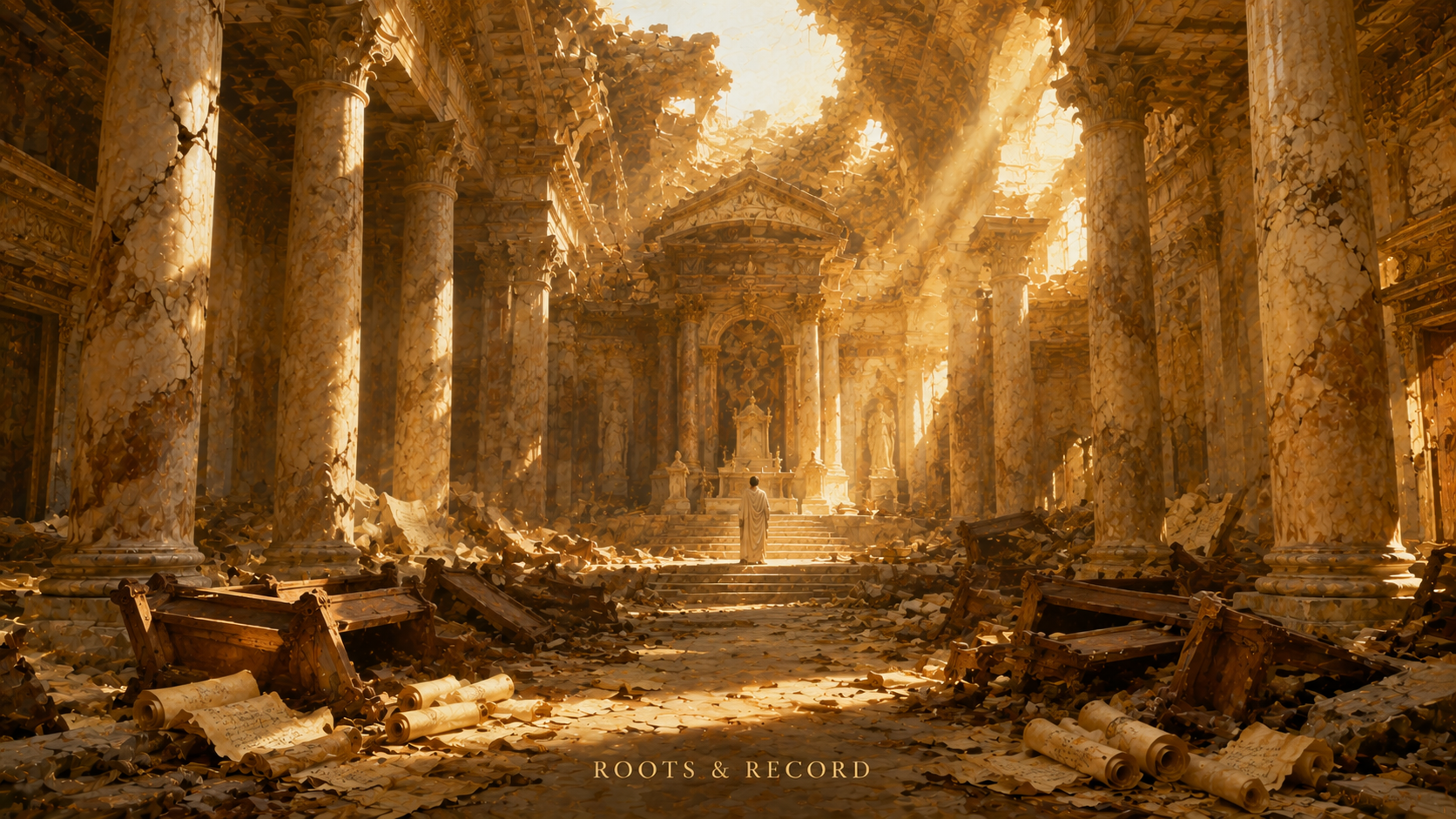
Every civilization has watched its institutions decay. Priesthoods turn venial. Courts become theaters of patronage. Republics hollow into factions. Churches that once corrected kings begin blessing whatever the kings do. The phenomenon is consistent enough across time and culture that the serious question is not whether institutions decay but why they do, and whether anything can be done about it. Ancient political philosophy gave one answer. Modern sociology gave another. The biblical tradition gave a third, and the third cuts deeper than either.
The Ancient Diagnosis
Plato identified a degeneration of regimes in which aristocracy slides toward timocracy, timocracy toward oligarchy, oligarchy toward democracy, democracy toward tyranny, each transition driven by a corresponding corruption of the human soul that each regime produces and rewards. The diseased city and the diseased soul mirror each other exactly, and the sequence is nearly inevitable once the downward motion begins. Aristotle refined this into a taxonomy of constitutions oriented toward the common good alongside their perverted counterparts (tyranny, oligarchy, debased democracy), in which rulers pursue private interest at public expense. Polybius, writing after the Roman conquest of Greece, theorized a cycle of constitutional change in which each form of government carries the seeds of its own corruption, monarchy decaying into tyranny, aristocracy into oligarchy, democracy into mob rule, before some external shock resets the wheel. Decay, these thinkers agreed, is structural: baked into the nature of political forms themselves.
Rome became the great laboratory for this anxiety. Sallust traced the collapse of republican virtue to the removal of the Carthaginian threat, arguing that fear of external enemies had been the primary adhesive of Roman moral discipline; once Carthage fell, the discipline dissolved with it. Cicero, writing as the republic was dying beneath him, insisted that Rome's institutions were only as strong as the citizens who inhabited them, a formulation that gestures toward something deeper than structural analysis but stops short of naming it fully. The Roman historians knew that something was rotting from within. They could describe its symptoms with extraordinary care. They were less certain about its root.
Covenant and the Corrupted Soul
The biblical tradition was not uncertain. From the earliest accounts of Israelite kingship, the text encodes a specific anthropology of institutional failure: institutions decay from the moral and spiritual condition of the people inside them. Samuel's warning to Israel in 1 Samuel 8:10–18 is one of the most searching critiques of political power in any ancient literature. Samuel does not merely predict what a king will do; he anatomizes it. The king will take your sons for his armies, your daughters for his household, your fields for his officials, your servants and your livestock for his work. The institution of monarchy carries within it a dynamic of accumulation and extraction that corrupts whoever sits at its center, and the people who demand a king are already exhibiting the spiritual disorder of wanting to be like other nations, the refusal to trust in a covenantal God, that will guarantee the institution's eventual abuse.
The covenant itself was the structural answer to this problem. Unlike any constitution in the ancient Near East, Israel's law placed the king explicitly under Torah. Deuteronomy 17:18–20 requires the king to write out a copy of the Torah for himself, to read it all the days of his life, to learn to fear the Lord, and to keep its commandments, so that his heart would not be lifted above his brethren. The purpose is to prevent the specific pathology that power produces: the inflation of the self above accountability, the slow conviction that the ruler stands above the law he was appointed to serve. Law above rulers was Mosaic architecture, centuries before it became a modern constitutional principle.
Proverbs names the mechanism at the level of the individual soul. "It is an abomination to kings to commit wickedness: for the throne is established by righteousness," reads Proverbs 16:12. The throne's stability is a direct function of the king's moral character, and the king's moral character is a direct function of his relationship to mishpat, justice as right order and legal claim, the Hebrew carrying a structural weight that the English word softens. The institution reflects the soul of whoever holds power within it; this is anthropological law, and the wisdom literature treats it as such.
Sacred Institutions Are Not Exempt
The prophetic literature extends this analysis from the monarchy to every institution that acquired sacred or civic weight. The corruption of the priesthood receives its most searching treatment in the story of Eli and his sons in 1 Samuel 2:12–36. Hophni and Phinehas held the highest ritual office in Israel while treating the sacrificial system as personal property, taking the best portions of offerings by force. The text is clinical about what this cost: the word of the Lord was rare in those days, and there was no frequent vision. Institutional corruption in the sacred sphere dimmed the people's access to the divine.
Jeremiah's temple sermon in Jeremiah 7:1–15 is a direct assault on institutional idolatry, the belief that the physical presence of the temple guaranteed divine protection regardless of the moral condition of those sheltering within it. The people chanted "The temple of the Lord, the temple of the Lord, the temple of the Lord" as a talismanic formula while stealing, murdering, and committing adultery, then returning to shelter under the temple's sanctity. Sacred institutions carry a particular vulnerability: their holiness can be abstracted from the holiness of their members and treated as a self-sufficient property of the building or the office. Ezekiel's vision of the divine glory departing the temple in Ezekiel 10:18–19 rendered the theological verdict on what that abstraction cost.
Jesus stood squarely in this prophetic tradition. His condemnation of the scribes and Pharisees in Matthew 23 is a prophetic indictment addressed to Jewish leaders about a Jewish institution in the same voice Jeremiah and Ezekiel had used centuries before: those who occupy the seat of authority have turned the institution into an instrument of self-protection, loading burdens on others they refuse to carry themselves. The charge is institutional, and it is ancient.
The Rabbinic Response
Rabbinic literature, shaped by the catastrophic failure of the Second Temple institutions, further elaborated this insight into the architecture of communal life. The concept of building a fence around the Torah, constructing additional safeguards beyond what the law strictly requires, reflected a sober reading of human nature: given sufficient proximity to a boundary, people will eventually cross it, and so the wise community places the boundary further back. The Mishnah's tractate Avot is organized around warnings about the pathologies of prestige and power within the academy itself. Avot 2:4 counsels against trusting in oneself until the day of death; Avot 2:3 warns against drawing near to the ruling authorities, who appear as friends when it profits them and abandon a man in his hour of need. The self corrupts first; the institution follows. The rabbis had watched institutions fail too many times to be naive about the dynamics of power, and their response was structural pluralism: the preservation of minority opinions in legal debate, the insistence that a ruling must be reasoned and challengeable, the suspicion of any concentration of interpretive authority that could not be questioned.
Modernity Describes the Symptom
Modernity has produced its own sociology of institutional decay, and it describes the mechanism with considerable care while remaining uncertain about the cause. Max Weber's analysis of bureaucratic rationalization identified the iron cage: formal structures that begin as instruments of human purpose slowly become ends in themselves, demanding conformity and producing specialists without spirit. Robert Michels, studying the socialist parties of early twentieth-century Europe, formulated the iron law of oligarchy: every organization, however democratic its founding ideals, tends toward control by a self-perpetuating elite whose primary interest becomes the organization's survival rather than its stated purpose. Hannah Arendt's analysis of totalitarian bureaucracy showed how ordinary men could participate in extraordinary evil by submerging personal moral judgment into institutional role. George Orwell identified the linguistic dimension: the corruption of language that precedes and enables the corruption of institutions, the euphemism that makes atrocity nameable only in passive constructions that assign agency to no one.
Each of these frameworks treats corruption as primarily structural, a property of organizational forms that rational redesign might in principle correct. Weber hoped that charismatic leadership might periodically break the cage open. Michels was bleakly deterministic. Arendt called for thinking, the recovery of personal moral judgment against institutional pressure. Orwell called for honesty in language. Each prescription has real merit. None fully accounts for why the redesigned institution develops the same pathologies as its predecessor, why the revolutionary organization built to avoid the corruptions of the old order so reliably produces new versions of them.
The Biblical Answer
The biblical tradition locates the problem one level deeper. Institutions fail because the souls within them fail, and souls fail because human beings carry within themselves a persistent orientation toward self-interest, self-exaltation, and the substitution of private advantage for covenantal obligation, the hardness of heart that the Hebrew Bible treats as a persistent feature of human nature. The soul that enters the new structure is the same soul that corrupted the old one, and no arrangement of offices addresses that continuity.
This is the point at which the biblical critique parts company with every proceduralist alternative. Modern institutional design rests on the assumption that the right system can produce tolerable outcomes from indifferent or self-interested actors, that checks and balances, separation of powers, and accountability mechanisms can compensate for the moral deficiencies of the people the system contains. There is real wisdom in this: the Founders were right to distrust concentrated power, and the Deuteronomic requirement that the king write out his own copy of the Torah was itself a structural safeguard. The fence around Torah matters. The prophetic institution, the office of the person appointed to speak truth to power regardless of personal cost, matters as a structural counterweight to the monarchy. These are serious institutional answers to an institutional problem. The biblical tradition simply refuses to treat them as sufficient answers to a spiritual problem.
Jesus gave this the sharpest formulation: "The greatest among you shall be your servant." (Matthew 23:11) The logic of institutional power runs in precisely the opposite direction, and no structural redesign reverses it. Only the person who has genuinely internalized the servant orientation resists what power does to those who hold it. Covenant renewal is possible, and Josiah's reformation in 2 Kings 22–23 stands as evidence that a people and its leaders can turn back from decay accumulated over generations. The text is equally clear that such recoveries are fragile, that Josiah's reformation did not survive his death, and that the fundamental problem resurfaces the moment institutional pressure relaxes. The prophets who called for teshuvah, repentance as genuine return rather than reform of procedure, were insistent about return as the precondition for any reform that would last. Reform without return produces new procedures inhabited by old souls.
From the court of Pharaoh to the modern regulatory agency, the pattern holds. The institution that begins as a corrective to a previous corruption produces, in time, its own corruption. The revolutionary movement that seizes power to end exploitation becomes a new apparatus of exploitation. The church that breaks from a corrupt hierarchy develops a corrupt hierarchy of its own. The biblical tradition does not conclude that institutions are hopeless or that reform is pointless. It concludes something more demanding: that the health of any institution, however well-designed, depends finally on the moral and spiritual condition of the people who inhabit it, and that no arrangement of offices, no distribution of powers, no system of accountability can substitute for people who genuinely want to be just. Every era relearns this at considerable cost, and from scratch.
Sources
Primary Texts
Scripture quotations are from the King James Version (KJV), accessible via Bible Gateway. Rabbinic texts accessed via Sefaria.
Secondary Literature
Arendt, Hannah. The Origins of Totalitarianism. Harcourt, 1951.
Aristotle. Politics. Translated by Benjamin Jowett. Oxford University Press, 1885.
Cicero. De Re Publica. Translated by Clinton Walker Keyes. Loeb Classical Library, 1928.
Michels, Robert. Political Parties: A Sociological Study of the Oligarchical Tendencies of Modern Democracy. Translated by Eden and Cedar Paul. Hearst's International Library, 1915.
Orwell, George. "Politics and the English Language." Horizon, 1946.
Plato. The Republic. Translated by Benjamin Jowett. Project Gutenberg.
Polybius. The Histories. Translated by Robin Waterfield. Oxford University Press, 2010.
Sallust. The Jugurthine War / The Conspiracy of Catiline. Translated by S. A. Handford. Penguin Classics, 1963.
Weber, Max. The Protestant Ethic and the Spirit of Capitalism. Translated by Talcott Parsons. Scribner, 1930.