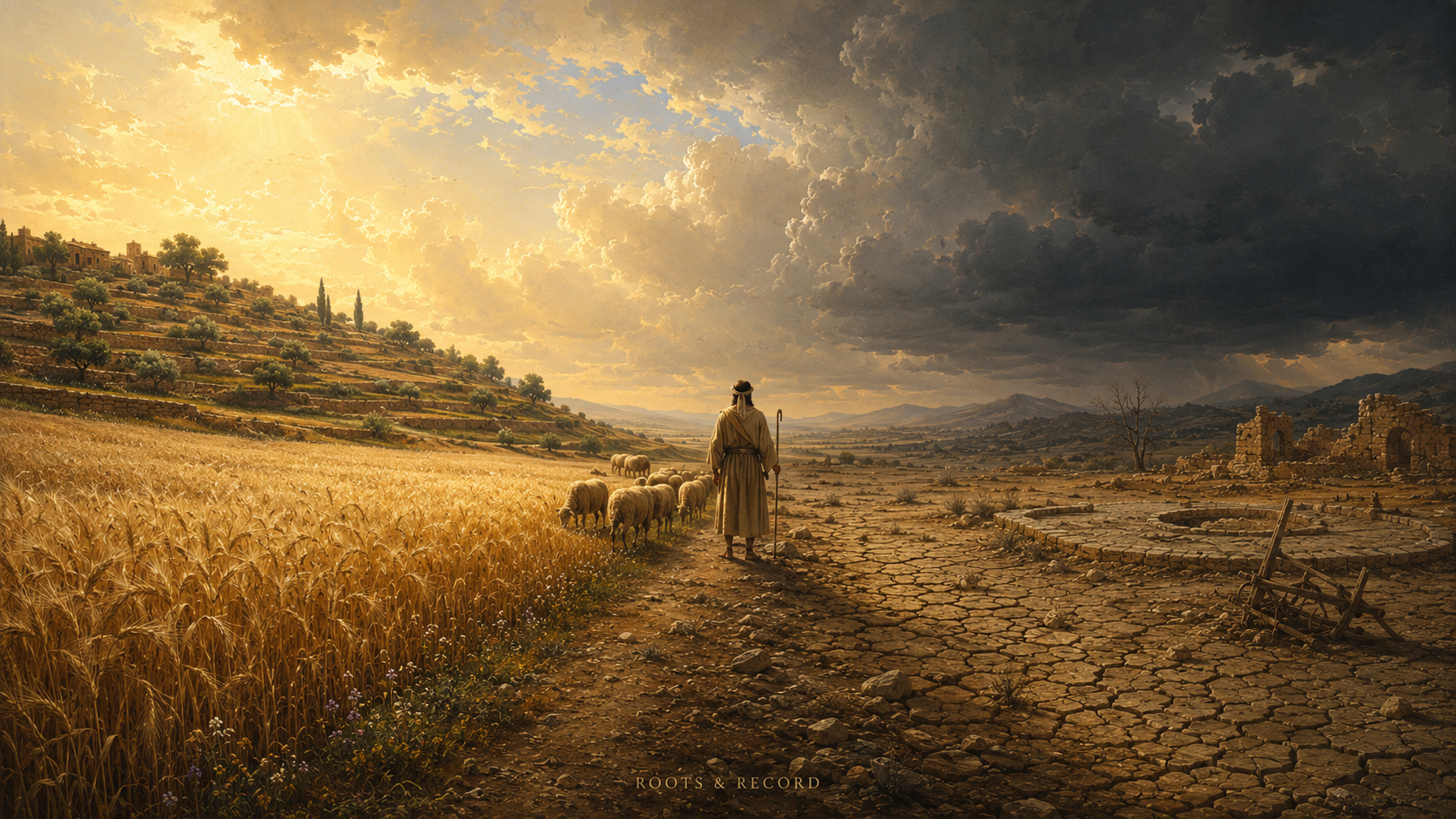
When Cain’s offering goes unregarded and his face falls, God speaks to him on the threshold of the first murder, and the words carry an entire anthropology: “sin is lurking at the door; its desire is for you, but you must master it” (Genesis 4:7). The scene stands in the fourth chapter of Genesis, immediately after the expulsion from Eden, and it presents a human being who lives east of the garden among thorns and mortality while remaining a moral agent with a genuine choice set before him. Western Christianity would later build a different account of what happened in Eden, one in which Adam’s transgression wounded the human will so deeply that return to righteousness required an antecedent act of divine grace, while Rabbinic Judaism traced the struggle of the human heart to two contending inclinations that Torah, repentance, and discipline equip a person to govern. The long conversation between these accounts, with Augustine at its hinge, is the subject of what follows.
Original sin holds a cherished place in the confessions of the Western churches, and the Eastern churches teach their own account of what Adam’s fall bequeathed to humanity, so many readers come to this subject with deep loyalty and good reason. The pages that follow offer a history of how the doctrine took shape, through generations of believers reading Genesis, Paul, and the divided human heart, with Augustine giving the reading its most influential form. Jewish and Christian readers can walk that path together, each recognizing in the other’s account a serious attempt to understand why people who know the good so often fail to do it.
Genesis Leaves the Wound Open
The third chapter of Genesis (Genesis 3) describes a catastrophe in careful sequence: the serpent questions God’s command, the woman and the man eat from the prohibited tree, shame follows, God pronounces judgment upon the serpent, the woman, the man, and the ground, and the humans leave Eden so that they cannot eat from the tree of life and live forever. Pain, toil, and mortality enter human experience, and the narrative leaves the inner nature of that change open, offering a story where a later age would want a systematic anthropology. The chapter speaks of expulsion, labor, and death, while the inherited guilt, the bound will, and the condemned infant that later doctrine would find in it arrive from other places, since the fourth chapter opens at once with a scene in which a human being is held responsible for what he does with the sin at his door.
That scene shows how open the question remains. The Hebrew of Genesis 4:7 ranks among the most compressed in the book, and translators divide over its final clause: NRSVue renders it in the imperative, “you must master it,” while the Jewish Publication Society translation reads “you can be its master” (Genesis 4:7 in the JPS translation). Both renderings picture sin lurking at the threshold with a desire that reaches toward Cain, and both assume that Cain stands before a live choice with the capacity to rule what waits for him. The ambiguity belongs to the text, and the text leaves the capacity intact.
The Torah knows the human heart well, and the word it uses for the heart’s bent is yetzer, which NRSVue renders “inclination.” The Hebrew derives from yatzar, the potter’s verb that Genesis 2:7 uses for God forming the first human from the soil, so that the word carries an image of something pressed into shape and molded, a nuance that “inclination” and “impulse” both flatten. Before the flood the narrator reports that every yetzer of the thoughts of the human heart was only evil (Genesis 6:5), and after the flood God observes that “the inclination of the human heart is evil from youth” (Genesis 8:21). The Torah’s portrait of humanity thus includes a heart formed with a bent toward evil, and the same Torah closes with Moses addressing that heart: “I have set before you life and death, blessings and curses. Choose life so that you and your descendants may live” (Deuteronomy 30:19). A shaped and wayward heart stands beside a commanded choice, and the biblical narrative holds people accountable because their decisions carry weight, which leaves the later doctrine of inherited guilt and a bound will to be assembled from other materials over the following centuries.
Second Temple Writers Were Already Arguing About Adam
By the Second Temple period Jewish writers were pressing questions that Genesis had left open: why humanity proves so susceptible to evil, whether Adam introduced death alone or altered his descendants as well, and how responsibility divides between Adam and each person who follows him. John Levison’s Portraits of Adam in Early Judaism surveys the range of answers and finds no single Jewish position. 4 Ezra, written near the end of the first century CE in the shadow of Jerusalem’s destruction, voices the darkest of them. Its author describes an evil heart that Adam carried and transmitted, so that the Law given at Sinai dwelt alongside that heart without removing it, and he laments, “O Adam, what have you done?” because the consequences reach every descendant. Michael Stone’s Hermeneia commentary examines the tension within the book, which also recalls Moses’s summons to choose life and holds each person accountable for the choice.
Another Jewish apocalypse, 2 Baruch, composed in the same generation, describes Adam’s transgression in equally dramatic terms, crediting it with premature death and a train of afflictions, and then draws a different conclusion about responsibility: Adam is the cause of his own sin alone, and every person determines his own fate. In A. F. J. Klijn’s translation the conclusion reads, “each of us has become our own Adam,” a sentence that could serve as the thesis of every account opposed to inherited guilt.
Second Temple Jews could therefore hold that Adam’s sin altered the human condition while guilt remained personal and moral freedom remained intact. Death passed down the generations, and each person reenacted Adam’s decision for himself. Paul, a Jew himself, entered this conversation, and his contribution reads best within it.
Paul Reorganizes the Adam Tradition Around the Messiah
In Romans 5 Paul constructs a grand parallel between Adam and Jesus: through one man sin entered the world, death followed sin, and death spread to all, while the obedience of the Messiah answers the disobedience of Adam in two representative acts that stand over two human conditions. The move extends well beyond Genesis 3, yet Jewish writers had already linked Adam’s transgression to humanity’s predicament, and Paul reorganizes that tradition around the Messiah so that Adam becomes intelligible through Jesus. The clause that carries the most weight for later doctrine closes verse 12, where death spreads to all “because all have sinned” (Romans 5:12), a phrase that joins Adam’s act, universal death, and each person’s own sinning without specifying the mechanism. Joseph Fitzmyer’s Anchor Bible commentary surveys the many readings the clause has received, and the range explains why the solidarity between Adam and humanity became one of the great interpretive questions of Christian history.
Romans 7 supplies the experiential counterpart: a person who recognizes the good finds another power at work within, and Paul writes, “I do not do the good I want, but the evil I do not want is what I do” (Romans 7:19). Scholars compare Paul’s language of sin and the flesh, sarx, with the rabbinic yetzer ha-ra, the evil inclination, and the comparison clarifies where Paul parts company with the rabbis: he holds that Torah, though holy, lacks the power to resolve the predicament, and the resolution lies in God’s action through the Messiah and the Spirit.
The Rabbis Describe a Divided Heart That Can Be Governed
The rabbis developed their account of moral conflict around the yetzer, expressed in the yetzer ha-tov, the good inclination, and the yetzer ha-ra, the evil inclination. The Hebrew ra covers the harmful, the damaging, and the bad, a range wider than the English “evil,” and Ephraim Urbach’s The Sages shows that the yetzer ha-ra names the appetites and drives that produce harm when misdirected, a force far removed from a miniature devil lodged in the personality. Genesis Rabbah makes the point vividly by reading God’s verdict on creation, very good, to include the yetzer ha-ra, since without it no one would build a house, marry, raise children, or conduct business. Desire calls for governing rather than annihilation.
The human being in this account experiences genuine conflict, and the means of ordering desire lie within reach: Torah, prayer, discipline, habituation, repentance, and the cultivation of the good inclination. A saying preserved in tractate Kiddushin of the Babylonian Talmud has God declare that he created the evil inclination and created Torah to remedy it, and the rabbis hold providence and freedom together without resolving the philosophical tension, as in Rabbi Akiva’s teaching in Pirkei Avot, “Everything is foreseen, yet freedom of choice is given,” and in tractate Berakhot, which places everything in the hands of heaven except the fear of heaven. Whatever metaphysical difficulties these formulations carry, their moral purpose is plain, and the person standing before a commandment is a responsible agent.
If God commands righteousness, human beings must possess some real capacity to pursue it; if repentance is commanded, repentance must be possible; and if a person sins, responsibility rests with that person rather than with Adam. An inherited bent toward wrongdoing leaves the ability to choose against it intact. Western Christianity took a different road, and its architect came to it carrying an experience of the divided will that gave Paul’s Adam a weight greater than the rabbinic tradition assigned him.
Augustine Reads Adam Through His Own Divided Will
Augustine of Hippo came to the question carrying an experience that Peter Brown’s biography places at the center of his life. A former Manichaean who had spent nine years among teachers who explained evil by a rival substance, he described in Book 8 of the Confessions a will that commands itself and is resisted, willing and unwilling at once, until a voice in a Milan garden sent him to Paul’s counsel in Romans 13:13–14 and the struggle resolved in surrender to God. The experience gave him a lens for Romans 7. In his early writings he took Paul’s divided self to be a person under the Law and before grace, and by the time he wrote To Simplicianus in 396 he had concluded that Paul describes the struggle of a believer, so that the weakness of the will persists within the redeemed and grace must carry the will from the beginning to the end of every good act.
The second element came from the Latin Bible. The Vulgate renders Romans 5:12 as in quo omnes peccaverunt, “in whom all sinned,” and the commentator Ambrosiaster had already taken the relative pronoun to refer to Adam, so that all humanity sinned in him. Augustine adopted the reading and returned to it repeatedly in his anti-Pelagian writings, among them Against Two Letters of the Pelagians. The Greek eph’ hō admits several renderings, and Fitzmyer’s commentary documents the range, from “because” to “with the result that,” while most modern interpreters reject the relative reading that Augustine’s Latin text carried. Brown notes that Augustine’s command of Greek was limited, and the Latin verse gave him a text that placed every human being inside Adam’s act. He supported it with Psalm 51:5, where the psalmist confesses being brought forth in iniquity, and Ephesians 2:3, which calls humanity children of wrath by nature, and these three texts carried the weight of the doctrine.
The doctrine acquired its mechanism in the writings against Pelagius. In On Marriage and Concupiscence Augustine locates the channel of transmission in the disordered desire that accompanies procreation, so that every child inherits Adam’s guilt together with Adam’s mortality, and the baptism of infants for the remission of sins, already a practice of the church, receives its theological explanation. Humanity in this vision forms a massa peccati, a lump of sin, the phrase of To Simplicianus, and the human will, wounded at the root, cannot turn itself toward righteousness without God’s prior action.
The shift from the Second Temple pattern is considerable. Writers such as the author of 2 Baruch had held that death passes down the generations while guilt remains personal, and Jaroslav Pelikan’s history of doctrine records that the Greek-speaking East largely retained that shape, speaking of an ancestral sin whose inheritance is mortality and corruption. Augustine joined guilt to mortality, joined both to the will, and made the saving work of Jesus the single remedy for a condition the human will could not repair by itself. The Western debates over grace, predestination, and free will developed largely within the framework he built, and Pelagius stood at the point where that framework first met resistance.
Pelagius Defends the Justice of the Command
Pelagius, a teacher of ascetic discipline in Rome, heard in Augustine’s Confessions a prayer that troubled him, da quod iubes et iube quod vis, “give what you command, and command what you will” in the Confessions. Augustine records in On the Gift of Perseverance that Pelagius could barely tolerate it. The prayer places the power to obey in God’s gift, and Pelagius, alarmed by Christians who excused moral complacency by appeal to human weakness, held that God’s commandments must be genuinely possible to obey, since a just God would hardly condemn creatures for failing to do what their nature made impossible.
Pelagius therefore placed free will at the center of his teaching. In his Letter to Demetrias, written around 413 for a young Roman noblewoman who had taken vows of virginity, he argues from the language of Scripture, which speaks repeatedly of human beings willing and refusing, choosing and rejecting, and he reasons that such language makes sense only where real alternatives exist. B. R. Rees’s translation of Pelagius’s letters makes the argument available in English. Pelagius counted the capacity for choice itself among God’s gifts, and the law, the teaching and example of Jesus, forgiveness, and divine assistance all fall within his understanding of grace. The question dividing him from Augustine concerned what grace does to the human will.
Augustine answered that a will wounded at its root requires healing before instruction can bear fruit. In On Nature and Grace, written in 415, he insists that fallen nature requires healing and that grace does more than tell human beings what they ought to do, since it grants the power to do it. Pelagius feared that Augustine’s doctrine dissolved moral responsibility, and Augustine feared that Pelagius’s doctrine rendered redemption unnecessary, so that each defended a different understanding of both freedom and grace.
The Western church sided with Augustine. A council at Carthage in 418 condemned propositions associated with Pelagius and Caelestius, affirming that Adam’s death resulted from sin, that infants are baptized for the remission of sins and so carry an inherited sin that baptism removes, and that divine grace supplies the power to perform the commandments as well as the knowledge of them. From that point Pelagianism became one of the enduring accusations in Christian theology.
Rabbinic Judaism Answers a Different Question
A rabbinic Jew could affirm that humans possess real moral freedom, that Adam’s guilt remains Adam’s own, that a person can resist the evil inclination, that obedience to the commandments is possible, and that each individual answers for his own choices. Beside Augustine’s mature theology such claims sound remarkably close to propositions associated with Pelagius, and the resemblance invites the conclusion that Judaism is Pelagian. The conclusion confuses resemblance with identity, since Pelagianism was an argument within Christianity about Adam, Jesus, baptism, salvation, grace, and the human will.
Judaism begins from the covenant at Sinai, where Torah is God’s covenantal instruction for Israel, a gift accompanied from the outset by divine assistance. The rabbis speak intensely about that assistance. The word teshuvah, usually translated “repentance,” means return and pictures a person turning back toward a relationship, and the possibility of that turning rests on God’s mercy. Jewish confidence in moral agency therefore sits comfortably alongside thoroughgoing dependence on God for life, for Torah, and for forgiveness, and the person standing before a commandment can choose within that dependence.
The resemblance to Pelagius tells a more interesting story than the label suggests, because it reveals how thoroughly Western Christianity learned to ask the question through Augustine. Once his categories become normative, any strong affirmation of human moral freedom begins to look Pelagian, while the Jewish traditions developed from Torah, wisdom literature, Second Temple arguments about Adam, and rabbinic reflection on human moral experience, centuries before the controversy and without reference to it.
The human being who emerges from Eden is wounded by desire, surrounded by death, capable of terrible violence, and repeatedly tempted toward evil, and when that human being stands at the threshold of the first murder, God describes sin waiting at the door and calls Cain to rule it.
Its desire is for you.
And Cain is told to master it.
Sources
Primary Texts
- 2 Baruch. Translated by A. F. J. Klijn, in James H. Charlesworth, ed., The Old Testament Pseudepigrapha, vol. 1. Garden City: Doubleday, 1983.
- 4 Ezra (2 Esdras 3–14). NRSVue text at Bible Gateway.
- Ambrosiaster. Commentary on Romans.
- Augustine. Against Two Letters of the Pelagians, On the Gift of Perseverance, On Marriage and Concupiscence, and On Nature and Grace, in Nicene and Post-Nicene Fathers, First Series, vol. 5, at CCEL.
- Augustine. Confessions, in Nicene and Post-Nicene Fathers, First Series, vol. 1, at CCEL.
- Augustine. To Simplicianus, in Augustine: Earlier Writings, translated by J. H. S. Burleigh. Philadelphia: Westminster Press, 1953.
- Berakhot 33b, at Sefaria.
- Canons of the Council of Carthage (418), in Nicene and Post-Nicene Fathers, Second Series, vol. 14, at CCEL.
- Genesis Rabbah 9:7, at Sefaria.
- Kiddushin 30b, at Sefaria.
- Pelagius. Letter to Demetrias, in The Letters of Pelagius and His Followers, translated by B. R. Rees. Woodbridge: Boydell Press, 1991.
- Pirkei Avot 3:15, at Sefaria.
- Scripture quotations and references (NRSVue), at Bible Gateway.
- Tanakh: The Holy Scriptures (Jewish Publication Society, 1985), Genesis 4:7, at Sefaria.
Secondary Literature
- Brown, Peter. Augustine of Hippo: A Biography. Revised edition. Berkeley: University of California Press, 2000.
- Fitzmyer, Joseph A. Romans: A New Translation with Introduction and Commentary. Anchor Bible 33. New York: Doubleday, 1993.
- Levison, John R. Portraits of Adam in Early Judaism: From Sirach to 2 Baruch. Sheffield: JSOT Press, 1988.
- Pelikan, Jaroslav. The Christian Tradition: A History of the Development of Doctrine, vol. 1, The Emergence of the Catholic Tradition (100–600). Chicago: University of Chicago Press, 1971.
- Stone, Michael E. Fourth Ezra: A Commentary on the Book of Fourth Ezra. Hermeneia. Minneapolis: Fortress Press, 1990.
- Urbach, Ephraim E. The Sages: Their Concepts and Beliefs. Translated by Israel Abrahams. Jerusalem: Magnes Press, 1975.
Scripture quotations are from the New Revised Standard Version, Updated Edition. Copyright © 2021 National Council of Churches of Christ in the United States of America. Used by permission. All rights reserved worldwide.