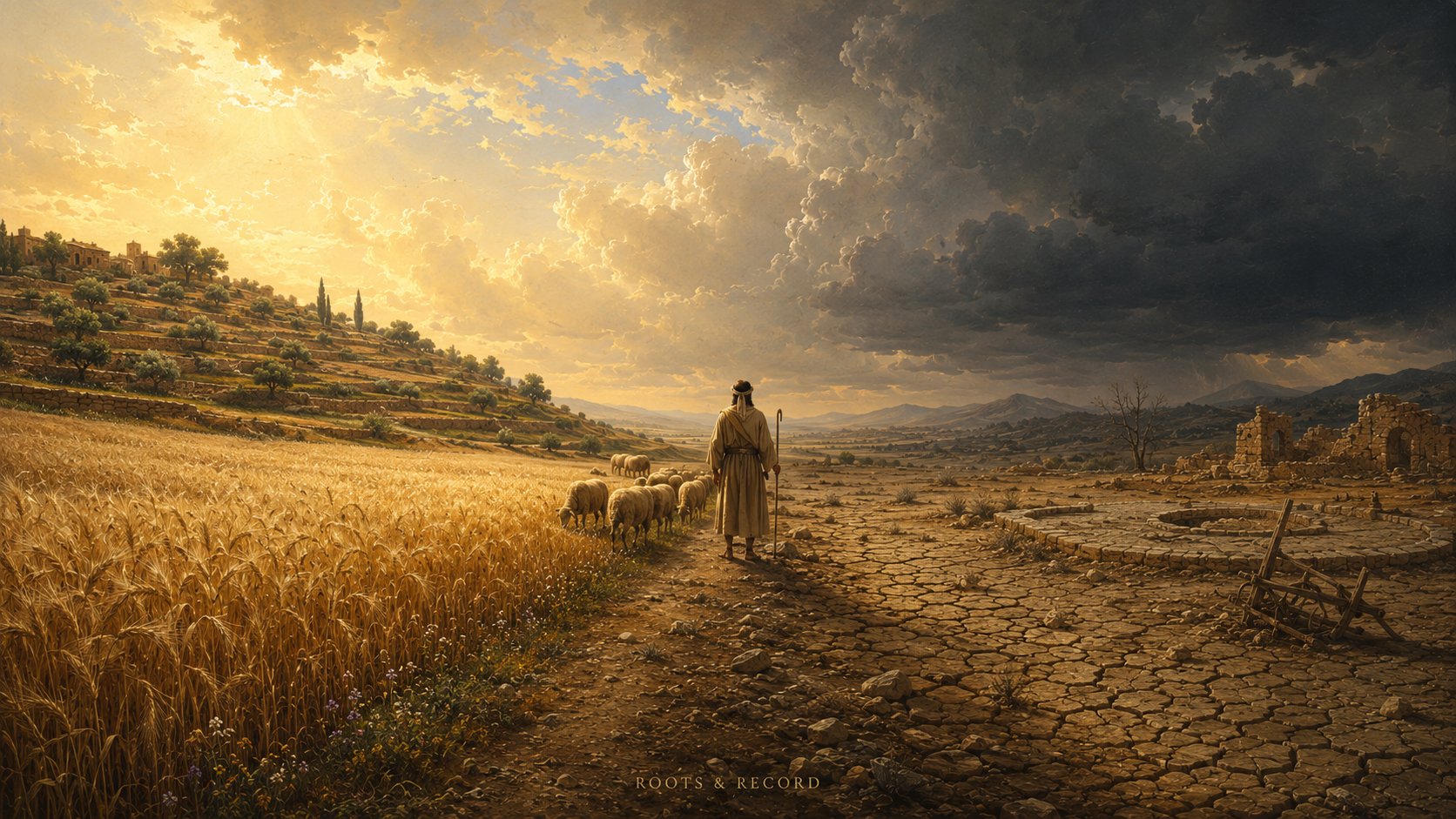
Jewish tradition counts forty-nine curses in Leviticus 26. In Deuteronomy 28, the count doubles to ninety-eight. Any reader who sits with that number long enough starts drawing conclusions about the God behind it, and two conclusions tend to present themselves, each with its own kind of comfort, and neither one survives contact with the actual text.
The first says: obedience produces prosperity, so prosperity is evidence of obedience, and the size of a person's blessing is the size of their standing with God. Deuteronomy 28 becomes a formula, and the prosperity gospel is what happens when a covenant gets read as a contract, its relational language quietly swapped for the language of transaction. The second says: this is the harsher, more transactional god of the Law, and Jesus came to correct him. The Beatitudes become the gracious rewrite of Sinai's ledger, and the reader gets to feel grateful for having landed on the newer, kinder side of the story. Both readings need the same thing to work. They need Deuteronomy 28 to be a scoreboard, something a person or a nation can win or lose against, points tallied and totals compared. It is a diagnosis instead, and a diagnosis has no score to keep.
The list rewards a close reading before any conclusion gets drawn about what kind of document it is. "The LORD will afflict you with the boils of Egypt, with tumors, scurvy, and itch... with madness, blindness, and confusion of mind" (28:27–28). Siege conditions escalate until "you will eat the fruit of your womb, the flesh of your own sons and daughters" (28:53), a horror the text names outright rather than gestures toward. Exile follows, total enough that "although once you were as numerous as the stars in heaven, you shall be left few in number" (28:62), scattered "among all peoples, from one end of the earth to the other" (28:64). Every item on this list names a specific way an agrarian covenant society can come apart, sector by sector: bodily collapse, crop failure, military defeat, and finally the complete unraveling of the nation itself, each one set down with the precision of someone who has thought carefully about exactly where a system like this breaks. A list built like that reads less like a threat than like exactly what it will turn out to be: a catalogue of failure modes, ordered by how deeply each one reaches into the life of the community, moving outward from the individual body to the fate of the nation entire.
A Textbook for What Goes Wrong
Health is simple to describe. A body doing what it's supposed to do can be summarized in a paragraph: systems functioning, nothing in pain, everything working together. Disease demands considerably more room, and the reason has nothing to do with which of the two a writer favors. A single medical textbook on pathology runs to thousands of pages because health has one basic shape and disease has as many shapes as there are ways for a system to fail, and the volume of the text tracks the complexity of failure rather than the author's appetite for it. The length of a hospital's index of what can go wrong is a measure of how many ways a body can break down, nothing more.
Deuteronomy 28 is built exactly that way. The blessings, in verses 1–14, take fourteen verses: city and field, basket and kneading bowl, children and livestock, coming in and going out, one integrated system running the way it's supposed to. The curses take the rest of the chapter, fifty-four verses cataloguing that same system failing, sector by sector: crops fail, health fails, weather turns against the harvest, war arrives, and the chapter ends in exile. Each verse names a distinct way the organism can break down, and a good diagnostician names every failure mode in detail for a simple reason: a failure mode named in advance is a failure mode that might be caught before it happens. The doctor who spends more time on the differential diagnosis than on the definition of health is practicing exactly the discipline that thoroughness requires.
Leviticus 26 tells the same story with a different structure, and the difference is worth noticing. Its curses arrive in five escalating waves, each one triggered if the previous warning goes unheeded, each wave explicitly worse than the last. The biblical scholar Jacob Milgrom traced the internal logic of that escalation closely, showing how each wave answers a specific form of covenant breach with a specific and proportionate consequence rather than an undifferentiated intensification of punishment, the text building a structured argument rather than simply raising its voice. Deuteronomy 28 drops the staged warning entirely and unleashes the full catalogue at once, "all these curses" (28:15), as though enough time has passed that gradual escalation is no longer the point. Read side by side, the two chapters look less like two tellings of the same threat and more like two stages of the same relationship: one still hoping a smaller warning will be heeded, the other naming the full weight of what's at stake because the smaller warnings already went unheeded. Both read like a physician enlarging the warning because the patient keeps failing to hear it, each escalation calibrated to how much has already gone unanswered.
What looks, at a glance, like a uniquely vindictive text turns out to be conventional for its genre. The scholar Kenneth Kitchen has argued that Deuteronomy's overall shape, a historical review followed by covenant obligations followed by a formal sequence of blessing and curse, matches the treaty form used across the ancient Near East for binding a people to a sovereign. That treaty form required its failure conditions spelled out in exhaustive detail for the same reason a diagnosis does: vagueness protects no one, and a treaty whose penalties are left implicit is a treaty either party can quietly reinterpret once it becomes convenient. The length of the curse section is a feature of the form doing its job, treaty language demanding the same exhaustive precision a diagnosis demands, not the record of a mood the text happens to be in.
Not a Wealth Formula
The prosperity gospel reads Deuteronomy 28 forward only: obey, and blessing follows, where blessing means personal wealth. To make that reading work, it has to quietly delete everything in the surrounding chapters that doesn't fit a wealth formula, because the blessings this chapter describes were relational from the start, never individual to begin with.
Two chapters earlier, the text spends its opening verses on the tithe: produce set aside every third year specifically for the Levite, the stranger, the orphan, and the widow, people with no personal stake in the harvest at all. A farmer's own prosperity is described consistently as something that keeps moving through the community, a current that has to keep circulating outward through the Levite, the stranger, the orphan, and the widow, or the harvest is not functioning as the covenant intends. Chapter 28's blessings inherit this logic directly. Rain "in its season" (28:12) names the condition of an entire agrarian society being fed at once rather than a private transaction between one worshipper and God. A wealth formula can be satisfied by one fortunate individual in an otherwise struggling country. The blessing this text describes exists only as something a whole community holds together, and it collapses the moment it is imagined as a private possession.
Two chapters earlier still, the text confronts the wealth formula directly and rejects it by name. "Do not say to yourself, 'My power and the might of my own hand have gotten me this wealth.' But remember the LORD your God, for it is he who gives you power to get wealth" (Deut 8:17–18). The text warns specifically against the claim that faithful people earn their fortune through righteous effort, spoken to people who have not yet even entered the land they're being warned about, as though Moses could already see the exact misreading his descendants would eventually make of his own words.
The curses confirm this from the other direction. The early modern commentator Kli Yakar noticed that the address in this chapter shifts from the plural forms used for Israel as a body in Leviticus 26 to the singular "you" that dominates Deuteronomy 28, and connected the shift to arevut, the principle that one person's conduct is never sealed off from what the whole community becomes. The individual address, on this reading, sharpens the communal stakes rather than replacing them: a single person's flourishing or collapse ripples outward precisely because that person was never a sealed unit to begin with. Even at its most individually addressed, the text holds flourishing and its collapse as a matter the whole covenant community shares. A prosperity gospel needs Deuteronomy 28 to be about individuals getting what they earned. The text keeps insisting it is about a people staying whole, and the singular voice turns out to be one more way of saying so.
Whose God Is This
The second misreading is quieter, and among observant Christians, more comfortable: this chapter belongs to a stricter, more transactional God, and Jesus's own teaching corrects him. Jesus, on this reading, is preaching against Moses.
Nothing in Jesus's own conduct supports this claim. In the wilderness, at forty days without food, tested at his most physically weakened point, he answers the devil three separate times, and all three answers are Deuteronomy, quoted as final authority rather than as a position to be improved on. Offered bread, he answers, "One does not live by bread alone, but by every word that comes from the mouth of God" (Matt 4:4, quoting Deut 8:3). Told to test God's protection, he answers, "Do not put the Lord your God to the test" (Matt 4:7, quoting Deut 6:16). Offered the kingdoms of the world, he answers, "Worship the Lord your God, and serve only him" (Matt 4:10, quoting Deut 6:13). Each answer reaches for the same source at the moment of greatest pressure, and the pattern itself carries weight: three separate temptations, three separate opportunities to reach for something else, and the same book answers all three. This is a man reaching for that text as his only weapon at the moment his own survival and mission were most directly threatened, drawing on Deuteronomy with the confidence of someone reaching for the tool closest at hand in a crisis, not the caution of someone handling a document he privately distrusts. If Deuteronomy's God were a different, harder god than the one Jesus served, this is exactly the moment a different god's authority would fail him. It holds instead.
The Beatitudes are usually set up as evidence for the other side of this argument, but they are doing something closer to what Deuteronomy 28 is doing than most readers assume. "Blessed are the poor in spirit, for theirs is the kingdom of heaven. Blessed are those who mourn, for they will be comforted" (Matt 5:3–4). Deuteronomy 28 asks what flourishing looks like when covenant order fills the land: rain, harvest, security, children, an entire society working as it should. The Beatitudes ask who is actually flourishing in God's sight once that order has broken down entirely, when the poor in spirit, the mourning, and the persecuted are the ones named blessed. Both passages offer the same definition of a rightly ordered life under God, described from two different sides of history: one side where the system is still intact, one side where it has been shattered by exile, occupation, and loss. Moses describes flourishing from inside an ordered world. Jesus describes it from inside a broken one. Each describes the same God's faithfulness under the actual conditions his hearers were living through, Moses to a people about to enter the land intact, Jesus to a people who had watched it fall apart generations before he ever opened his mouth on the mountainside.
This is also, in the end, what the sheer number of curses was always doing. A list this long, this specific, this determined to name every way a covenant can fail, is the record of a God who would rather his people see the collapse coming than live through it unwarned. Jesus, naming the poor in spirit and the mourning as blessed generations later, stands in that same tradition, still doing the same thing at both ends of the story: naming what is coming before it arrives, so that seeing it coming might be enough to change course.