
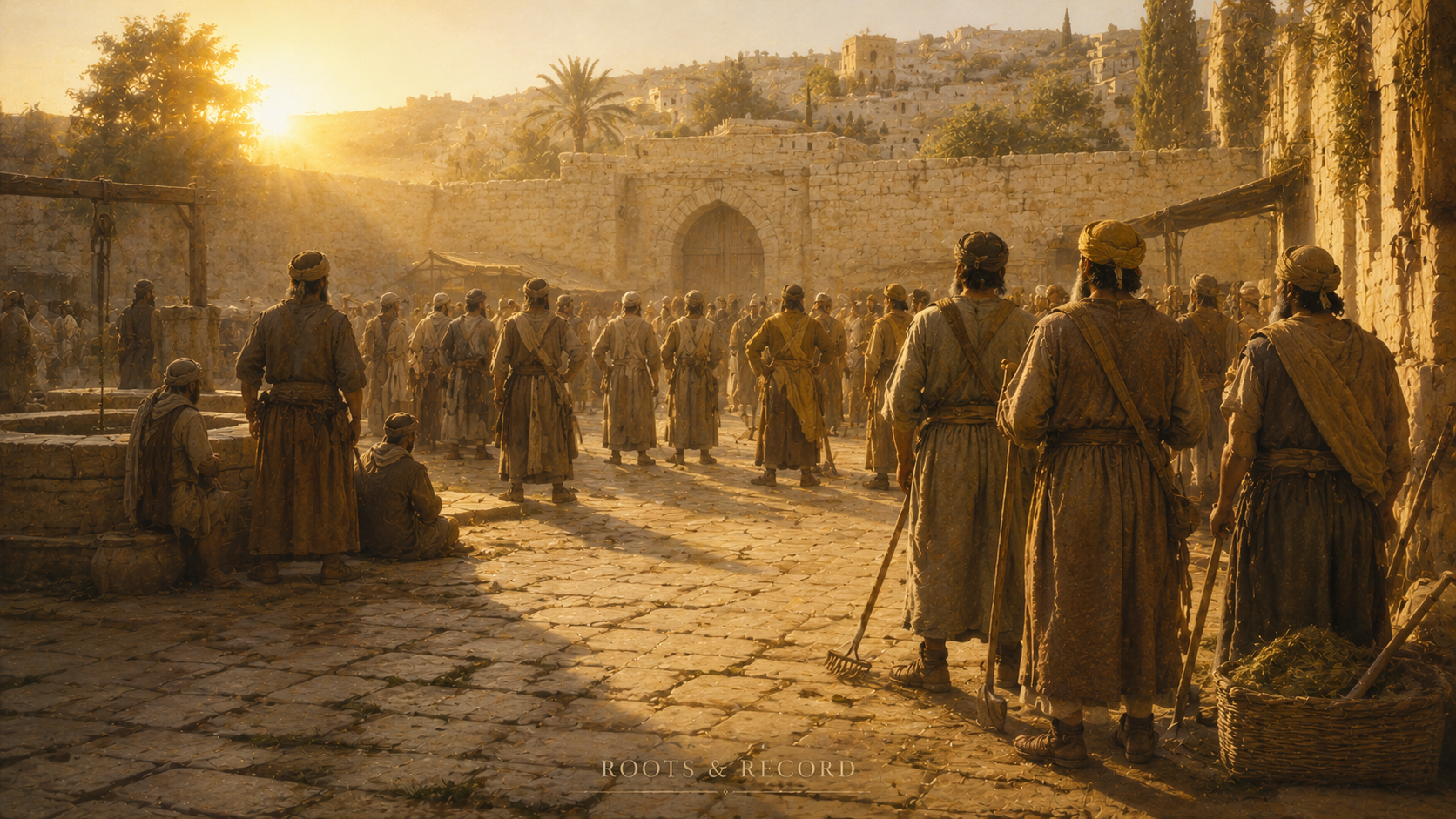
A parable in Matthew 20 has been making people uncomfortable for two thousand years, and the discomfort rarely locates itself correctly. A landowner goes to the marketplace at dawn and hires workers for his vineyard, agreeing to pay them a denarius, the standard day's wage. He returns at the third hour, the sixth, the ninth, and even the eleventh hour, each time hiring more workers and promising to pay "whatever is right." When evening comes, the landowner instructs his manager to pay everyone beginning with the last hired. Every worker receives one denarius. Those hired at dawn, expecting more, receive the same as those who worked a single hour in the cooling afternoon. They complain. The landowner replies: "Friend, I am not being unjust to you. Didst thou not agree with me for a penny? Take that thine is, and go thy way: I will give unto this last, even as unto thee. Is it not lawful for me to do what I will with mine own? Or is thine eye evil, because I am good?" (Matt 20:13–15).
Modern readers reach for an ideological framework. Capitalists note that the landowner is a private employer exercising legitimate contractual authority over his own property. Socialists counter that the parable challenges market logic by decoupling wages from labor time. Both readings import a framework the parable does not share and will not sustain. The landowner is neither Adam Smith's rational economic actor nor a proto-Marxist agitator. He is a figure operating within a specific theological and covenantal world, rooted in Torah, shaped by prophetic imagination, and intelligible only within the Judaism of which Jesus was a product.
To read this parable well is to hear it as a first-century Jewish audience would have: saturated with legal concepts, charged with prophetic resonance, and shaped by the specific debates of the oral tradition contemporaneous with Jesus and with the composition of Matthew's Gospel. When those resonances are recovered, the parable ceases to be a provocation about economics and becomes a provocation about something far more radical: the nature of divine generosity, and the human incapacity to receive it without resentment.
The Covenantal Vineyard
No first-century Jewish listener would have heard the word "vineyard" as a neutral economic term. The vineyard is one of the most charged images in the Hebrew Bible, unmistakable to anyone formed by Torah and the Prophets. Isaiah's Song of the Vineyard in Isaiah 5 constructs what appears to be an agricultural lament, a careful, loving vintner who planted choice vines only to harvest wild grapes, before turning abruptly into a courtroom. "For the vineyard of the LORD of hosts is the house of Israel, and the men of Judah his pleasant plant: and he looked for judgment, but behold oppression; for righteousness, but behold a cry" (Isa 5:7). The failure of the vineyard is a covenant failure, wild grapes standing for injustice and bloodshed where justice and righteousness were expected. Psalm 80 deepens the image, framing exile as a vineyard without a keeper; Jeremiah extends it into accusation; Ezekiel 17 and 19 apply it to the Davidic dynasty itself. The vine, in prophetic imagination, is not merely agricultural; it is political, covenantal, eschatological.
When Jesus tells a parable set in a vineyard, his audience hears Israel. They hear covenant. The landowner of Matthew 20 occupies the structural position the Prophets consistently assigned to God: the one who tends, who plants, who invites laborers, and who ultimately determines what the harvest means.
The Marketplace, the Idle, and the Day's Wage
The landowner finds workers in the agora, the marketplace or town square, and this detail is socially precise. The workers who stand idle are unemployed. When the landowner finds those who have waited all day at the eleventh hour and asks why they have been idle, their answer carries a weight the Greek makes plain: "Because no one hired us" (Matt 20:7). They are the structurally excluded, those whom the ordinary logic of productive employment left standing in the heat.
The Torah's legislation about wages is specific. Leviticus 19:13 prohibits withholding a hired worker's wages overnight. Deuteronomy 24:14–15 clarifies: "Thou shalt not oppress an hired servant that is poor and needy… At his day thou shalt give him his hire, neither shall the sun go down upon it; for he is poor, and setteth his heart upon it." The daily wage is a lifeline rather than a contract between equals, the denarius serving as survival rather than compensation for time. The Mishnah's tractate Bava Metzia reflects this tradition: the relationship between landowner and day laborer is governed by Torah's insistence that the poor worker's dignity takes precedence over the employer's economic advantage. The landowner of Matthew 20 pays at evening, in exact accordance with Torah, and then pays everyone the same, which is the moment the parable reveals it was never primarily about economics at all.
The Evil Eye and the Rabbinic Debate About Reward
The landowner's closing question is the theological spine of the entire parable: "Is thine eye evil, because I am good?" The phrase "evil eye," ayin hara in Hebrew, carries considerable weight in both biblical and rabbinic literature. In the Hebrew Bible, the evil eye is the eye of the miser, the one who begrudges generosity to others. Deuteronomy 15:9 warns against it as the sabbatical year approaches; Proverbs 28:22 connects it directly to greed. The one who watches another receive what he did not earn and experiences it as a personal injury has, in the vocabulary of Torah, an ayin hara: a spiritual diagnosis rather than a supernatural curse, naming the inability to rejoice in another's good fortune and the zero-sum vision that sees generosity to others as deprivation of oneself.
A remarkable passage in the Jerusalem Talmud, Berakhot 2:8, tells of Rabbi Bun bar Hiyya, a prodigy who died young but had covered more ground in Torah study than aged scholars had in full careers. His teacher told a parable strikingly similar to Matthew 20: a king hired many workers, but one worked so diligently that after two hours the king dismissed him and paid him a full day's wage. When the other workers complained, the king replied that this one had accomplished in two hours what the others had not managed in a full day. Matthew's parable inverts the frame, with the latecomers being the overlooked poor rather than prodigies, yet the underlying theological territory is identical: divine reward does not operate by the logic of human labor markets, and the attempt to calculate it by those metrics is itself a spiritual error.
Grace, Merit, and the Prophetic Imagination
The tension Matthew 20 dramatizes, between a logic of desert and a logic of grace, runs through the prophetic literature with a force interpreters often underestimate. The book of Jonah is perhaps the purest prophetic exploration of this theme. Jonah's anger at the end has nothing to do with the fish or the plant; it is about the exact dynamic Matthew 20 dramatizes: Nineveh, which deserved destruction, repented and was spared, and Jonah, who has served God faithfully, is furious. God's question, "Doest thou well to be angry?" (Jon 4:4), is structurally identical to the landowner's: both expose the spiritual pathology of experiencing divine mercy toward others as injustice toward oneself.
Hosea frames the problem in terms of covenant love, ḥesed, the Hebrew term for a loyalty that exceeds obligation and carries a covenantal dimension that "lovingkindness" only partly holds. "For I desired mercy, and not sacrifice" (Hos 6:6). The landowner's decision to pay the latecomers a full denarius is an act of ḥesed, exceeding a contract rather than violating one. Isaiah 55 extends this into explicit economic terms: "Ho, every one that thirsteth, come ye to the waters; and he that hath no money; come ye, buy, and eat," a divine economy that inverts marketplace logic, abundance flowing from the character of the giver rather than the calculations of the recipient. Micah 6:8 holds justice and ḥesed together without collapsing them, and the landowner does the same: he is scrupulous, paying exactly what was agreed to everyone, but ḥesed moves beyond justice's minimum. The one who expected justice to be the ceiling discovers that for the landowner, justice is only the floor.
Eschatological Inversion
Matthew frames the parable between two nearly identical sayings: "But many that are first shall be last; and the last shall be first" (Matt 19:30; 20:16). The immediately preceding passage involves Peter asking what the disciples, who have left everything, will receive, and the parable is in part an answer, one that is unexpected: the question itself reveals a spiritual problem. The motif of eschatological reversal runs through Torah and the Prophets with striking consistency. Jacob receives the birthright over Esau. Joseph, sold into slavery, becomes the ruler before whom his brothers bow. Israel's own election is the story of a small, landless people chosen over the great empires: "For thou art an holy people unto the LORD thy God: the LORD thy God hath chosen thee to be a special people unto himself, above all people that are upon the face of the earth. The LORD did not set his love on you, nor choose you, because ye were more in number than any people; for ye were the fewest of all people" (Deut 7:6–7). Hannah's prayer in 1 Samuel 2 articulates reversal as a characteristic of divine action: "He raiseth up the poor out of the dust, and lifteth up the beggar from the dunghill" (1 Sam 2:8), and the poor worker who has waited all day unhired and receives a full denarius stands squarely in this tradition.
Reading the Parable on Its Own Terms
Both ideological appropriations of this parable involve importing assumptions the text resists, and clarifying the parable's actual claims matters precisely because the misreadings are so persistent.
The landowner is a figure for God in the way that the father of the prodigal son is: the analogy is theological and partial, not a template for secular economic organization. Torah's actual wage legislation, in Leviticus 19 and Deuteronomy 24, remains in force and is not superseded by a parable whose domain is entirely different. Effort is also not irrelevant to the parable; the workers who labored all day receive exactly what was promised. The parable resists only the inference that their labor gives them a claim on what the landowner chooses to give to others, because no one in the parable has a claim on the landowner's generosity. That generosity flows from his character, not from their desert.
The workers who complain are observing something accurate, that something unusual has happened, while misreading what it means. Their error is the one that appears wherever self-interest bends the lens of perception: the distortion Hannah Arendt identified in the totalitarian personality and C.S. Lewis mapped in Screwtape's demonic strategy, the incapacity to see reality as it is because comparison has already replaced perception. The landowner's generosity added nothing to their day and took nothing from it. The injury exists only in the comparison, and the comparison is the problem. Mishnah Avot 4:1 asks: "Who is rich? One who is satisfied with his portion." The one who received a denarius and goes home furious because someone else also received a denarius has experienced abundance as deprivation, a spiritual condition requiring a diagnosis in kind.
The Parable in Its Jewish Home
Recovering Matthew 20 as a Jewish parable does not reduce its theological claim. It amplifies it. Jesus is drawing out a logic already present in Torah, already audible in the Prophets, already debated in the rabbinic academy: the vineyard as covenantal space, the prohibition of the ayin hara, the prophetic insistence that God's ḥesed exceeds all human calculation of merit. The parable sharpens the tradition's most radical implications and presses them on an audience that has, perhaps, domesticated them. It is always easier to affirm eschatological reversal in the abstract than to receive it concretely, when the one exalted is standing next to you in the payment line having worked one hour to your twelve.
The prophetic vision of Isaiah 56, "the sons of the stranger, that join themselves to the LORD… Even them will I bring to my holy mountain" (Isa 56:6–7), is the vineyard of Matthew 20 from the other side. Latecomers arrive and are welcomed by a God whose generosity refuses to be bounded by the calculations of the early arrivals. The parable is not a contribution to the history of economic thought. It is a contribution to the theology of divine character, addressed to people formed by Torah and shaped by the Prophets, employing legal concepts and spiritual vocabulary that become legible only when the text is read in its Jewish home.
The workers who complain are the parable's mirror. In them, the audience sees its own reflexive calculation, the deep human tendency to measure divine generosity by the standards of a zero-sum world. The landowner's closing question is an invitation to see differently: can you perceive my generosity to another as simply generosity, without experiencing it as a threat to what you have been given? Rooted in Torah's prohibition of the ayin hara and the Prophets' announcement of a divine economy that exceeds human calculation, that question remains the parable's live edge, one the first century did not resolve, and one every generation that reads the vineyard narrative must eventually sit with, in discomfort and in hope.
Sources
Primary Texts
King James Version (KJV). Bible Gateway.
Mishnah Bava Metzia. Sefaria.
Mishnah Avot 4:1. Sefaria.
Jerusalem Talmud, Berakhot 2:8. Sefaria.


