When the tempest passes, the wicked are no more, but the righteous are established forever.Proverbs 10:25
Genesis (Bereshit, “In the Beginning”)
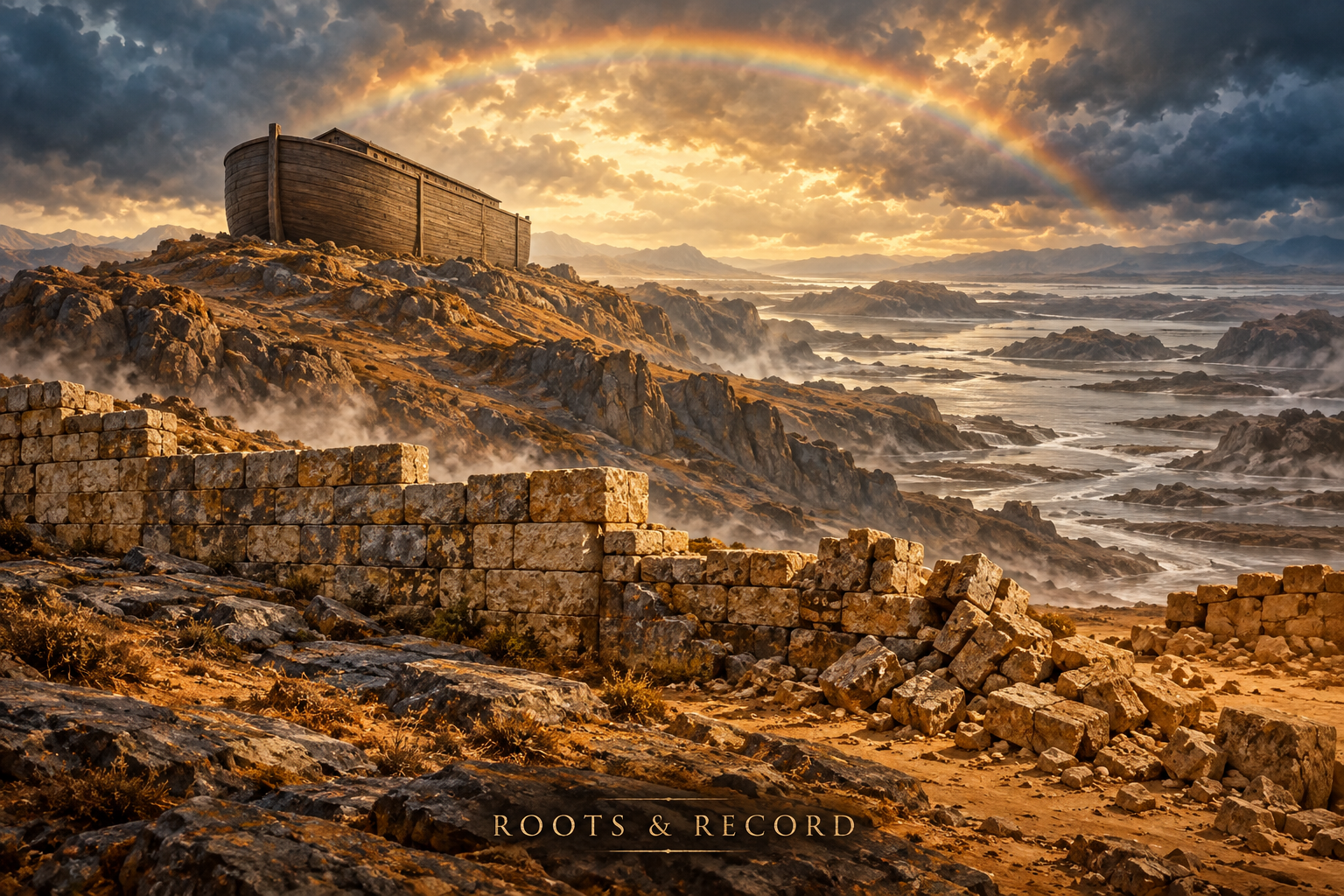
6:1–9:18
When & Where
Flood traditions reach from Mesopotamia and India to Greece and the Americas, and they share a shape: a catastrophe, a small remnant that survives, and a world begun again. In Anishinaabe tradition a flood covers the earth, Nanabozho survives on a raft with the animals, and Muskrat dives until it surfaces with a few grains of earth from which the land is remade on the back of Turtle. In Hopi tradition, as set down by Frank Waters in 1963, a flood ends the Third World and the faithful survive in hollow reeds that carry them to the Fourth. Hopi tradition counts successive worlds ended by fire, ice, and flood, so the flood is one ending among three there, and the remnant that carries life forward remains the constant. The Maya Popol Vuh and the Nahua account of the Fourth Sun also close an age in water.
The argument here favors a catastrophe larger than any one river valley. Regional floods are among the most common disasters, and a people who survived one would recall the flood of its own valley. Dozens of such episodes would leave dozens of local deluges scattered through the record, each with its own hero and its own date. The traditions instead preserve a single defining event, after which a small group restarts creation. A remnant that begins the world again describes the end of one world and the opening of another, and a flood confined to one region does not carry that weight across peoples with no known contact. The competing reading holds that each culture preserved its own local flood, and oral tradition does preserve regional disasters with accuracy: Makah and Quileute accounts of a great wave match the Cascadia earthquake and tsunami of January 1700. That reading explains the number of stories, and it still has to explain why so many local floods took the shape of one remnant restarting creation.
The physical record does not decide the question. It shows no single flood covering every continent at once, and the flood deposits at Ur, Kish, and Shuruppak belong to different centuries.
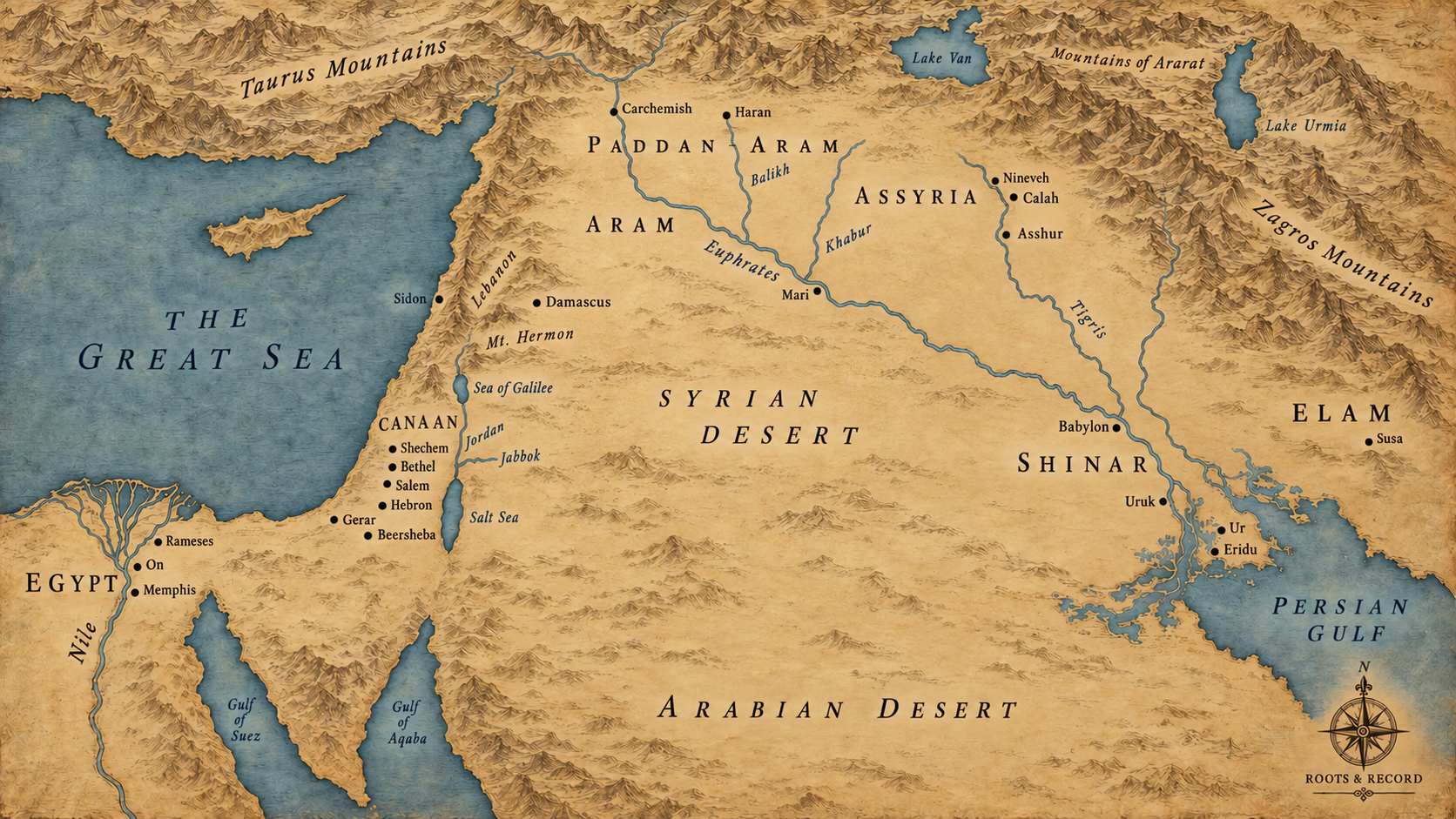
Mountains of Ararat
What to Watch For
The Sons of God · Genesis 6:1–4
- The phrase benei ha-elohim, rendered “sons of God,” divides ancient readers. Elohim denotes God, gods, or powerful persons, and the single English word “God” closes a range the Hebrew leaves open. Second Temple writers, including the Book of Watchers in 1 Enoch, read heavenly beings who cross a boundary. Rabbinic tradition, following an early Aramaic translation, reads human rulers and judges who exploit their rank. Both readings agree on the action: they see, and they take whomever they choose.
- The sequence repeats Genesis 3:6, where the woman sees the fruit and takes it. Desire leads to taking in both scenes, and in Genesis 6 those who hold power treat desire as entitlement. The Nephilim and the famous warriors of old stand beside them, and the text attaches renown to them without attaching praise.
Violence Fills the Earth · Genesis 6:5–13
- The earth fills with ḥamas in 6:11 and 6:13. English offers “violence,” which suggests brawling in the street. The Hebrew covers wrongful injury, oppression, and the seizure of another person’s property, and Amos and Jeremiah apply it to the exploitation of the poor and the stranger. Rabbinic tradition names robbery as the sin that sealed the sentence and describes people who took goods in amounts just below the value a court would act on, so that no claim could be brought.
- The diagnosis is social. Individual appetite hardened into practice, practice into custom, and custom into the ordinary operation of a society. A civilization can hold great strength and wealth while losing the restraint that keeps it alive, and the text shows the collapse arriving when entitlement replaces justice.
Noah in His Generations · Genesis 6:9
- Noah is called ṣaddiq, righteous, and tamim, whole or undivided in integrity, “in his generations.” The Hebrew bedorotav is plural, and the singular in many English translations hides the question the rabbis pressed: whether Noah’s righteousness was a triumph against a corrupt age or a modest standard that looked large only beside a wicked one, and whether he would have counted for less beside Abraham.
- Noah walks “with” God in 6:9, while Abraham walks “before” God in 17:1, and classical commentators read the difference as dependence set against self-standing. The contrast sharpens at Sodom, where Abraham argues with God for the city in 18:23–32. Genesis records no comparable plea from Noah, though the silence of the text does not prove he made none.
- Noah also takes initiative. After the flood he builds an altar and offers sacrifice in 8:20 with no recorded command, in a form of worship the text does not explain, as Cain and Abel offered before him. Gratitude and initiative belong to his righteousness alongside obedience, which leaves the reader to weigh whether remaining upright in a corrupt society is the whole of righteousness or its first part.
The Ark · Genesis 6:14–22
- The Hebrew word for the ark is tevah, and it appears in only one other story: the basket in which the infant Moses is placed in Exodus 2:3–5. English gives the two vessels different names and the link disappears. In both, a vulnerable life is carried through threatening water inside a vessel built to protect it.
- The dimensions come to 300 by 50 by 30 cubits, about 450 by 75 by 45 feet at eighteen inches to the cubit, with three decks, rooms, and an opening called ṣohar, which commentators read as a window, a source of light, or a luminous stone. The wood called gopher remains unidentified. The vessel has no sail and no rudder, so Noah’s task is to hold life safely while God decides where the ark goes.
- Genesis 6:18 gives the Torah’s first use of berit, covenant, and announces it before any terms exist. The terms arrive in chapter 9.
Clean Animals Before Sinai · Genesis 7:1–3
- God tells Noah to bring seven pairs of each clean kind and one pair of each unclean kind, and Leviticus 11 has not yet defined either. Jewish tradition answers that the righteous knew divine instruction before it was formally given to Israel, and the Book of Jubilees places Noah’s worship within a sacred order that predates Sinai. Critical scholars answer that the account uses vocabulary familiar to later Israelite readers, and they find in the differing animal counts a trace of separate literary sources. The plain narrative function appears in 8:20, where the extra clean animals supply the sacrifice without ending any species.
- Each answer carries the same claim: worship and moral obligation to God exist before Sinai. Obligation to God precedes the nation of Israel.
The Flood Reverses Creation · Genesis 7:11–8:14
- Genesis 7:11 breaks open the fountains of the great deep and the windows of heaven, and the waters God separated in 1:6–9 return. Order dissolves back into the deep. In 8:1 God sends a ruaḥ over the earth and the waters recede, as a ruaḥ of God moves over the waters in 1:2. Translations that render the word “spirit” in the first passage and “wind” in the second hide one Hebrew word and the echo it creates. The flood undoes creation and then creates again.
- Scholars have proposed a mirror structure for the account, with rising waters answering receding waters, entry into the ark answering exit, and the announcement of destruction answering the promise of preservation. The center falls on 8:1, “God remembered Noah.” The Hebrew verb zakhar describes action on behalf of someone, and the verse does not suggest that God had forgotten. The center of the account is God acting to preserve life. Jewish philosophical tradition asks whether language of remembering, regret, and grief reports divine emotion or speaks of God in terms people can grasp, and Genesis keeps the emotional force either way.
- Companion read: the Roots & Record essay “Is God Anthropomorphic” follows this question through Philo, the rabbis, and Heschel. It returns to Hosea 11:9, where God’s difference from mortals grounds mercy.
- The rain lasts forty days and the whole episode lasts about a year. Forty marks testing and transformation elsewhere in the Torah, from Moses on Sinai to Israel’s years in the wilderness, and rabbinic tradition ties the number to the sins of the generation, a link Genesis itself does not make. The chronology carries its own lesson. Destruction comes quickly and restoration comes slowly, and when the ground is dry in 8:14 Noah stays in the ark until God speaks in 8:15–16.
The Heart After the Flood · Genesis 8:20–22
- God’s stated reason for the promise is startling: the inclination of the human heart is evil from youth. The same diagnosis in 6:5 precedes the flood, and in 8:21 it grounds the promise not to repeat it. The diagnosis stays the same and God’s response changes.
- English renders the Hebrew yeṣer as “inclination,” and the word comes from the verb for shaping, the verb used when God forms the man from the dust in 2:7. The heart is a formed thing, and its formation continues. Later rabbinic tradition builds its teaching of the yeṣer ha-ra and the yeṣer ha-tov, the inclinations toward evil and toward good, on this vocabulary.
- The promise leaves the earlier curse on the ground in place, so labor and mortality remain, and it guarantees the regularity of seedtime and harvest, cold and heat, summer and winter, day and night. The text names a lasting moral vulnerability in human beings and keeps human responsibility intact. God preserves the conditions under which people continue to choose.
The Second Beginning · Genesis 9:1–4
- Genesis 9:1 repeats the blessing of 1:28, and the world it addresses has changed. Fear and dread, môrā’ and ḥat, now fall on the animals in their relationship to humanity. Genesis 1:29–30 gave plants to humans and animals for food, and 9:3 permits humans to eat animals with the blood excluded. Rabbinic tradition reads this as a new permission to Noah and his descendants, and interpreters differ over whether it concedes to human nature, answers altered conditions, or extends dominion. All three readings agree that dominion now operates in a world with fear in it, and that creation does not return to its first form.
Human Life and the Image of God · Genesis 9:5–6
- Immediately after the permission to eat animals comes the demand for an accounting for human blood, from animals and from human beings. The ground given is the image of God in 9:6, the image declared in 1:26–27. Killing a person attacks that image, and this is the first place the Torah draws a protection from it.
- Verse 6 is commonly read as permitting capital punishment for murder. The Torah then distinguishes deliberate killing from accidental killing in Numbers 35 and Deuteronomy 19, treats the killing of a burglar differently according to the immediate threat in Exodus 22:2–3, and rabbinic tradition develops the duty to stop an attacker who threatens a life. The Torah does not treat all killing as one act.
- This bears on Matthew 26:52, where Jesus warns that those who take the sword perish by it. He speaks at his arrest to a disciple who has drawn a weapon, and the saying addresses that moment while leaving open the question of defending others against an imminent attack. Readers who apply the verse as a blanket condemnation of force, ancient or modern, set aside the distinctions the Torah draws. The same distinctions bind the defender: protection of innocent life, proportionality, and the line between combatant and noncombatant remain in force.
The Covenant With Every Living Creature · Genesis 9:8–17
- God makes the covenant with Noah, his descendants, and every living creature, and it depends on no nation. The sign is the rainbow, and the Hebrew word qeshet is the ordinary word for a warrior’s bow. The sign is a weapon placed in the sky, and the English compound “rainbow” hides that image.
- God says in 9:15–16 that he will see the bow and remember the covenant, and the verb zakhar returns from 8:1. In Gilgamesh, Ishtar points to her lapis necklace and vows to remember the days of the flood, and Atrahasis describes measures to prevent the conditions that caused it. Neither attaches a sign to a covenant with all creatures.
- Later rabbinic tradition derives the seven Noahide commandments from this covenant, including prohibitions of murder, theft, idolatry, and sexual wrongdoing and the duty to establish courts. Genesis 9 lists no such code, yet the commandments address the failures that preceded the flood. The world is preserved, and humanity remains responsible for how it lives in it.
Matthew 5–7 · “The Mount”
When & Where
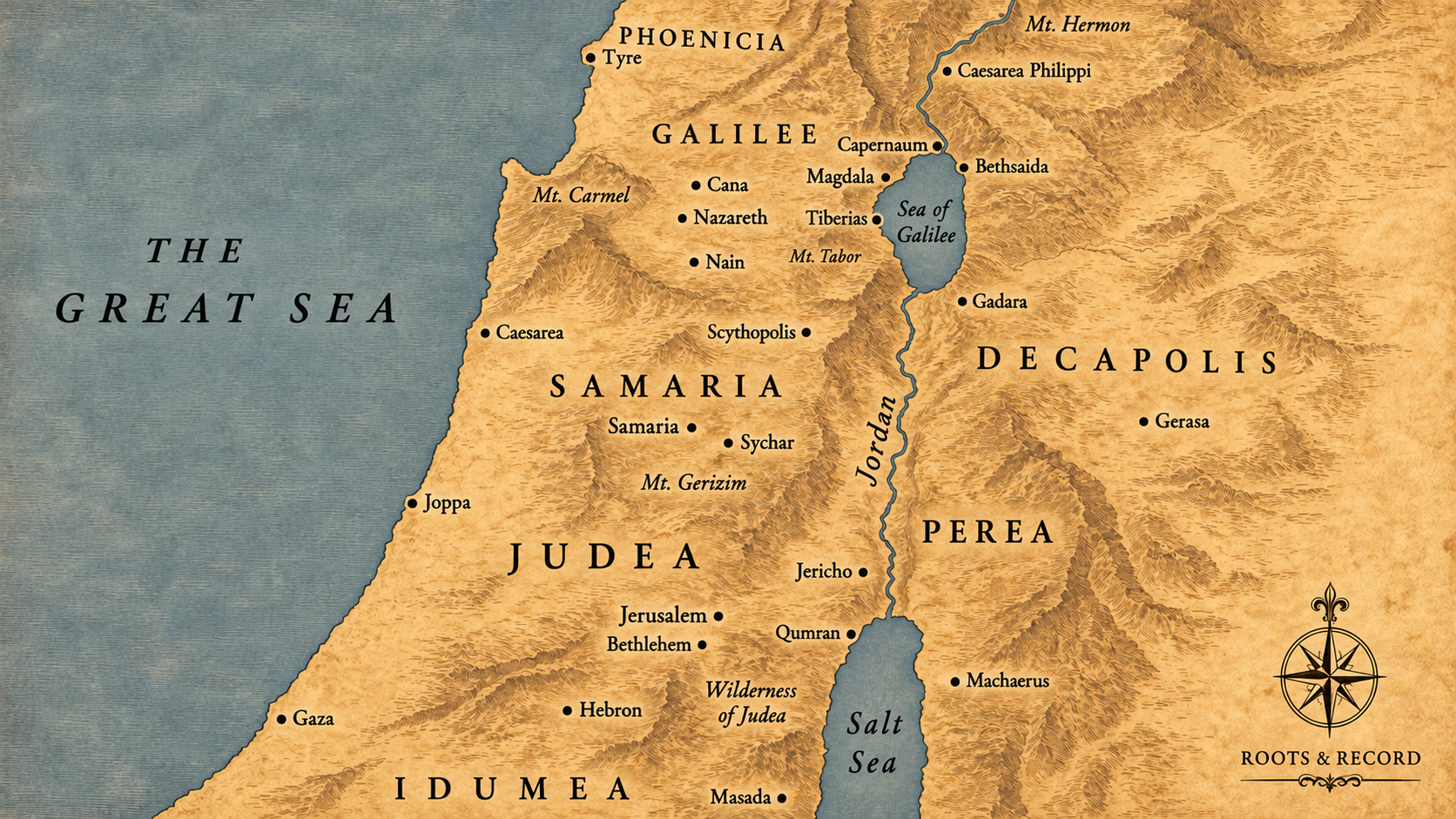
The Mountain, Galilee
What to Watch For
The Mountain and the Blessings · Matthew 5:1–16
- The mountain invites comparison with Moses at Sinai, and the Beatitudes draw on the Torah, Psalms, and Prophets. The meek inheriting the land in 5:5 echoes Psalm 37:11, the comfort promised to mourners in 5:4 echoes Isaiah 61:2, and the pure in heart in 5:8 echo Psalm 24:4. Humility, mercy, and justice belong to Jewish moral teaching, and Jesus speaks here as a teacher inside it.
- Salt and light in 5:13–16 tie righteousness to visible conduct. A community shows what it believes by how it lives.
Jesus and the Torah · Matthew 5:17–48
- Matthew 5:17–20 states that Jesus has not come to abolish the Torah or the Prophets, that the smallest letter of the Torah keeps its force, and that teaching others to relax the commandments carries a penalty. Any reading of the sermon that presents Jesus as replacing an obsolete religion with a new ethic has to account for these verses first.
- The six sayings that follow, which scholars call the antitheses, each take a familiar commandment and press toward the disposition behind it. Murder leads to anger and contempt in 5:21–22, adultery to desire in 5:27–28, and the same movement runs through the teaching on reconciliation, oaths, retaliation, and love of enemies. This belongs to Jewish interpretation, and the Torah already addresses the heart in the command not to covet in Exodus 20:17.
- Genesis 6:5 locates the root of the flood in the formation of the human heart. The sermon works on that same ground, treating anger as the seed of murder and desire as the seed of the taking that filled the earth before the flood.
Practice Without Display · Matthew 6:1–34
- Charity, prayer, and fasting are established Jewish practices, and Jesus assumes them. His objection falls on performing them for public admiration, which turns devotion into vanity. The Lord’s Prayer in 6:9–13 asks for the sanctifying of God’s name and the coming of his kingdom in language close to the Kaddish, though the dating of the two relative to each other is unsettled, and it adds daily bread, forgiveness, and deliverance.
- The teaching on wealth and anxiety follows from the same concern for an undivided heart. Possessions can claim the loyalty that belongs to God, and worry over them divides a person.
Judgment and Obedience · Matthew 7:1–23
- Matthew 7 forbids hypocritical judgment and still demands discernment. The Golden Rule in 7:12 sums up the Torah and the Prophets, and Hillel gave a close formulation to a prospective convert, telling him not to do to others what is hateful to himself. The parallel places the sermon’s ethic inside Jewish teaching.
- Matthew 7:21–23 delivers the sermon’s hardest warning. Calling Jesus “Lord” falls short, and those who prophesy and do deeds of power in his name are sent away for practicing anomia. The Greek word means lawlessness, literally the absence of law, and the people it condemns are people who claim loyalty to Jesus. The warning cannot be redirected at the Pharisees or at Judaism.
- Later Christian preaching often cast the Pharisees as spiritually bankrupt legalists displaced by the church. The sermon applies its sharpest warning to followers of Jesus, and its hard lines about religious leaders reflect disputes inside Jewish life that continued after 70 CE. A sermon invoked to prove Christian superiority supplies powerful grounds for criticizing religious complacency among Christians, and conclusions drawn later from Paul or from doctrine should not be read back over Matthew in a way that erases the Jewish setting of Jesus’ teaching.
The Two Builders and the Flood · Matthew 7:24–27
- The sermon closes with two houses, one on rock and one on sand. The same rain, flood, and wind strike both, and the foundation alone separates the house that stands from the house that falls. The wise builder hears the words of Jesus and acts on them.
- Noah hears and acts: God commands, and Noah does all that he is told in Genesis 6:22. Water in both readings exposes the foundation of a life, and in both the difference lies in conduct. Noah is marked by how he lives, and Jesus warns in 7:21 that invoking his authority falls short of doing the will of the Father.
- The sermon also presses the question of initiative that Noah and Abraham raised. Reconciliation takes priority over the gift at the altar in 5:23–24, and peacemakers are blessed in 5:9, so righteousness includes moving toward other people and extends past avoiding wrongdoing. Justice and mercy also sit together across the two readings. Genesis 9:5–6 demands an accounting for bloodshed and Matthew 5:7 blesses the merciful, and neither text sets one against the other.
Three Things Worth Sitting With
1. When does desire become injustice?
The generation of the Flood shows desire hardening into entitlement, entitlement into exploitation, and exploitation into the shape of a whole society. The Sermon on the Mount returns attention to the dispositions that feed such actions.
Where does desire serve as sufficient justification for what gets done? Which ordinary compromises, tolerated for the sake of comfort, contribute to injustices larger than any one person?
2. Does righteousness require more than obedience?
Noah obeys God and preserves his household, and his altar after the Flood adds gratitude and initiative. Abraham pleads for Sodom, and Jesus calls for reconciliation, mercy, and peacemaking.
A person can avoid every share in wrongdoing and remain indifferent to the suffering nearby. What would it take to move from personal uprightness to the active protection of the dignity and well-being of others?
3. What should humanity do with the patience it has been given?
The Flood leaves the human inclination toward evil in place, and God still promises to preserve the world and sets obligations for the protection of life. The Sermon on the Mount assumes a continual confrontation with moral weakness, and its closing image holds that hearing instruction lays no foundation until the instruction becomes action.
Continued life offers repeated chances to choose differently. How are those chances being used, and what kind of world are the choices building?