She is a tree of life to those who lay hold of her; those who hold her fast are called happy.Proverbs 3:18
Deuteronomy (Devarim, “Words”)
33:1–34:12
When & Where

Mount Nebo
What to Watch For
Deuteronomy 33 is poetry, yet the text introduces it as a blessing and withholds the word for song that names the poem of chapter 32. The two labels divide the poems by what each does. The song accuses Israel and predicts its failure, while the blessing gives each tribe a share of what God intends for it. Jacob closed Genesis the same way, calling his sons to his bedside and speaking over each tribe as death approached in Genesis 49, so the Torah is bracketed by two deathbed blessings, one at each end.
Verse 4 names what Moses leaves behind, and the word is morashah. English versions give heritage, possession, or inheritance, and the same words render naḥalah, the allotted holding of land that a family owns. Morashah comes from yarash, the root for succession, and describes what passes to an heir. Exodus 6:8 uses it for the land, and here the text uses it for the Torah, placing instruction where the land would stand. The heritage Moses hands on in his last speech is the teaching itself, the possession Israel can carry across a river Moses will not cross. Rabbinic tradition read the word both ways. One reading pronounced it me’orasah, betrothed, and heard in it a Torah promised to Israel like a bride. Another insisted on morashah, the plain inheritance, because a Jew who had wandered could return to it as to property already his.
The tribes enter the blessing carrying the histories Jacob assigned them. Reuben, the firstborn who lost his standing in Genesis 49, receives a prayer that he survive. Simeon receives nothing. Jacob had joined Simeon to Levi as instruments of violence to be scattered in Israel, and Simeon’s later territory did consist of towns inside Judah’s borders, a scattering fulfilled without the redemption Levi received. Levi’s blessing is the longest in these verses and the one that assigns Israel its teachers: the Urim and Thummim, the test at Massah and Meribah, the loyalty that set kin second to God after the golden calf, and the charge to teach Jacob God’s ordinances and Israel the Torah. The zeal Jacob condemned becomes, after Sinai, the credential for teaching.
Judah receives a prayer that God hear his voice, bring him back to his people, and help him against his adversaries. The English word Jew descends from the tribe’s name, so a prayer for one tribe’s survival extends to the people who would carry its name through exile. Benjamin, called beloved of the Lord, receives the blessing that turns to dwelling. The Hebrew verb is shakan, to settle in a place and remain there, and it appears twice in verse 12. English versions render it as rests in one clause and dwells or lives in others, which conceals a single verb that recurs in the chapter’s later blessings. Rabbinic tradition heard in the dwelling between Benjamin’s shoulders the sanctuary itself, which stood on the high ground of his territory. Benjamin’s blessing gives God an address inside one tribe’s territory.
Joseph receives the most extensive catalog of material blessing in the chapter: the dew and the deep, the fruit of the sun and the yield of the months, the best of the ancient mountains. The blessing rests on the favor of the one who dwells in the bush, a phrase that carries the reader back to Exodus 3:1–6, where Moses first met God at a burning thorn bush and received the task that ends on this mountain. The word for the one who dwells is a form of shakan, so the God who once dwelt in a bush is named by the verb the chapter has used for the tribes. Moses closes the Torah by recalling the place where his own story began.
The tens of thousands of Ephraim and the thousands of Manasseh repeat Jacob’s elevation of the younger brother over the elder in Genesis 48:13–20. Ephraim went on to lead the northern kingdom, whose first king, Jeroboam, was an Ephraimite who set up golden calves at Bethel and Dan. Asher, promised oil so plentiful that he may dip his foot in it, holds a modest place in Israel’s later history. The blessings describe favor that is real, and Deuteronomy 28–30 has already stated what governs it: land, prosperity, and security continue while the covenant is kept. A blessing in this chapter is a gift the recipient can lose. The poem then turns from the tribes to the God who gave it.
The tribes disappear at the end of the poem. Verses 26 through 29 address Israel as one people, and the only figure set beside Israel is God, who is described in terms of place. The eternal God is Israel’s dwelling place, with everlasting arms beneath. The Hebrew word in verse 27 is me’onah, which English versions render as dwelling place or refuge depending on the translation, and the Hebrew holds both, the place where one lives and the place where one is safe. It is a different word from shakan, which verse 28 then supplies, with Israel dwelling in safety. The sequence places the dwelling of the people inside the dwelling of God before the poem ends.
Moses closes with the exclamation “Happy are you, O Israel!” (Deut 33:29), and the reason he gives is that Israel is a people saved by the Lord, who is its shield and its sword. The final emphasis falls on that relation and leaves the tribes’ relative fortunes behind. Moses’s last words to Israel are a declaration of happiness, and the next verse takes him up the mountain.
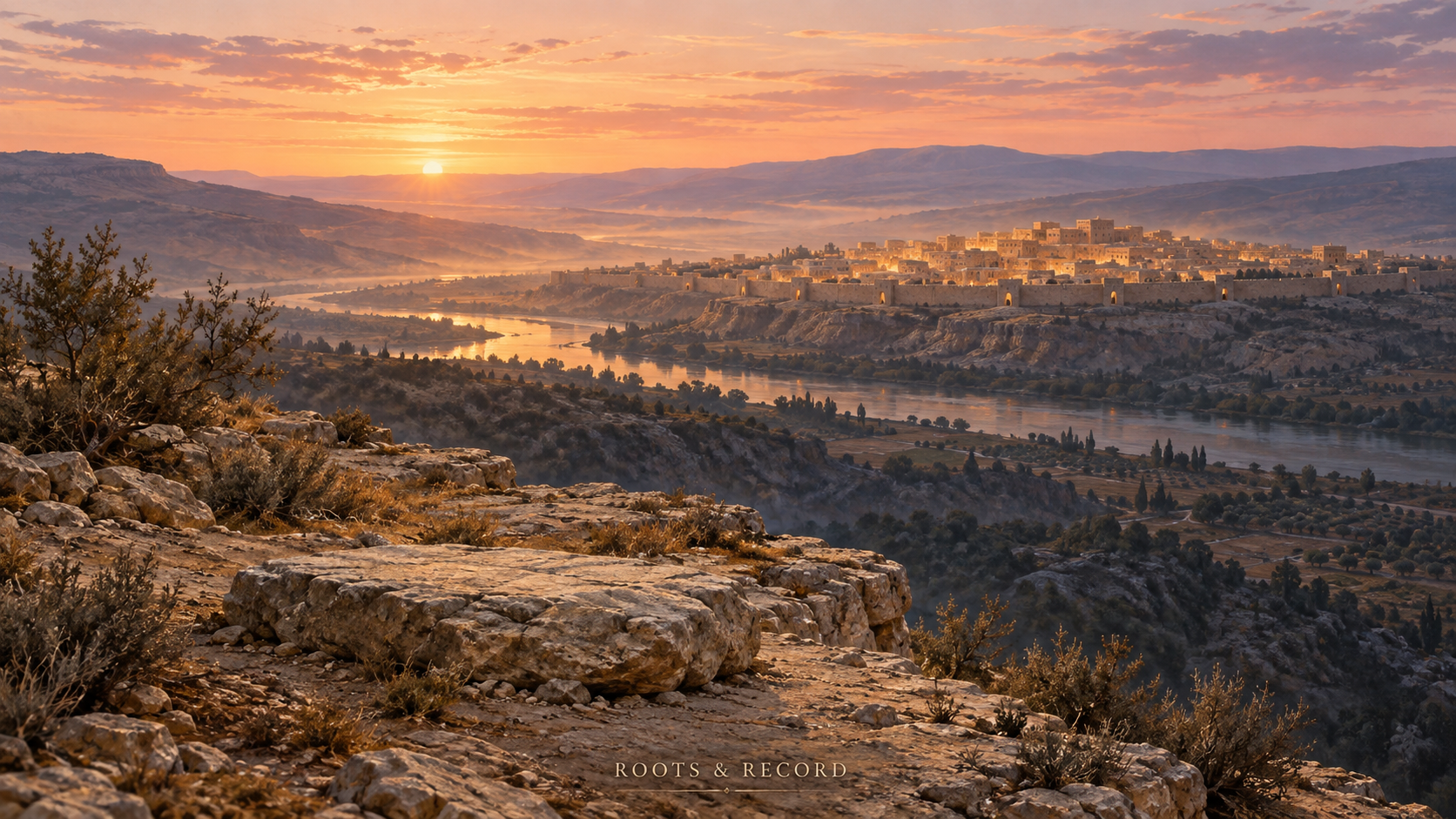
God shows Moses the whole land in a single look, from Gilead in the east to Dan in the north, across Naphtali, Ephraim, Manasseh, and Judah to the western sea, and south through the Negeb to the plain of Jericho and Zoar. God names it as the land sworn to Abraham, Isaac, and Jacob, and states the limit in the same speech: Moses has seen it with his own eyes and will not cross over. The list carries the mark of a later hand. Dan received that name after the Danites conquered the city of Laish, as Judges 18:27–29 records, and the same later name appears in Genesis 14:14, so the text describes the land from a vantage later than Moses’s own.
The Torah ends with fulfillment in sight and unfinished. Genesis 15 promised the land, Exodus began the journey toward it, and Deuteronomy stops at the edge with the promise visible to a man forbidden to enter. The crossing belongs to Joshua’s book, and the Torah leaves its own readers on the bank where Moses stands.
Verse 5 calls Moses eved of the Lord. English versions give servant, and the Hebrew word covers servant and slave alike, the same eved that describes Israel under Pharaoh in Deuteronomy 6:21. The Torah’s central movement runs on that word. Israel leaves Egypt as avadim of Pharaoh, and Leviticus 25:55 states the terms of the exchange, that the people God brought out of Egypt are God’s own avadim. Moses ends the Torah bearing the title Israel was freed to carry. The enslaved people were released from one master so that they could belong to another, and their greatest prophet dies under the name of that belonging.
The verse also says Moses died al pi the Lord, which English versions render as at the Lord’s command, the ordinary sense of an idiom the Torah uses for orders given and obeyed. Literally the phrase means by the mouth of the Lord, and it accompanies a death only twice in the Torah, here and at Numbers 33:38 for Aaron. Rabbinic tradition read the literal wording as a death by a kiss and extended it to Miriam, and a medieval philosopher understood the kiss as the soul leaving at the height of its knowledge and love of God. The Latin Bible renders the phrase as a command, and Calvin took it as the fulfillment of a sentence, the mouth of the Lord named so that Israel would see God carry out what he had threatened even against his most distinguished prophet. The same words carry a kiss in one reading and a verdict in another, and the text permits each.
God buries Moses in the valley opposite Beth-peor, and no one knows the grave to this day. The text does not explain the concealment, and its effect is plain: a grave no one can find cannot become a shrine. Calvin read it the same way, as a precaution against superstition. The people mourn for thirty days. The sons of Israel weep for Moses, where Numbers 20:29 says the whole house of Israel wept for Aaron, and rabbinic tradition explained the difference by Aaron’s reputation as a peacemaker, one who restored harmony between neighbors and between husbands and wives.
The last eight verses of the Torah narrate Moses’s death, burial, and mourning, and readers noticed early that Moses could hardly have written them. The text supplies its own evidence of a later narrator. Verse 6 says no one knows the grave to this day, and verse 10 says no prophet like Moses has arisen since, statements made from a vantage well after the events.
Rabbinic tradition held two views and kept both open. One holds that Moses wrote through verse 4 and that Joshua wrote the last eight verses. The other holds that God dictated them and Moses wrote them in tears, so that a scroll records its writer’s own death. The synagogue reflects the difficulty in a ruling that a single reader takes all eight verses without a break. Two first-century Jewish writers took up the question as well. Josephus says Moses recorded his own death so that no one could claim he had been taken up to God, a concern that matches the concealed grave of verse 6, and Philo says Moses wrote it prophetically, in advance. Calvin allowed Joshua or Eleazar the priest and judged the question of no great importance. Each view reads the same eight verses at a different level, and none forecloses the others.
Joshua son of Nun is full of the spirit of wisdom because Moses laid his hands on him, an act Numbers 27:18–23 records at God’s command. The succession is secured by transmission and stops short of equivalence. Israel obeys Joshua, but the Torah closes by declaring that no prophet has arisen since like Moses, whom the Lord knew face to face. The verb runs from God’s side: the Lord knew Moses, which places the intimacy in God’s initiative rather than in Moses’s attainment. Exodus 33:11 had already said the Lord spoke to Moses face to face as one speaks to a friend, and Exodus 33:20 had said that no one can see God’s face and live, so the intimacy the Torah ascribes to Moses is real and carries a boundary. Joshua succeeds Moses as leader without replacing Moses as Moses.
The last two verses look back rather than forward, to the signs and wonders done in Egypt before Pharaoh, and the Torah ends with Israel as the witness of what Moses did.
Revelation 17–22 · “New Jerusalem”
When & Where

Rome
What to Watch For
Revelation names the city Babylon and describes Rome. The woman on the beast sits on seven mountains, rules over the kings of the earth, and drinks the blood of the saints, marks that together identify the imperial capital under the name of the empire that destroyed the first Temple. Babylon is an archetype here, a name for imperial power that trades in luxury, idolatry, and violence.
The fall in chapter 18 is economic. Kings mourn Babylon, and so do the merchants and shipmasters whose trade depended on her, and the cargo list they recite runs from gold and spices to horses and chariots and ends with slaves. The text adds a second phrase, the lives of human beings, as though the word slaves needed help to say what was sold. The list draws on the lament over Tyre, where Javan, Tubal, and Meshech pay for Tyre’s goods with persons and bronze vessels. The indictment covers an economy that turns human beings into merchandise.
The summons in verse 4, “Come out of her, my people” (Rev 18:4), repeats the call to leave Babylon in Jeremiah 51:45, and it recalls the departure from Egypt with which the Torah ends its own account, looking back to Pharaoh in Deuteronomy 34:11.
The prostitute of chapters 17 and 18 disappears, and a bride takes her place at the marriage supper of the Lamb. Revelation sets two women against each other and, in the end, two cities: Babylon, the prostitute and the doomed city, and the New Jerusalem, the bride. The prophets had already described the covenant in marriage terms, as Hosea 2:19–20 does.
The rider who follows is called the Word of God, and his weapon is a sword that comes out of his mouth. The weapon is speech, judgment spoken. The image draws on Isaiah 11:4, where the Davidic king strikes the earth with the rod of his mouth and slays the wicked with the breath of his lips, and on Wisdom 18:15–16, where God’s all-powerful word leaps from the royal throne as a stern warrior carrying a sharp sword. Both texts give the word a body. The beast and the false prophet are captured and destroyed.
Satan is bound for a thousand years, the faithful reign with the Messiah, and Satan is released for a short time before his final defeat. The passage has produced three families of readings. Premillennial readers place the Messiah’s return before the thousand years, amillennial readers take the thousand years as a symbol for the present age, and postmillennial readers expect the kingdom to arrive within history before the return. Revelation presents the sequence in apocalyptic imagery and does not map it onto a calendar. Its final battle draws on Ezekiel 38–39, where Gog of the land of Magog gathers the nations against restored Israel, and Revelation turns Gog and Magog into names for the nations themselves. The thrones and the judgment given to the saints come from Daniel 7:9–27.
Jewish writers had their own schemes of ages. Rabbinic tradition, reading a day as a thousand years by Psalm 90:4, counted the world’s history in thousands, with one teaching that six thousand years would be followed by a seventh in which the world lies desolate and another giving the days of the Messiah two thousand. 4 Ezra, written after 70 CE, gives the messianic kingdom four hundred years and then the Messiah’s death. The thousand years of Revelation belongs to this habit of counting the age to come.
The dead stand before the throne and are judged by what they did, according to the books, and the book of life is opened alongside them. The image of open books comes from Daniel 7:10. Then Death and Hades themselves are thrown into the lake of fire. The last enemy is larger than any beast, king, or empire in the book. It is death itself, and Isaiah had said that God would swallow up death forever in Isaiah 25:8. The Torah ends with a death and a grave no one can find, and Revelation places the death of death at the end of its own account.
A new heaven and a new earth replace the first, and the holy city descends from heaven, so that the story returns to creation and to the garden. The voice from the throne gives the promise that carries the rest of the book: the skēnē of God is with humanity. English versions render the Greek word as dwelling, which hides that it is the word the Greek Bible uses for the tabernacle. Its consonants also echo shakan, the Hebrew verb of dwelling that ran through the blessings of the tribes. God’s dwelling, which those blessings placed inside one tribe at a time, now covers all peoples. Death, mourning, crying, and pain are gone. Genesis began with humanity dwelling with God before the exile from Eden, and Revelation ends with that dwelling restored on the scale of the cosmos.
The bride is a city, and the city keeps Israel’s names. The New Jerusalem has twelve gates inscribed with the names of the twelve tribes of Israel and twelve foundations bearing the names of the twelve apostles, who were Jews. Revelation says the gates carry the tribal names and gives no list. Ezekiel 48:31–34 does give one, and it gives Simeon a gate, the tribe Moses omitted from his blessing. Dan is blessed in the last chapter of Deuteronomy and has a gate in Ezekiel’s city, yet Dan is missing from the sealed tribes of Revelation 7:4–8, where Simeon appears. No two of these lists match, and Israel remains inscribed in each of them.
The city has no Temple, because God and the Lamb are its sanctuary, a vision drawn from Isaiah and Ezekiel and measured like the city of Ezekiel 40–48. A Qumran text known as the New Jerusalem, 4Q554, likewise measures a city whose gates carry tribal names.
The river of life and the tree of life return, and the tree’s leaves are for the healing of the nations, the image Ezekiel 47:12 gives to the trees on the river’s banks. The text then says there will be no more curse. The phrase draws on Zechariah 14:11, whose Hebrew word is ḥerem, devotion to destruction, a stronger word than the English curse. The exile from the tree of life in Genesis 3:22–24 is reversed. The citizens are the servants of God, and they serve him and see his face. Revelation calls Moses the servant of God when its redeemed sing his song in Revelation 15:3, so the title Moses carried to his death belongs to the whole city. Exodus 33:20 said no one could see God’s face and live, and Revelation 22:4 says they will see it.
The book ends waiting. The closing refrain is that he is coming soon, answered by a plea that he come, and the readers have seen the ending without yet living in it. A warning at the close, that nothing be added to the book and nothing taken from it, repeats the formula of Deuteronomy 4:2 and Deuteronomy 12:32, so both books end with the same seal. Moses looks across the Jordan and sees the land, and Revelation’s readers look toward a city. Each closes at a boundary with the promise visible and the crossing still ahead.