The memory of the righteous is a blessing, but the name of the wicked will rot.Proverbs 10:7
Before You Read. The Study is a companion to reading the text, and the text comes first. Read this week's passages in full, using the observations below as guides, and keep them in mind while paying attention to the surrounding context and to details that complicate them. The Study exists to help the reader notice what translation, familiarity, or inherited interpretation can obscure, while the biblical text itself remains primary.
Three questions shape every observation: what is lost in translation, why a long or seemingly plain text matters to Jewish and Christian readers alike, and what the passage asks of a person made in the image of God.
Genesis (Bereshit, "In the Beginning")
4:1–5:32
When & Where
What Translation Hides
- Two names carry the story. In Genesis 4:1–2 Cain's name, Qayin, sounds like qanah, "to acquire," and Abel's name, Hevel, means "breath" or "vapor." The brother who acquires ends with nothing, and the brother who is only breath still has a voice after he is gone. Genesis opens its first human family with a question about what gives a life weight.
- A keeper becomes a question. Cain's evasion in Genesis 4:9 asks whether he is his brother's shomer, "keeper," the root God used in Genesis 2:15 when the first man was set in the garden to keep it. English preserves the echo and rarely draws it: the man assigned to keep a garden refuses to keep a person. The next verse speaks of Abel's dmei, "bloods," and Mishnah Sanhedrin 4:5 reads the plural as every descendant Abel would have fathered. One killing closes a whole line.
- Enoch walked, and the verb keeps walking. Genesis 5:22 and 5:24 say Enoch "walked with God" in a Hebrew form, hithallekh, that describes habitual, continuing walking rather than a single journey. Genesis uses it again of Noah in Genesis 6:9. Rashi reads Enoch's early removal as God's intervention before he could decline, Second Temple Enochic writings make him a visionary of heavenly realms, and Hebrews 11:5 reads him as taken without dying. Genesis itself says how Enoch lived and leaves how he left unexplained.
- One translated verse hides a dispute. Genesis 4:26 is usually rendered as the moment people began to call on the name of God. Rashi hears in the same verb the sense of profaning, and Maimonides describes how honoring the stars as God's servants slid into worshipping them. Both readings stand in the tradition, and the second carries a warning: devotion can lose track of what it serves.
Why a List of Names Matters
- Each list selects. Genesis 5:4 says Adam had other sons and daughters, so the two lines in these chapters are chosen, one through Cain and one through Seth, and the choosing narrows toward Abraham and Israel. Names repeat across the lines: Enoch and Lamech appear in both, and Irad and Jared, Methushael and Methuselah, are close variants. Repeated names point to shared stock or shared tradition and do not identify one person.
- The two lines answer each other. In Genesis 4:17–24 Cain's line builds cities, herds, music, and bronze and iron tools, and it peaks in Lamech, who boasts of killing a man for wounding him and sets his vengeance at seventy-sevenfold. Seth's line in Genesis 5 closes nearly every entry with one refrain, vayamot, "and he died," across lifespans of centuries. One genealogy shows what humanity can build and the other shows what it cannot escape, and Enoch alone interrupts the refrain.
- For Jewish readers the list is working history. A genealogy establishes family identity, tribal belonging, priestly descent, and covenantal continuity, which is why 1 Chronicles 1:1–4 opens by reciting these names, Adam, Seth, Enosh, and carries them forward. Genesis 5 supplies the first links of a chain the Hebrew Bible keeps counting.
- For Christian readers the list is ground Jesus stands on. A Christian reader may ask why a roll of ancient names should matter at all. Luke 3:23–38 answers by running Jesus' ancestry back through Seth and Enosh to Adam, so the line in Genesis 5 is the road that Gospel walks. Paul's arguments about Adam in Romans 5:12–21 and 1 Corinthians 15:45 depend on a humanity that begins with one family and one shared name. A reader who skips these chapters loses the ground those texts stand on.
- Seth's line ends with a name instead of a boast. In Genesis 5:29 Seth's Lamech, a different man from Cain's, names his son Noaḥ, "rest," and says he will bring yenaḥamenu, "relief," from the labor of the cursed ground. English "comfort" loses the sound of the two words answering each other. Rashi finds an agricultural innovation that eased farming, and Genesis leaves open whether the hope holds.
What It Asks of a Person
- Likeness is handed on. Genesis 5:1–3 opens by recalling that God made humanity in the divine likeness and called them, male and female, adam, one shared name. Then Adam fathers Seth in his own likeness and image. The vocabulary of creation reappears at the scale of a household: parents pass on likeness, and each generation receives character alongside a face. A person made in God's image is also a person forming the next one.
- Mastery comes before the crisis. In Genesis 4:6–7 God speaks to Cain about his anger before any blood is shed and tells him that sin crouches at the door and can be mastered. The failure begins when resentment governs the response to disappointment, and the refusal to be a keeper follows from it. Formation happens in the habits that stand between a disappointment and a decision.
- The lines pose the question of what a life is organized around. Cain's line grows more capable by the generation, and Genesis does not condemn the skill. It places the boast beside the walk and lets the reader ask which one a life is built on.
Matthew 3–4; John 1:19–51
Wilderness (midbar)
When & Where
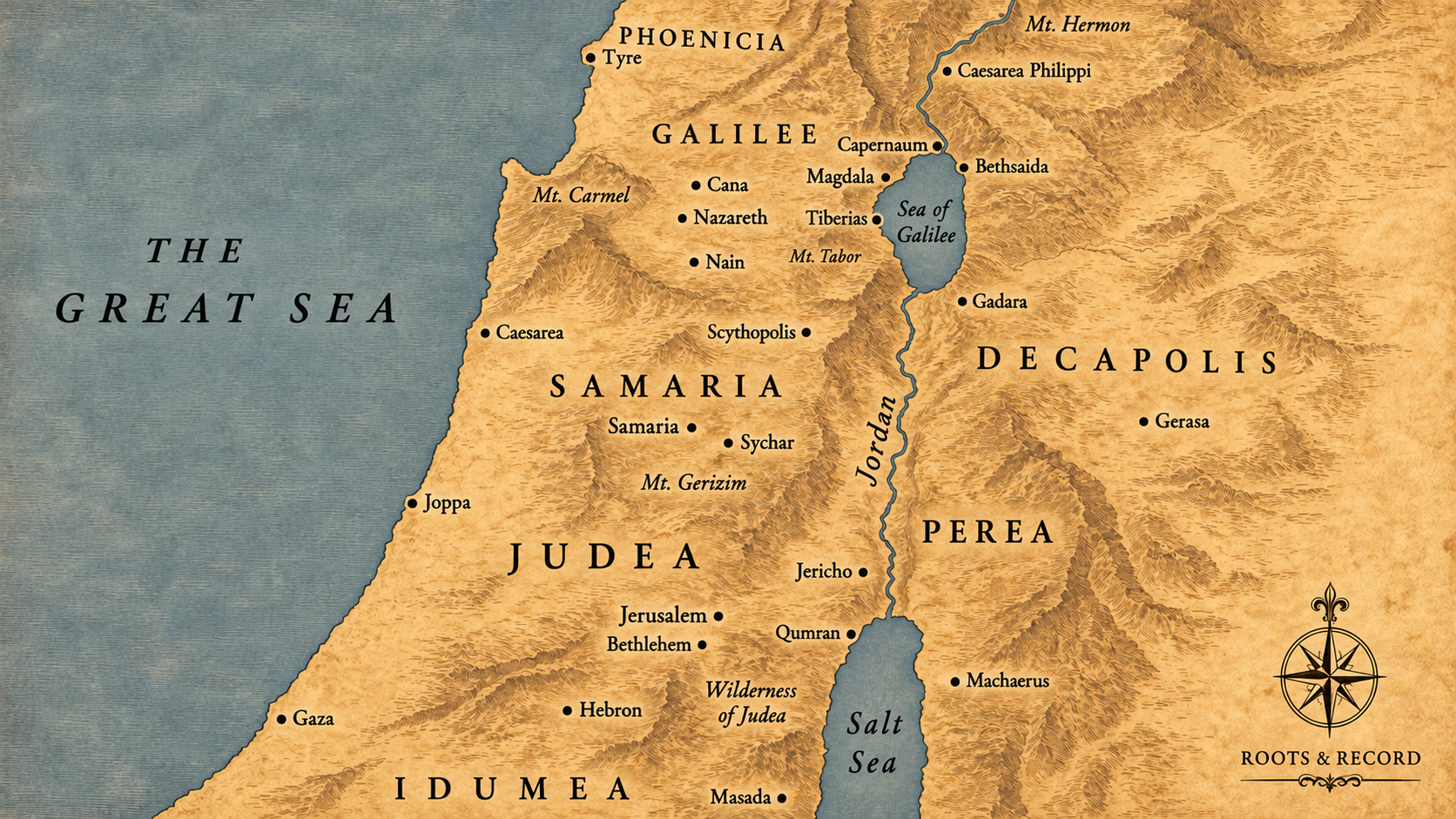
Bethany beyond the Jordan is placed on the east bank near Jericho. Its exact site is debated.
- Ancestry and fruit. In Matthew 3:1–12 John addresses people who already belong to Israel and warns them against resting on descent from Abraham. His call, metanoeite, is usually translated "repent," a Greek verb of changed mind and direction that a Jewish hearer would set beside teshuvah, "return" to God. John demands fruit that matches the return. Genesis 4–5 has already shown the limit he names: a line of descent establishes belonging, and conduct decides what the belonging is worth.
- The Jordan and the wilderness. Matthew 3:5–6 and John 1:19–28 set John's immersions at the Jordan, the river Israel crossed into the land under Joshua, and Matthew ties the scene to Isaiah's call to prepare the way in the wilderness. Ritual washing was familiar in the Jewish world of the first century, so the setting speaks of preparation and a new beginning before it speaks of anything sacramental.
- Tested with Scripture. In Matthew 4:1–11 the forty days recall Israel's forty years, and each of Jesus' three answers comes from Deuteronomy 6–8, the wilderness chapters. Cain was told to master what crouched at his door and failed. Here a person under pressure answers need, advantage, and power from Scripture instead of appetite. Formation shows in what a person reaches for when each of them offers a shortcut.
- Seen and known. In John 1:43–51 Philip answers Nathanael's doubt about Nazareth with "come and see." Jesus calls Nathanael an Israelite in whom there is no deceit, language that invites comparison with Jacob, who became Israel, and the angels ascending and descending recall Jacob's dream in Genesis 28. Prejudice, willingness to look, and integrity meet in one short scene, and the Hebrew Bible supplies the vocabulary for all three.
Three Things Worth Sitting With
1. Righteousness shows in conduct, and inheritance carries a duty.
Cain worships and then murders his brother. John tells the descendants of Abraham that descent bears no fruit of its own.
Consider: Where does religious identity stand in for the character it was meant to produce?
2. Freedom becomes real through responsibility.
Cain is told to master what crouches at his door and then refuses the role of keeper. The wilderness testing shows the same mastery held under pressure.
Consider: Which habits are deciding things before the moment of temptation arrives?
3. A life is measured by its walk and by what it leaves.
Genesis 5 repeats "and he died" and makes room for one man who walked with God and one child named for relief. The Gospel readings press the same weight on repentance and a demanding path.
Consider: What kind of person is being formed, and what will the next generation inherit from that person's choices?
Next week: Genesis 6–9, the Flood. The reading begins with ha-adam, "the human," the sons of God, the Enochic traditions, humanity's corruption, and Noah's righteousness.