
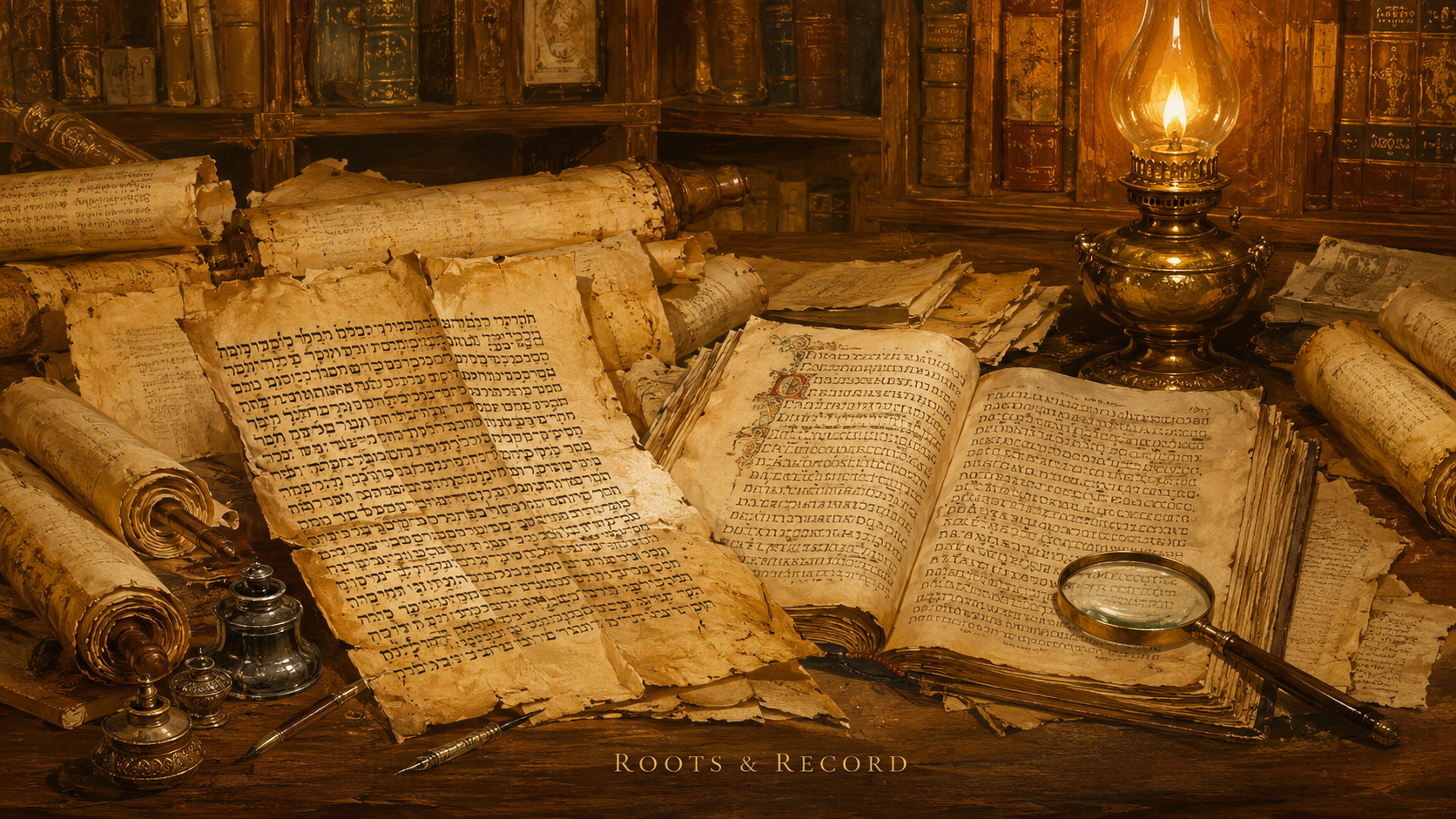
For generations now, a particular accusation has circulated through certain corners of popular apologetics, internet polemics, and conspiratorial religious discourse. The charge holds that rabbinic Judaism deliberately altered the Hebrew Bible to obscure or erase prophecies about Jesus. The claim appears in many forms, sometimes framed academically, sometimes emotionally, and sometimes with outright hostility toward Jewish tradition itself. Yet the central allegation remains essentially the same in every version; the Masoretic Text represents a corrupted Hebrew Bible, crafted to conceal what earlier readers supposedly saw plainly.
The deeper problem runs past the claim's lack of nuance. Modern manuscript discoveries have rendered it historically unsustainable.
The rise of textual criticism, the discovery of the Dead Sea Scrolls, and deeper scholarly engagement with the Septuagint have radically transformed our understanding of the textual world of Second Temple Judaism. That work reveals a complex manuscript culture, considerably more historically grounded and more genuinely interesting than any coordinated anti-Christian conspiracy; multiple Hebrew textual traditions coexisted long before Christianity and rabbinic Judaism fully emerged as separate religious identities.
This distinction matters immensely. Legitimate theological disagreement between Judaism and Christianity is real and unavoidable. The two traditions interpret key passages differently and carry distinct assumptions regarding messiah, covenant, fulfillment, and the relationship between prophecy and history. Theological disagreement and textual conspiracy belong to entirely different categories of claim. One may argue for Christian interpretations of Isaiah, the Psalms, or Daniel while leaving behind the historically indefensible claim that Jews maliciously rewrote their Scriptures to hide Jesus from future generations. Indeed, the manuscript evidence increasingly points in the opposite direction.
The Myth of a Frozen Biblical Text
Modern readers often unconsciously imagine ancient Scripture functioning like a digital document, fixed and standardized and universally identical across geography and time. The ancient world possessed no such reality. Biblical texts lived within a manuscript culture, copied by hand, transmitted through communities, and preserved through recitation, commentary, and liturgical use across generations. Variation naturally emerged across centuries of transmission, particularly before the eventual stabilization of authoritative textual traditions. That variation marks a living text, carried forward by communities rather than fixed as a single artifact from the outset.
Prior to the discovery of the Dead Sea Scrolls, many assumptions about the Hebrew Bible rested upon incomplete evidence. Scholars possessed the Masoretic Text in its medieval form, the Greek Septuagint, the Samaritan Pentateuch, the Syriac Peshitta, the Latin Vulgate, and scattered quotations from ancient Jewish and Christian writers. The oldest complete Hebrew manuscripts available to them dated only to the tenth century, more than a millennium removed from the Second Temple period they claimed to describe. A Bedouin shepherd searching for a stray goat near Qumran in 1947 changed that distance overnight, when he threw a stone into a cave and heard the sound of breaking pottery rather than the sound he expected. What came out of that cave, and dozens of others explored over the following decade, were manuscripts and fragments of nearly every book of the Hebrew Bible, some copied centuries before Jesus was born. The Dead Sea Scrolls changed the conversation permanently, collapsing a thousand-year gap in the evidence in a single discovery.
The Qumran discoveries revealed something astonishing. Manuscripts resembling the later Masoretic tradition existed centuries before Christianity emerged as a distinct religion, while other Hebrew manuscripts aligned more closely with the Hebrew Vorlage underlying portions of the Septuagint, and still others reflected mixed or independent textual traditions. Second Temple Judaism preserved textual plurality before later standardization hardened the boundaries, and this alone severely damages the conspiracy theory. If proto-Masoretic manuscripts existed before Christianity, the claim that rabbis later invented the Masoretic tradition to erase Jesus becomes extraordinarily difficult to sustain, and the evidence points instead toward several ancient Hebrew textual families coexisting within Judaism itself.
What the Septuagint Is
Much confusion surrounding this issue stems from misunderstandings about the Septuagint. The Septuagint began as a Jewish translation project, undertaken primarily for Greek-speaking Jews living in the Hellenistic world, especially Alexandria. By the centuries immediately preceding Jesus, many diaspora Jews no longer spoke Hebrew fluently, and Greek had become the lingua franca of the eastern Mediterranean. The Septuagint therefore represents Jewish translators rendering Hebrew Scripture into Greek for Jewish communities.
Popular retellings of this history often reach for the Letter of Aristeas, a Jewish text from the second century BCE describing seventy-two elders, six chosen from each of the twelve tribes, sent from Jerusalem to Alexandria at the request of Ptolemy II to render the Torah into Greek for the royal library. According to the legend, the translators worked in isolation from one another and, after seventy-two days, produced identical Greek texts, a unanimity read as proof of divine inspiration and preserved in the name Septuagint itself, from the Latin word for seventy. Even taken at face value, though, this founding story covers only the five books of Moses. It says nothing about the Prophets, the Psalms, or the rest of the Hebrew Bible, which reached Greek form gradually, translated by different individuals across the two centuries that followed. The historical Septuagint bears little resemblance to seventy scribes laboring in isolated unanimity. It bears the marks of a long and genuinely human translation project, carried out book by book and translator by translator across generations, some working with remarkable literalness that preserved Hebrew syntax almost mechanically in Greek, others translating more freely, clarifying difficult phrases, smoothing ambiguities, or rendering concepts dynamically rather than rigidly.
This historical reality matters greatly, since some modern arguments implicitly treat the Septuagint as though it were a secret Christian version of the Hebrew Bible, later suppressed by rabbinic Judaism. The translators themselves were Jews, working across generations and without any of the isolated unanimity the legend imagines.
Differences between the Masoretic Text and the Septuagint therefore sometimes indicate different Hebrew originals, and sometimes reflect only the translator's interpretive choices, since translation itself is an act of interpretation, particularly when moving between languages as structurally and conceptually different as Hebrew and Greek. Failing to recognize this distinction lies near the heart of the conspiracy theory.
The Hebrew Vorlage and the Nature of Translation
The German scholarly term Vorlage refers to the source text lying behind a translation. When scholars speak of the Hebrew Vorlage behind the Septuagint, they mean the Hebrew manuscripts the Greek translators were working from, and differences between the Septuagint and the Masoretic Text emerge from more than one source along these lines. In some cases the Greek translator possessed a genuinely different Hebrew manuscript tradition; in other cases the translator worked from essentially the same Hebrew wording later preserved in the Masoretic tradition but rendered it differently into Greek. These represent two distinct phenomena, and the conspiracy argument routinely collapses them into one. It compares Hebrew wording directly against Greek translation as though both occupied the same textual layer, and comparing Hebrew to Greek without accounting for translation dynamics produces profoundly misleading conclusions, visible nowhere more clearly than in Isaiah 7:14.
Isaiah 7:14 and the Failure of the "Virgin Conspiracy"
The Masoretic Hebrew text of Isaiah 7:14 gives the crucial word as עַלְמָה, transliterated almah, a term that denotes a young woman or maiden of marriageable age rather than the more explicit technical Hebrew term for virginity, betulah (בְּתוּלָה). The Septuagint translators rendered almah into Greek as παρθένος, parthenos, a word frequently associated with virginity though it did not always carry that modern clinical precision. Centuries of controversy grew from this divergence.
The word's other appearances across the Hebrew Bible only reinforce the ambiguity at the center of the dispute. Rebekah is called an almah at the well in Genesis 24:43, in a passage that separately confirms her virginity using betulah, the more explicit term. The infant Moses's sister, watching over his basket among the reeds, is an almah in Exodus 2:8. Proverbs 30:19 numbers the way of a man with an almah among the things too wonderful to understand. In every case, the word marks a young woman of marriageable age without asserting or denying a biological condition directly; the surrounding context, where it exists, does that work instead.
One of the most important realities often omitted from popular discussions is that the Dead Sea Scrolls confirm the same Hebrew reading, almah, with no strong textual evidence that the Hebrew Vorlage behind the Septuagint ever contained a different Hebrew word. The primary difference lies in translation and interpretation rather than in competing Hebrew manuscripts, and that distinction changes everything. The Septuagint translators were Jews, translating Hebrew into Greek centuries before Christianity emerged. Early Christians inherited this Jewish Greek translation tradition and interpreted it messianically, working from wording that Jewish scholarship had already fixed long before them.
Two questions linger beneath the polemics, though neither side often pauses long enough to ask them carefully. The first asks what assumptions ordinarily accompanied the description of a young unmarried maiden of marriageable age within the social and covenantal world of ancient Judea; modern readers often approach the debate with a clinical precision foreign to the texture of the ancient text itself. The second asks whether the central Christian claim regarding Jesus genuinely stands or falls upon narrowing Isaiah's language to a single biological condition, or whether later controversies compressed a far larger theological vision into a solitary lexical dispute. One may answer these questions differently depending on theological commitments, yet whatever conclusions one reaches, the textual evidence overwhelmingly indicates a shared Hebrew source behind both the Masoretic tradition and the Septuagint rendering of Isaiah 7:14. The dispute belongs to interpretation and translation, growing from that shared source rather than from any later rabbinic excision of messianic prophecy.
Cases Where the Septuagint Reflects a Different Hebrew Tradition
The Septuagint does sometimes preserve readings genuinely different from the Masoretic tradition, and in some books the evidence for distinct Hebrew editions is substantial.
Jeremiah provides the clearest example. The Greek version of Jeremiah is significantly shorter than the Masoretic version and arranges portions of the material differently. For many years scholars debated whether the Septuagint translator had simply abbreviated the Hebrew text. The Dead Sea Scrolls altered that discussion dramatically, since Hebrew manuscripts discovered at Qumran, notably 4QJerb, aligned more closely with the shorter Greek form, suggesting that multiple Hebrew editions of Jeremiah circulated during the Second Temple period.
Likewise, portions of Samuel preserve variants in which the Septuagint occasionally reflects shorter or smoother readings than the Masoretic tradition, with some Dead Sea Scroll evidence supporting the Greek against the Masoretic Text in particular passages.
Deuteronomy 32:8 presents another famous case. The Masoretic Text refers to the nations being divided according to the "sons of Israel," while the Septuagint and Dead Sea Scroll traditions, including 4QDeutq, preserve a reading closer to "sons of God" or divine beings. Many scholars regard the latter as the earlier reading, with the Masoretic tradition potentially reflecting later discomfort with older divine-council imagery.
These variants emerged within Judaism centuries before any rabbinic-Christian conflict over Jesus existed, which places them against the conspiracy theory rather than in its service. The manuscript evidence points toward ordinary textual development within a living religious civilization, unfolding independently of any later effort to erase Christian theology from Scripture.
The Dead Sea Scrolls and the Collapse of the Conspiracy Theory
Ironically, the discovery most damaging to the "suppressed messianism" theory came from Jewish manuscripts buried in caves near Qumran, unearthed independent of any Christian archaeological effort.
Before the Dead Sea Scrolls, one could theoretically speculate that medieval rabbis altered the Hebrew Bible in opposition to Christianity. After Qumran, such arguments became extraordinarily difficult to sustain. The eleven caves near Qumran yielded roughly nine hundred manuscripts and fragments, representing every book of the Hebrew Bible except Esther, copied across the last three centuries before Jesus and the first century after him. The scrolls demonstrated that proto-Masoretic textual traditions existed before the rise of Christianity. At the same time, they confirmed that Hebrew textual traditions resembling portions of the Septuagint Vorlage also existed during the Second Temple period, preserved by the same community, in the same caves, on the same shelves.
The result favors no simple victory for one side over another. Ancient Judaism preserved multiple textual streams before eventual standardization, and that layered picture is the more historically accurate one. Both the Masoretic Text and the Septuagint emerged from the manuscript culture of ancient Judaism itself, each grown out of that culture rather than invented from nothing or fabricated by outsiders.
This realization can deepen appreciation for the extraordinary preservation of the biblical tradition across millennia of exile, conquest, translation, and transmission, for Jewish and Christian readers alike. The biblical text survived history because communities carried it, copied it, debated it, translated it, preserved it, and treated it as sacred, generation after generation. That process left fingerprints, and fingerprints mark the hand of transmission rather than the hand of forgery.
The Weight of the Manuscript Evidence
Many supposed proofs of suppression dissolve, on closer examination, into ordinary translation dynamics between Hebrew and Greek, the natural residue of a manuscript culture rather than the fingerprints of a crime. Genuine theological disagreement between Judaism and Christianity survives this reckoning fully intact. The two traditions diverge meaningfully regarding prophecy, messiah, covenant, fulfillment, and interpretation, and those disagreements remain real, ancient, and intellectually serious, worth pursuing on their own terms rather than flattened into a simpler and uglier story about textual crime. Disagreement and conspiracy occupy entirely different moral and evidentiary categories, and confusing the two serves neither tradition's understanding of the other.
What the manuscript record settles is narrower than either side of the polemic tends to claim, and more striking for it. Every piece of evidence capable of deciding this question, one way or the other, was copied, guarded, and transmitted by Jewish hands long before any dispute over Jesus existed to motivate concealment. The scrolls that vindicate the antiquity of the Masoretic tradition were sealed into Qumran's caves by Jews. The translation that Christians would later read messianically was produced by Jews, for Jewish readers, in Alexandria. A conspiracy to erase Jesus from the Hebrew Bible would have required suppressing evidence that Jewish communities themselves generated and preserved across two millennia of exile and dispersion, an irony the popular version of this argument has never had to reckon with, because it has never had to reckon with the manuscripts at all.
Sources
Primary Texts
Genesis 24:43. Bible Gateway (KJV).
Exodus 2:8. Bible Gateway (KJV).
Proverbs 30:19. Bible Gateway (KJV).
Isaiah 7:14. Bible Gateway (KJV).
Deuteronomy 32:8. Bible Gateway (KJV).
Letter of Aristeas. Trans. Moses Hadas. Aristeas to Philocrates. New York: Harper, 1951.
Secondary Literature
Tov, Emanuel. Textual Criticism of the Hebrew Bible. 3rd ed. Minneapolis: Fortress Press, 2012.
Ulrich, Eugene. The Dead Sea Scrolls and the Origins of the Bible. Grand Rapids: Eerdmans, 2015.


