
Exodus 13:2 states the claim without preamble: Sanctify unto me all the firstborn, whatsoever openeth the womb among the children of Israel, both of man and of beast: it is mine. The command arrives in the immediate aftermath of the tenth plague, and its timing is deliberate. Egypt has just been struck at the point where it kept its future, since the firstborn, in every civilization of the ancient Near East, was continuity itself, the thread that held dynasty, property, and identity together across generations. Israel watched that thread cut in a single night. The Torah responds with a legislation of consecration rather than a victory decree. The firstborn who survived belong to God, must be presented to God, and must be redeemed. The question the Torah raises, and refuses to answer cheaply, is what it means for a life to belong to God, and what kind of civilization follows from that answer.
The Firstborn in the Ancient World
The firstborn in the ancient Near East was the continuation of the father, carrier of the household's name and gods, inheritor of its land and obligations, and the architecture by which complex societies transferred wealth, authority, and identity across generations without fracture. No civilization surrounding Israel was ambiguous about this.
In Egypt, royal ideology elevated the logic to its absolute form. Pharaoh's firstborn son was dynastic legitimacy made flesh, the future vessel of divine kingship, standing beside his father in battle and in the cult from earliest youth, already absorbing the identity that would one day make him king and god. Egypt's stability, and Egypt was nothing if not obsessed with ma'at, the eternal recurrence of cosmic order, depended on an unbroken firstborn chain extending backward to the gods and forward without end.
Mesopotamia organized the same principle through law. The Code of Hammurabi, whose inheritance laws, read in full, presuppose the firstborn's privileged share as the baseline from which all other distributions are calculated, reflects a society in which that status was legally protected and transferable only under exceptional circumstances. The Nuzi tablets, a cache of fifteenth-century BCE legal documents from northern Mesopotamia analyzed in E.A. Speiser's study of family law in the region, show the same arrangement at the household level. The social order was inseparable from this hierarchy of birth, and the eldest son served as the guarantee that what had been built would endure.
Among the Canaanites and Phoenicians, the logic reached its darkest expression. Child sacrifice, reflected in the biblical condemnations of Molech worship, drew on a theology in which the firstborn was the ultimate offering, the most precious thing a man possessed, returned to the deity who had given fertility and harvest. The fullest archaeological record comes from the tophet burial grounds at Carthage, though that evidence dates to the eighth century BCE and later, several centuries after the Exodus, and scholars read it as continuity with earlier Phoenician practice rooted in Tyre and Sidon rather than as direct evidence from the period itself. Closer to the Exodus era, the Greek historian Diodorus Siculus described the Carthaginians' child sacrifices to Baal Hammon as an inherited ancestral rite rather than an innovation, and the early twentieth-century excavations at Gezer, a Canaanite site in the land later settled by Israel, uncovered infant burials beneath standing stones that the excavator identified with a Canaanite high place. The evidence remains debated in its particulars, and the Gezer findings in particular reflect the limitations of early twentieth-century excavation methods, but the convergence of biblical condemnation, classical testimony, and archaeological remains points toward a practice in which the firstborn was the irreplaceable sacrificial object, the gift most pleasing precisely because it cost the most.
Rome formalized the same underlying logic through law rather than cult. Patria potestas gave the Roman father near-absolute authority over his children, and the firstborn son carried the family name, its religious obligations, and eventually its property into the next generation. The Roman census was, at its root, an accounting of male heirs, the firstborn chains that constituted the republic's citizen body, and to sever those chains was to threaten the body politic itself, not merely a family.
The world into which the Torah speaks has already settled the question: the firstborn belongs, in every civilization surrounding Israel, to the structures of human power, to continuity, dynasty, and the preservation of what the father built. The Torah enters that world and transforms it from within.
Consecration and Redemption
The verb in Exodus 13:2, kadesh, to sanctify, to set apart, is the same root that governs the holiness of the Sabbath, the holiness of the sanctuary, and the holiness of the priests. As Nahum Sarna observes in his commentary on Exodus, the term relocates the firstborn from the category of things that belong to their owners into the category of things that belong to God. The consecration is ontological, a change in the firstborn's fundamental orientation rather than a legal transfer of title.
Exodus 13:13 presses the logic further. Every firstborn donkey is redeemed with a lamb, its neck broken if not redeemed, and every firstborn son is redeemed, making clear that the claim is a permanent reorientation rather than a permanent confiscation. What God takes, God gives back, though it comes back differently than it was received.
That mechanism of return receives its fullest institutional treatment in Numbers 3, where God consecrates Israel's firstborn on the night of the plague and then replaces them with the Levites, the entire tribe taken as a substitute for Israel's firstborn males. Jacob Milgrom's commentary on Numbers walks through the census in Numbers 3:39–51 as a careful accounting, 22,000 Levites set against 22,273 firstborn Israelites, with a redemption price of five shekels per excess firstborn. God claimed the firstborn and substituted for them a tribe consecrated to sanctuary service, a vocation of covenant obligation rather than dynastic inheritance. What had been claimed as God's was returned to Israel transformed, bearing a different kind of obligation than the one it carried before.
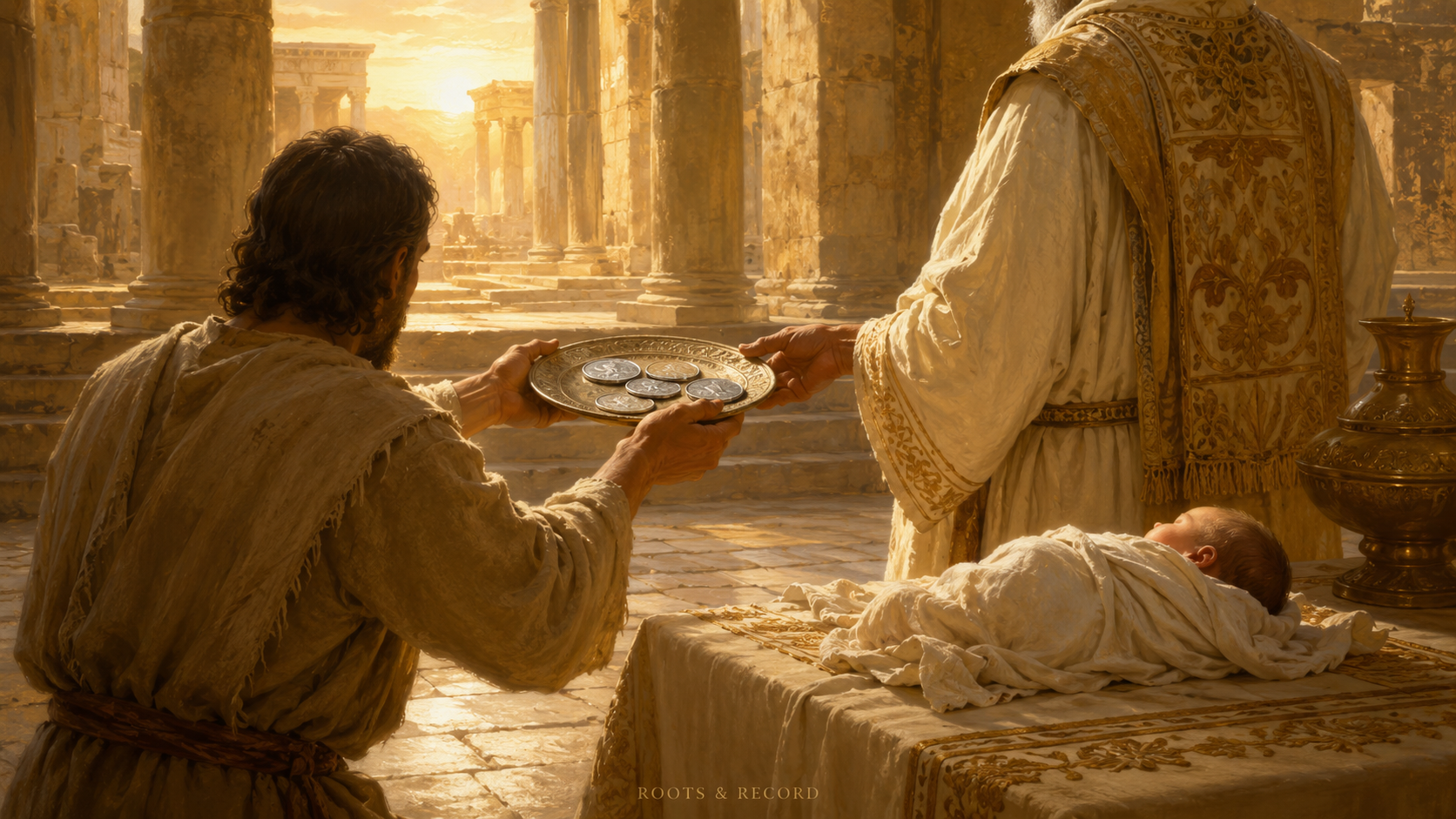
The later practice of Pidyon Haben, the redemption of the firstborn son on the thirty-first day after birth, carries this theology forward into the living fabric of Jewish practice. The father presents his son to a kohen, a descendant of Aaron, and the kohen asks which he prefers, his son or the five silver coins. The father chooses his son and pays the redemption price, acknowledging through the exchange a prior claim that the five coins recognize but cannot extinguish. The son returns to the family as a gift received, and the five coins declare that the giving preceded the receiving.
Throughout the Torah, the first of anything offered to God functions as the representative through which the whole is acknowledged as His, appearing as the firstfruits of the harvest in Exodus 23:19, the first of the flock in Exodus 34:19, and the first yield of the threshing floor in Numbers 18:12. Leviticus 27:26 makes the principle explicit. The firstborn of animals already belongs to God and therefore cannot be dedicated as an offering, since dedication presupposes a transfer of ownership that has already occurred. The farmer who brings firstfruits to the sanctuary declares the entire harvest to be under God's prior claim, with the first portion serving as the visible acknowledgment of what is true of all the rest. The firstborn son operates by the same logic. His consecration declares, through him, what is true of every child, that human custody of a life is a stewardship received from a prior owner rather than a possession acquired by biological right.
The Temple Scroll (11QT) affirms that this reading was operative well before the rabbinic period, harmonizing the firstborn and firstfruits legislation under the unified category of reshit and treating them as a single theological argument. All firsts belong to God as acknowledgment that all things belong to God, and the consecration of the first is the covenantal act through which Israel declares its entire life to be held in trust rather than in fee. The community at Qumran, living by a rigorous reading of this covenantal logic, understood themselves as segullah, God's treasured possession, the designation Exodus 19:5 gives to Israel as a whole, with the firstborn legislation serving as the enacted sign of what that possession meant.
Egypt's firstborn died because Egypt had made the firstborn the vessel of its own perpetuation, the carrier of Pharaoh's divinity and the guarantee of the imperial order's immortality. Israel's firstborn are consecrated and redeemed precisely because that function belongs to God rather than to the structures of human power. The child returned to the family through Pidyon Haben arrives back marked, a life whose prior claim has been publicly acknowledged and whose custody is therefore a stewardship undertaken before witnesses. That distinction, stewardship rather than ownership, custody received rather than possession claimed, is the hinge on which the Torah's entire treatment of the firstborn turns.
The Unlikely Firstborn
Scripture deploys the firstborn motif with a persistence that reveals it as a theological argument rather than a cultic regulation, and the argument consistently runs against the grain of natural hierarchy.
God names Israel His firstborn son in Exodus 4:22 before the plagues begin, the declaration arriving as their precondition rather than their reward: Israel is my son, even my firstborn... Let my son go, that he may serve me (Exodus 4:22–23). The claim positions Israel as inheritor of covenantal obligations and covenantal intimacy, the relationship of a father to his firstborn. Israel inherits this as a nation of slaves with no land, no dynasty, and no inheritance. The most precious designation in the ancient world fell on the most structurally powerless people in it.
Jacob, the second-born, receives the blessing and the covenant over Esau. Joseph, the eleventh of Jacob's sons, becomes the agent of salvation for the entire family. In Genesis 48, Jacob crosses his hands deliberately over Joseph's two sons, placing his right hand on Ephraim the younger and his left on Manasseh the elder. When Joseph tries to correct him, the old man refuses: I know it, my son, I know it: he also shall become a people, and he also shall be great: but truly his younger brother shall be greater than he (Genesis 48:19). In 1 Samuel 16, God sends Samuel to Jesse's household to anoint a king, and Samuel moves through the elder sons one by one, each with a firstborn's bearing, before the Lord stops him: Look not on his countenance, or on the height of his stature... for the Lord seeth not as man seeth (1 Samuel 16:7). The youngest, out keeping the sheep, is David. God bestows the firstborn's claim where God chooses, and God's choices consistently confound the human logic of natural succession.
Jeremiah gives the motif its most direct statement. In the great oracle of return from exile, God speaks of Ephraim: For I am a father to Israel, and Ephraim is my firstborn (Jeremiah 31:9). Ephraim, the younger of Joseph's sons, the tribe that lent its name to the northern kingdom, the people lately carried into Assyrian exile, is God's firstborn through diminishment rather than despite it, standing in covenant relation at the precise moment when human measures of firstborn status have been stripped away entirely.
The Torah's engagement with the ancient world's mechanism of firstborn continuity amounts to a sustained counter-claim. The firstborn belongs to God, the future belongs to God, and no human dynasty, no imperial order, no structure of accumulated power can claim the firstborn as the guarantee of its own perpetuation. The most ancient argument for why rulers rule, that their line is blessed, continuous, and divinely sanctioned, is undercut at its root.
Obligation, Not Privilege
Tractate Bekhorot, in its treatment of the firstborn son's redemption, traces the obligations of firstborn status with characteristic legal care, and the thread running through the legal surface is consistent. The firstborn obligation is a mark laid on the consecrated, with accountability flowing from prior consecration rather than from capability or rank. Shemot Rabbah develops Israel's firstborn status explicitly in terms of stewardship. Israel's prior claim on God's covenantal attention is a responsibility of service rather than a privilege of position, and the firstborn, set apart first, is accountable first.
Tractate Bikkurim, in its account of the firstfruits procession and declaration, carries the argument further. The farmer's declaration in Deuteronomy 26, A Syrian ready to perish was my father (Deuteronomy 26:5), becomes, in rabbinic elaboration, a full recitation of Israel's covenantal history, the descent into Egypt, the suffering, the deliverance, the entry into the land. The firstfruits ceremony is a re-enactment of the Exodus itself. The offering of the first produce declares the entire harvest to be held under the same covenantal claim that brought Israel out of Egypt, and the Pidyon Haben ceremony, read through this lens, becomes the moment in which each family re-enacts the Exodus in miniature, acknowledging that the child they are receiving back was never theirs to begin with.
The Firstborn and the Gospels
Luke 2:22–24 carries more theological weight than its brevity suggests. Mary and Joseph bring the infant Jesus to the Temple to fulfill the requirements of Leviticus 12 and Exodus 13, offering the sacrifice prescribed for the poor, two turtledoves or two young pigeons, the entirely ordinary thing Jewish parents did with their firstborn sons. The reader who knows the Exodus theology recognizes the moment. This child is being presented as belonging to God and redeemed back into his family's care.
Luke has constructed the infancy narrative entirely within the symbolic world of Temple, priestly lineage, and covenant. Gabriel appears to Zechariah at the altar of incense; Elizabeth is of the daughters of Aaron; the Magnificat is a cento of Hannah's song and the psalms; Simeon and Anna are faithful Israel at the sanctuary, waiting. Into this setting Luke places the Pidyon Haben moment, and the ceremony breaks open under the weight of what Simeon announces while holding the child, a consecration that looks outward, beyond tribe and nation, toward a light to lighten the Gentiles, and the glory of thy people Israel (Luke 2:32). The firstborn consecrated at birth is now consecrated for something the ceremony itself cannot contain.
Paul develops the theology explicitly. In Colossians 1:15, Jesus is named prototokos pases ktiseos, firstborn of every creature. In Romans 8:29, prototokos en pollois adelphois, firstborn among many brethren, the eldest of a family God is bringing to glory. The letter to the Hebrews presses the cultic logic directly. He entered the sanctuary with his own blood rather than the blood of bulls and goats, securing an eternal redemption rather than a yearly one (Hebrews 9:12). The Exodus pattern runs through all of it. Consecration comes first, then a redemption that transforms the consecrated one into something that cannot simply be returned to what it was.
The Christian reading extends the Jewish theology of the firstborn. It takes what the Torah established, a structure of covenant obligation in which the firstborn belongs to God, is redeemed from God, and remains marked by that consecration for life, and reads it as a pattern reaching its culminating instance in one particular firstborn, with the logic identical and the scale different.
The divergence is genuine and deserves direct acknowledgment. Jewish readers of the firstborn legislation read the Pidyon Haben ceremony as complete in itself, a renewal of covenant inheritance, a living re-enactment of the Exodus claim that each child is held in trust rather than in ownership, and the ceremony carries its full weight without any Christological extension. The Christian reading claims that the pattern the Torah established reaches a further instance in a specific event, with the same logic of consecration, redemption, and transformed belonging appearing again at larger scale. Both readings remain accountable to the same textual inheritance, and neither renders the other incoherent.
Who Owns the Next Generation
Every civilization must decide what children are for. The answers have ranged from the nakedly utilitarian, children as labor, heirs, soldiers, dynastic instruments, to the sentimentally possessive, in which children become extensions of the parents' own identity, shaped in their image and for their purposes. Both answers, by different roads, produce the same error. Children become objects of human projects rather than subjects of their own covenantal standing.
The Torah's answer is structurally different. The firstborn belongs to God before he belongs to his father, and he arrives in his family's care already marked, a life returned under conditions the family did not set and cannot alter, received as a gift rather than acquired as a possession. At the Pidyon Haben ceremony, the father acknowledges a prior ownership that the ceremony makes visible but does not create.
Hannah grasps this with a clarity the narrative makes no effort to soften. In 1 Samuel 1, she prays for a son with such desperation that Eli the priest mistakes her for a drunk woman. She conceives, gives birth to Samuel, and then, when the child is weaned, young enough that he would not yet remember being given away, she brings him to the Temple and leaves him there. Her explanation comes in a single sentence: I have lent him to the Lord; as long as he liveth he shall be lent unto the Lord (1 Samuel 1:28). The Hebrew word sha'ul, lent, is a form of the same root as the child's name, for she named him Lent-to-God before she gave him away, knowing from the moment of his conception that he was never fully hers. The five shekels of Pidyon Haben are implicit in the story even where they are not explicit. Hannah skips the redemption and offers back what was always God's, a person whose life arrives already addressed to something larger than the family receiving it, held in trust by parents who received rather than acquired him.
The modern state has replicated, with considerable sophistication, the Egyptian logic the Torah confronted. States claim children through mandatory education, through conscription, through the legal apparatus that determines what parents may teach, believe, or practice in their children's presence. The family's authority over the child is real but derivative, in the modern liberal framework, from the state's prior claim to form citizens. In a more recent ideological configuration, the child belongs to his own self-determined identity, to be constructed free of any prior claim from family, tradition, or covenant. As Jon Levenson traces in his study of the beloved son's death and transformation across Jewish and Christian thought, the Torah's counter-claim locates the prior claim in God rather than in any human institution, family, state, dynasty, or cult, making every human custody of a child a stewardship that implies accountability to the one who actually owns, rather than an ownership that implies authority answerable only to itself.
The God who claims the firstborn also redeems him, giving him back into the ordinary texture of human life marked but not consumed. This forecloses any theocratic reading that would treat consecration as permanent confiscation, just as the parents' receiving the child from God forecloses any claim to unlimited parental authority, and the child's arriving in every human institution already claimed forecloses the state's formative ambitions at their root. The Exodus did not happen so that Israel could become a new Egypt, a nation producing its own imperialism, its own dynastic logic, its own treatment of the next generation as raw material for national projects. The firstborn legislation stands, in part, as a structural guard against precisely that drift. Every firstborn son in Israel was a living reminder of the night Egypt lost its heirs, a reminder meant to produce accountability rather than pride.
Empire, the Torah suggests, is what happens when the firstborn stops belonging to God and starts belonging to the structures of human power. The tenth plague stands as diagnosis as much as judgment. This is what becomes of a civilization that has made the future into its own possession.
The question is never finally closed. The Torah establishes a counter-logic, consecration, redemption, transformed belonging, and commends it as a way of living with the question of ownership rather than dissolving it. The temptation to make the firstborn serve human ends is left in place precisely because the ceremony that guards against it must be chosen, not legislated into inevitability. Pidyon Haben is still performed in Jewish households today. The ceremony is brief and festive, a father's acknowledgment that his son arrived already addressed to a prior claim, the five coins declaring that the child was received rather than produced. The logic it enacts, that human custody of a life is a stewardship held in trust, that children arrive already belonging to something larger than the family receiving them, remains one of the more consequential ideas the ancient world produced. It arrived first in a plague, passed through a priestly census, was carried in a small silver coin, and is still being contested, implicitly and inter alia, every time a civilization tries to decide what the next generation is for.
Sources
Primary Texts
Scripture quotations follow the King James Version (KJV). Greek terms from the Gospels and Epistles are transliterated and glossed against the KJV rendering.
Diodorus Siculus, Bibliotheca Historica, Book 20.
Mishnah, tractates Bekhorot and Bikkurim.
Temple Scroll (11QT). Dead Sea Scrolls.
Secondary Literature
Levenson, Jon D. The Death and Resurrection of the Beloved Son: The Transformation of Child Sacrifice in Judaism and Christianity. Yale University Press, 1993.
Milgrom, Jacob. Numbers. JPS Torah Commentary. Jewish Publication Society, 1990.
Sarna, Nahum M. Exodus. JPS Torah Commentary. Jewish Publication Society, 1991.
Speiser, E. A. "New Kirkuk Documents Relating to Family Laws." Annual of the American Schools of Oriental Research 10 (1930): 1–73.


