
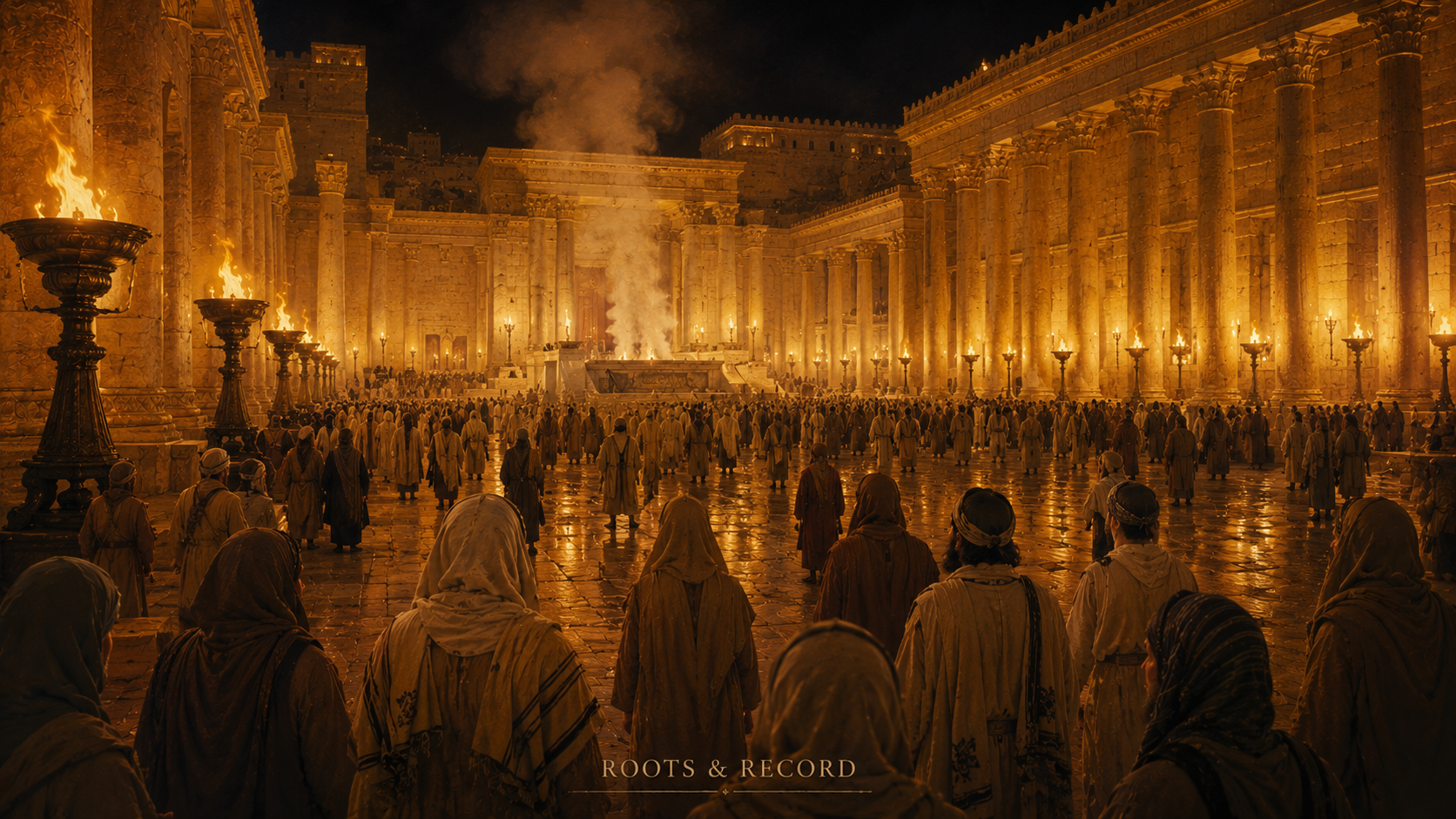
Modern readers of the Gospels and Epistles approach them as though they unfold in a religious vacuum, the stories familiar, the doctrines well-worn, the liturgical world in which the apostles lived largely forgotten. The Jewish sacred calendar, which structures the Gospels and Epistles at every level, passes almost unnoticed as a result. The life of Jesus, the ministry of the apostles, and the rhythms of historic Christian worship are built upon the feasts of Israel rather than merely adjacent to them, and reading the Gospel narratives without the Jewish calendar in hand is to read a drama while ignoring the architecture of the theater in which it unfolds.
Jesus was a Jew whose disciples were Jews, and the earliest church was overwhelmingly Jewish in its composition and its self-understanding. The apostles understood themselves to be proclaiming the fulfillment of Israel's covenantal hopes in the person of her Messiah, heirs of Israel's story rather than founders of a religion severed from it. The feasts that follow appear across the Gospels and Epistles as active theological structure, doing work that cannot be recovered once they are forgotten.
Passover and Holy Week
The Passion narratives are set during Pesach, the feast commemorating Israel's deliverance from Egypt, and the placement is deliberate at every level. As lambs were slain in remembrance of Israel's redemption, Jesus is presented as the true Passover Lamb whose blood delivers from a greater bondage; as Israel ate the covenant meal before her liberation, he institutes the Eucharist in the midst of the Passover meal itself, in language saturated with covenant renewal overtones that would have rung loudly in Jewish ears. The meal is a transformation of something very old, Jesus deliberately placing his death within the framework of sacrificial deliverance and sacred remembrance that Israel had enacted for centuries before him.
Eastern Christians to this day call Easter "Pascha," preserving the Greek and Latin form of the Hebrew Pesach, and Eucharistic theology in both Eastern and Western tradition continues to preserve the covenant meal from which it sprang. Christianity proclaimed Jesus as Passover's culmination, not its replacement, and the liturgical inheritance of that claim has never been difficult to trace.
The Omer and the Paschal Season
In Jewish tradition, Israel counts forty-nine days from Passover until Shavuot, moving from deliverance toward revelation, from Egypt toward Sinai, freedom coming first and revelation following because deliverance is ordered toward covenant. The Gospels trace a structurally identical rhythm. After his resurrection, Jesus remains with his disciples for forty days before ascending into heaven; ten days of waiting follow before Pentecost, together forming the fifty-day Paschal season still observed in Catholic and Orthodox liturgical tradition. Just as Israel journeyed from the waters of deliverance toward the mountain of divine revelation, the church journeys from Resurrection toward the descent of the Spirit, the shape of sacred time itself preserved and clothed in new garments while resting on the same calendar bones.
Shavuot and Pentecost
"Pentecost" is simply the Greek word for "fiftieth," referring to the Jewish Feast of Weeks, Shavuot, and the miracle of Acts 2 occurs on one of the holiest days of the Jewish year. By the first century, Shavuot had become associated with the giving of Torah at Sinai as much as with the harvest: fire descends from heaven, the people gather, and God reveals himself amid divine manifestation. In Acts 2 the Spirit descends amid fire upon the church in Jerusalem, with the law now written not on tablets of stone but upon human hearts. As Israel once received divine instruction to form her as a covenant people, the church receives divine empowerment to carry covenant truth into the nations. Pentecost is a new Sinai, and the feast makes that identification unavoidable for any reader who arrives at Acts 2 with the Jewish calendar in hand.
Purim and the Unnamed Feast
John 5:1 mentions "a feast of the Jews" without naming it, an unusual omission for a Gospel otherwise careful to identify its liturgical occasions. Scholars have debated the identification for centuries, with Passover, Pentecost, and Purim as the leading candidates, and chronology alone makes a strong opening case for Purim: falling in Adar, it follows the Cana wedding of John 2 and precedes the Passover of John 6, the only candidate that does not disrupt the Gospel's timeline.
Chronology, though, is only where the argument begins. Purim commemorates the deliverance of Israel through Esther, the single book of the Hebrew Bible in which God's name does not appear anywhere in the text. His hand works entirely through hidden providence: events unfold, reversals accumulate, and the rescue arrives through what looks, on the surface, like nothing more than a sequence of fortunate coincidences. Divine presence made known through concealment is the book's governing theological logic, and it is against that backdrop that John's account at Bethesda takes on its full weight.
Jesus heals a man on the Sabbath, then withdraws before the crowd can identify him (John 5:13). The miracle precedes recognition; the healer is gone before the healed man knows who healed him. Sharp controversy over Sabbath observance follows, the very kind of legal reversal that structures the Purim story throughout. If John intended Purim, he may have left the feast unnamed for the same reason the book of Esther obscures the divine name: presence everywhere, announced nowhere. The omission would then be the interpretation, not a gap in it.
Scholars who pass over Purim in favor of Passover or Pentecost tend to do so on grounds of theological prominence rather than narrative logic, and John's Gospel operates by its own narrative logic with considerable consistency. The convergence of chronological fit, thematic coherence, and deliberate literary silence deserves more weight than the commentaries have generally given it.
Tabernacles and the Incarnation
Some of Jesus' most theologically charged declarations in John's Gospel occur during the Feast of Tabernacles, Sukkot, the feast commemorating Israel's wilderness wandering and the divine presence dwelling in their midst. During the festival, elaborate water rituals and lamp-lighting ceremonies filled the Temple courts, as Alfred Edersheim documents in his study of Temple services, and it is against this backdrop that Jesus stands and cries out: "If any man thirst, let him come unto me, and drink" (John 7:37), and soon after, "I am the light of the world" (John 8:12). Both declarations are spoken into a liturgical celebration saturated with water and light imagery, each claiming, in the feast's own language, to be what the feast points toward.
John writes that "the Word was made flesh, and dwelt among us" (John 1:14), more literally tabernacled among us, and the feast that commemorated divine presence in tents now points toward divine presence in flesh. Even Peter's instinct at the Transfiguration to build booths becomes intelligible here: his mind was steeped in the symbols of Israel, reaching instinctively for the feast's own form when confronted with glory.
Hanukkah and Dedication
John 10:22 places Jesus in Jerusalem at "the feast of the dedication," Hanukkah, the festival commemorating the purification and rededication of the Temple after its desecration by pagan powers. During a feast celebrating the restoration of sacred space to God, Jesus enters that very Temple and makes his boldest claims regarding his identity and unity with the Father. The Temple had been cleansed of pagan corruption and reconsecrated for holy use; standing in its courts is one who identifies himself as greater than the Temple itself. John turns the feast of dedication into a stage for Christological revelation, the irony exact: the question of what truly constitutes the dwelling of God is answered in the one the feast cannot contain.
Israel's Calendar, the Church's Inheritance
Strip the Jewish feasts from the Gospels and much of the symbolism collapses; forget them and many of Jesus' words lose their force, spoken as they are into a liturgical context they presuppose and transform. Catholic and Orthodox Christianity understood this well enough to preserve the liturgical calendar's skeleton, the feast days held in place even as the living Jewish world that gave them meaning receded from view. Easter retained the timing of Pesach while the interpretive world of the Seder fell away; Pentecost preserved the date of Shavuot while the Sinai covenant that made it legible grew distant from Christian awareness. What remained was the structure of Israel's sacred calendar, largely emptied of the Jewish substance that had made it theologically coherent.
The church emerged from Jerusalem, shaped by a calendar older than itself, and recovering what that calendar meant is not a revision of Christian faith but a deepening of it. The feasts were never preparatory scaffolding to be dismantled once the building stood complete; they were the living framework within which the Gospel events unfolded and through which their authors expected them to be read. That framework is still there, waiting to be inhabited again.
Sources
Primary Texts
The Holy Bible, King James Version. Bible Gateway.
Secondary Literature
Edersheim, Alfred. The Temple: Its Ministry and Services. Hodder and Stoughton, 1874.


