
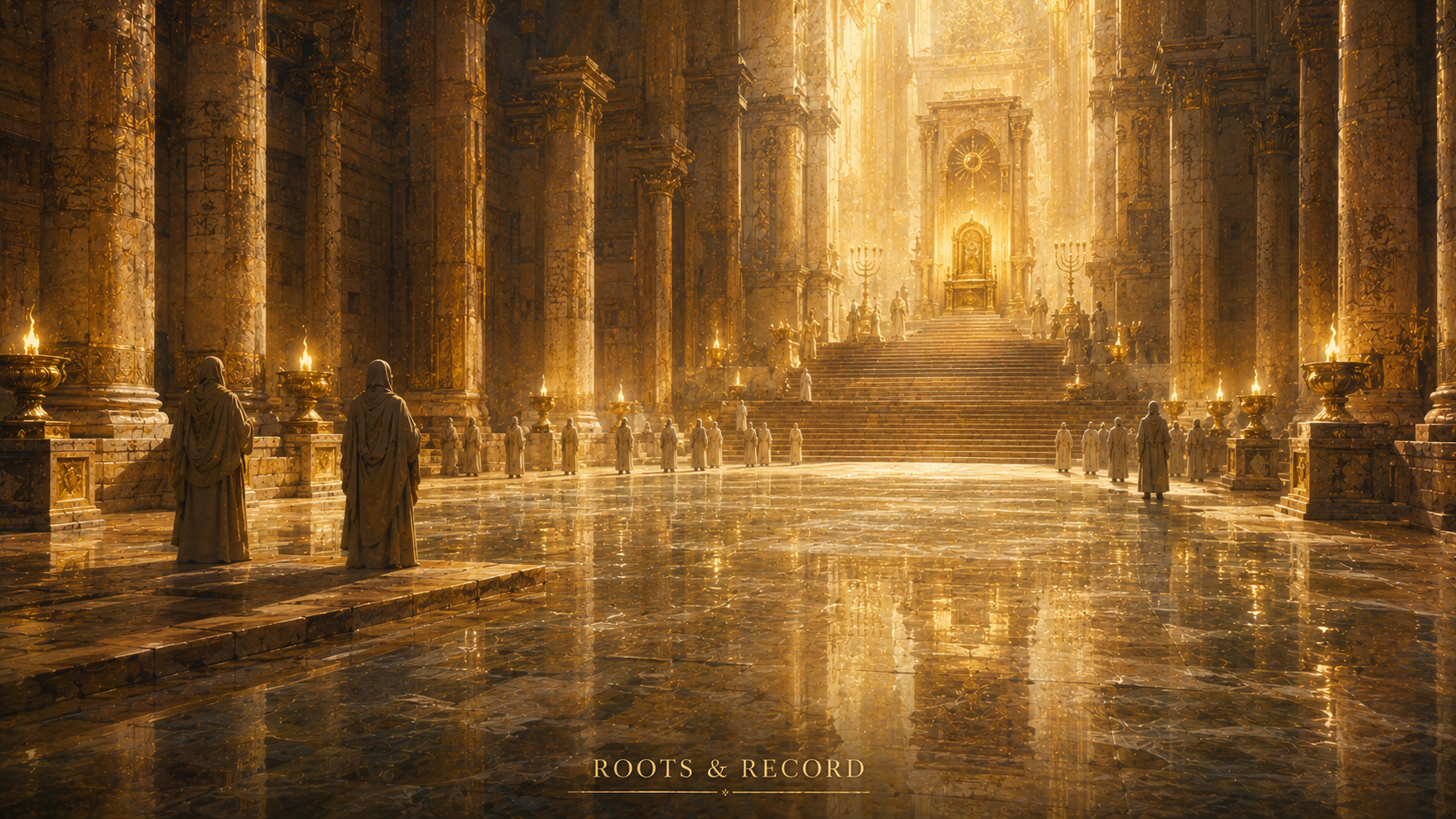
Revelation is among the most thoroughly Jewish books in the Christian corpus, and arguably the most symbolically Hebraic, a fact so obvious it is routinely passed over. Readers have grown so accustomed to imagining the Gospels and Epistles as standing over against Judaism, rather than arising from within it, that they pass over what stands plainly before them: a book saturated in Jewish thought, Jewish symbols, Jewish patterns of worship, kingship, judgment, holiness, and redemption, animated by the Hebrew Scriptures from the inside out.
Three readings of Revelation dominate the tradition. One treats it as a catalogue of future calamities, a sacred almanac by which the modern world may be measured and the end of history charted. Another treats it as a political tract clothed in mystical language, written to comfort communities suffering beneath Roman power. A third finds something grander: a cosmic unveiling, a disclosure not of what shall happen but of what is always true beneath the surface of history. All three contain something real. None of them begins where the book itself begins, in the prophetic imagination of Israel.
Once that imagination is recovered, a question follows naturally. If Revelation is so deeply rooted in Torah and the Prophets, its purpose may extend beyond the condemnation of pagan empire. It may also constitute a warning, addressed to any faith that would forget the soil from which it sprang.
The Book John Wrote
John's apocalypse belongs to the long tradition of Jewish prophetic vision. Its nearest kindred are Daniel, Ezekiel, Zechariah, and Isaiah, and John writes as those prophets wrote. He sees beasts rise from the sea as Daniel saw them. He beholds heavenly thrones as Ezekiel and Isaiah beheld them. He is carried into the courts of heaven, instructed by angels, shown mysteries beneath symbols, made witness to the hidden architecture of history. The entire atmosphere is Jewish: one cannot read more than a few pages without encountering Temple, altar, incense, priesthood, sacrifice, covenant, and kingship. John's imagination is so thoroughly formed by the Hebrew Scriptures that even where he does not quote them directly, he seems scarcely capable of thinking apart from them.
A methodological distinction matters here. The rabbinic literature presents a chronological challenge, since the Talmud reached its final written form centuries after the apostolic age, and claims of direct influence require care. Yet rabbinic Judaism preserves traditions far older than their written form, and structural parallels remain illuminating even where direct literary dependence cannot be established. The Dead Sea Scrolls present no such difficulty: composed between the second century BCE and the first century CE, they are contemporaneous with the world John inhabited and provide the clearest window into the symbolic vocabulary his readers would have carried.
The War Scroll (1QM) and the Community Rule (1QS) depict a cosmic conflict between the Prince of Light and Belial, the Angel of Darkness, who functions as an accuser and adversary of the covenant community before God, prosecutorial and relentless, operating within a heavenly juridical framework. When John writes of "the Accuser of our brethren… which accused them before our God day and night" (Rev 12:10), he is drawing on a category already well-established in the symbolic world of Second Temple Judaism, one his readers would have recognized immediately. The same adversarial logic runs through Job and Zechariah's vision of the accusing angel; the Qumran community codified what was already a living theological vocabulary.
Fragments from Qumran, notably 4Q174 (the Florilegium) and 4Q246 (the Aramaic Apocalypse), anticipate a period of eschatological tribulation preceding messianic restoration, a structure that maps closely onto Revelation's own sequence of cosmic distress giving way to the vindication of the righteous. The Talmud's discussion of the chevlei mashiach, the birth pangs of the Messiah, in Sanhedrin 98b, preserves the same pattern from a later vantage. John, the Qumran community, and the later rabbis are drawing from a shared well: the prophetic imagination of Israel, alive and active in the first century, speaking a language Revelation has never stopped speaking.
Ezekiel's Architecture in the Visions of John
Of all the Hebrew prophets, Ezekiel's imprint on Revelation is the most architecturally precise. The book of Ezekiel opens with a theophany: four living creatures, each with four faces, moving beneath a crystalline expanse, above which sits a figure on a sapphire throne (Ezek 1:4–28). Revelation's throne room vision in chapters 4 and 5 follows the same structure with unmistakable fidelity: four living creatures appear again, each with a different face, surrounding a throne above which sits the Ancient of Days, with a crystalline sea spread before it (Rev 4:6–8). John is not borrowing a motif. He is inhabiting an architectural vision already built by Ezekiel, walking its corridors as though he knows the floor plan.
The correspondence deepens in the two books' shared preoccupation with the kavod, the divine glory, understood as a palpable presence that can depart and return. Ezekiel's central theological catastrophe is the withdrawal of the divine presence from the Temple in chapters 10–11, the glory lifting from the threshold and moving eastward in stages, each stage a judgment. Revelation's new Jerusalem in chapters 21–22 reverses this withdrawal with structural precision: the glory returns, the Temple is gone because God himself and the Lamb are its Temple (Rev 21:22), and the river of life flows from the throne exactly as Ezekiel's river flows from beneath the Temple threshold in Ezekiel 47. The end of Revelation is Ezekiel's exile reversed: divine presence restored to its people, not in a rebuilt Temple but in a renewed creation where the distinction between sanctuary and city has dissolved entirely.
Ezekiel's Gog and Magog, the cosmic enemy nations gathered for the final assault on restored Israel (Ezek 38–39), reappear in Revelation 20:7–9 with the same name and the same function, the final rebellion of the nations preceding the ultimate judgment. John is reading Ezekiel eschatologically, as the Qumran community also read him, finding in those oracles a structure not yet exhausted by their original historical occasion.
Daniel's Beasts and the Son of Man
Daniel's contribution to Revelation is equally foundational, and equally precise. The four beasts of Daniel 7, rising from a stirred sea, each more terrible than the last, reappear in Revelation 13 collapsed into a single composite figure: like a leopard, with the feet of a bear and the mouth of a lion, rising from the same sea. Where Daniel's vision spreads the empires across historical sequence, Revelation compresses them into a single image, suggesting that what Daniel saw as successive manifestations of the same pattern now appear simultaneously. The structure of world power is being named, not merely a single empire enumerated.
The Ancient of Days enthroned in Daniel 7:9–10, white-haired, surrounded by fire, attended by ten thousand thousands, stands directly behind the figure John sees in Revelation 1:12–16, whose hair is white as wool and whose eyes are like a flame of fire. John is not constructing a new figure. He is identifying the glorified Jesus with the divine presence Daniel saw, and doing so through a deliberate echo that any reader formed by Daniel would recognize immediately.
The Son of Man in Daniel 7:13–14, coming with the clouds of heaven, approaching the Ancient of Days, receiving dominion over all peoples and nations, is the most theologically charged inheritance Revelation takes from Daniel. Jesus applies this title to himself in the Gospels; John sees him in Revelation 1:7 coming with the clouds, and again in Revelation 14:14 seated on a cloud with a golden crown, reaping the harvest of the earth. The trajectory from Daniel's vision to Revelation's is direct: the one who receives everlasting dominion from the Ancient of Days is the same one the Lamb of Revelation is. The Jewish vision of cosmic investiture has become, for John, the interpretive key to the crucifixion and resurrection.
The chevlei mashiach in Sanhedrin 98b and the discussion of Satan as accuser and prosecutor in Bava Batra 16a both reflect the same eschatological grammar Daniel established: tribulation precedes vindication, accusation precedes acquittal, the apparent defeat of the righteous precedes their exaltation. Revelation does not invent this grammar. It inherits and extends it.
The Song of Moses and the Song of the Lamb
The judgments poured upon the earth in Revelation are unmistakable echoes of Exodus: water turns to blood, darkness descends, locust-like creatures torment the wicked, hail and fire rain from heaven. John is presenting history through the pattern of the Exodus: Babylon as a new Egypt, the faithful as a new Israel, the Lamb leading a new deliverance. The intention is made explicit in what the redeemed sing: "And they sing the song of Moses the servant of God, and the song of the Lamb, saying, Great and marvellous are thy works, Lord God Almighty; just and true are thy ways, thou King of saints" (Rev 15:3). The song of Moses has become the song of the Lamb, two joined as a single act of praise, continuity made audible across the whole span of Israel's history.
Israel's Messiah
Throughout Revelation, Jesus is presented as the culmination of Israel's story. John cannot conceive of him apart from the covenantal world of Israel. The titles he carries are drawn entirely from the Hebrew Scriptures: "the Lion of the tribe of Juda, the Root of David" (Rev 5:5); the Passover Lamb; the Son of Man seen by Daniel; the Temple-presence of Ezekiel's vision; the Messianic King promised to Zion. Remove the Hebrew Scriptures and Revelation ceases to cohere, not because the references become opaque, but because the entire logic of the book depends on a God who keeps promises made to a particular people over a particular history.
The whole book rests on the assumption that the God of Israel remains faithful to his covenantal purposes, that the promises made through Israel remain central to redemptive history, and that the Messiah is intelligible only as the fulfillment of Israel's hope. The nations are gathered into Israel's story through Israel's Messiah, healed by entering the covenantal drama rather than by displacing it. Christianity does not replace Judaism any more than a branch replaces the tree from which it grows. The branch may extend outward, reaching farther than the trunk alone, but it lives only so long as it remains nourished by the life beneath it.
Commandments and Covenant
John's repeated insistence that the faithful are those who "keep the commandments of God, and the faith of Jesus" (Rev 14:12; cf. 12:17) deserves to be read carefully rather than pressed into a doctrinal argument it may not be making. Revelation is a vision, not a polemical tract, and obedience and faith appear in John's vision as a single commitment: two facets of the same covenant loyalty, held together the way Israel had always held them. Allegiance to the Messiah entails fidelity to the moral order established by God; the two are inseparable in John's imagination because they were inseparable in the tradition he inherited.
Babylon and the Corruption of Worship
Revelation's deepest concern is the corruption of worship. Babylon is condemned because it seduces: again and again John warns the churches against compromise, against accommodation, against the temptation to make peace with surrounding culture at the cost of covenantal faithfulness. Babylon is every system that exalts power above truth, appetite above holiness, and human glory above God. It is every theology that preserves the language of faith while evacuating it of obedience, every religion that desires the comforts of transcendence while setting down the burden of covenant.
Revelation's Summons
The last book of the biblical canon is not a prediction but a homecoming — a call back to the covenantal world from which the faith of Israel grew, back to the God of Sinai whose promises do not expire, back to the Lamb whose conquest is intelligible only to those who know what Israel was waiting for. Its final vision of creation renewed, heaven descending to earth and the river of life flowing from the throne as it once flowed from Ezekiel's Temple, is not novelty but fulfillment: the oldest promises arriving at their appointed end. Strip away Torah and the Prophets and Revelation loses not its imagery but its grammar, the assumption of a God who keeps faith with a particular people across a particular history, and that assumption is the load-bearing wall on which every vision in the book depends. The final word of Scripture, after all the visions and judgments and songs, is an invitation addressed to anyone standing at the margins of Babylon, still capable of hearing it.
Come out of her, my people.
Sources
Primary Texts
King James Version (KJV). Bible Gateway.
The War Scroll (1QM); The Community Rule (1QS); 4Q174 (Florilegium); 4Q246 (Aramaic Apocalypse). Leon Levy Dead Sea Scrolls Digital Library, Israel Museum, Jerusalem. Search the archive by scroll designation.
Babylonian Talmud, Sanhedrin 98b. Sefaria.
Babylonian Talmud, Bava Batra 16a. Sefaria.
Secondary Literature
Collins, John J. The Apocalyptic Imagination: An Introduction to Jewish Apocalyptic Literature. 3rd ed. Eerdmans, 2016.


