Few numbers in the book of Revelation have gathered more theology than 144,000. Readers have counted it literally, read it as a symbol, assigned it to Jewish believers, to Christian virgins, or to the whole Church, and treated it as evidence that only a small remnant of Israel enters the redeemed community, until the number has become so familiar through later theological systems that meeting it as John first presents it takes deliberate effort. The question that comes first, before asking who the 144,000 became in Christian theology, is who John says they are.
That question carries weight because two related claims have been attached to these passages. One holds that John's Israel has become the Church, so that the tribal language of Revelation now refers to the Church. The other retains an identifiable Israel and reads the 144,000 as a small remnant preserved while the remainder stand outside the redeemed community. The two conclusions differ and sometimes pull against each other, yet both have been drawn from the same visions, and Revelation deserves a hearing before either is imposed on it.
A Number Heard, a Multitude Seen
Revelation 7 opens during the seals, with four angels holding back destructive winds while another angel commands that judgment wait until the servants of God have been sealed. John then hears their number, 144,000, sealed from every tribe of Israel, and the list that follows in Revelation 7:1–8 is unusually elaborate, with twelve thousand assigned to Judah, twelve thousand to Reuben, twelve thousand to Gad, and so on through twelve tribal names.
The list is stylized. Twelve thousand multiplied by twelve yields 144,000, and twelve is one of Revelation's dominant symbolic numbers. The roster itself is unusual, with Judah standing where Reuben normally stands, Levi included despite its distinctive status within Israel, Joseph named beside his son Manasseh, and Dan absent. These features give good reason to read 144,000 as a symbolic figure and to resist treating it as a demographic census, while the words that name the sealed as Israelites remain in the text alongside the symbolism, because a symbolic number can carry an Israelite identity.
Immediately afterward the vision shifts, and John sees a multitude too great to count, drawn from every nation, tribe, people, and language in Revelation 7:9–17. The pairing raises one of the central interpretive questions in Revelation, whether John describes two groups, an Israelite company followed by an international multitude, or one redeemed community seen twice.
The second possibility has real textual strength, because Revelation frequently pairs something heard with something seen that discloses the same reality. In Revelation 5:5–6 John hears of the Lion of Judah and turns to see a slaughtered Lamb, and Revelation 7 may follow the same pattern, with the numbered Israel heard and the same people then seen as a multitude from the nations. A recent article in the Harvard Theological Review by John Van Maaren extends the discussion in a further direction, proposing that the innumerable multitude itself describes the regathered twelve tribes, taken out from the nations among which they had been scattered, and documenting how widely the hope of a regathered Israel circulated in works such as 2 Baruch and 4 Ezra. The imagery permits more than one serious reading.
Even if the 144,000 and the multitude describe a single community, another step is required to conclude that Israel has therefore lost an identity of its own. John could be universalizing Israel, drawing the nations into Israel's symbolic world, depicting a restored Israel among the nations, or building one eschatological people out of categories that keep their own significance. Identifying the two visions is an exegetical argument, while declaring Israel replaced is a theological conclusion added afterward.
When Israel Became the Gentiles
That additional step appears remarkably early. Origen, writing the first book of his Commentary on John at Alexandria before 231, connects Revelation 7 with the reappearance of the 144,000 in Revelation 14 and treats the sealed Israelites and the company standing with the Lamb on Mount Zion as the same people, and so far his reasoning follows the text closely. He holds that believers who lack patriarchal ancestry are still gathered out of the tribes, and then he observes that believers belonging to Israel according to the flesh were few, too few by his estimate to supply anything near 144,000, so that the number, in his words, "must be made up" of those who came to the divine word out of the Gentile world.
The argument carries the demographic condition of Origen's own generation into John's vision. John says the sealed come from the tribes of Israel; Origen surveys the Christian world of his day, finds too few Jewish believers to fill the number, and reads the tribes as Gentiles, well over a century after Revelation was written. The reasoning also generates a difficulty of its own. If twelve thousand from each tribe is a symbolic figure, then the count of Jewish believers Origen could identify in his own generation, whatever it was, leaves the question of John's meaning untouched, since a figure of spiritual completeness has been asked to serve as a demographic threshold that historical Israel fails to meet.
Origen's contemporaries read the same number differently. Methodius of Olympus, in the first discourse of his Banquet of the Ten Virgins, takes the 144,000 of Revelation 14 as a company of virgins whose number was fixed from the beginning, and he sets that limited company beside the innumerable multitude of the other saints. For Methodius the limitation attaches to an ascetic class while the multitude represents the wider redeemed community, so that in his hands the number carries a third meaning, distinct from the Jewish remnant and from the whole Church. Later commentators continued to find symbolic meaning in it, and Andrew of Caesarea read the equal tribal shares as a figure for the fullness produced by apostolic preaching and turned the tribal names into spiritual qualities of the saved. The early record shows Christians reading highly symbolic imagery and arriving at substantially different conclusions, and no single Christian meaning grew naturally out of John's language.
The Firstfruits on Mount Zion
The 144,000 return in Revelation 14:1–5, standing with the Lamb on Mount Zion with the name of the Lamb and of his Father on their foreheads. The connection with chapter 7 is easy to see, because there the servants of God were sealed on their foreheads and here the content of that seal becomes visible. John now adds detail. The 144,000 sing a song that only they can learn, they follow the Lamb wherever he goes, and they have been redeemed from humanity as firstfruits to God and to the Lamb, so that Revelation gives the numbered company a function and a place within the larger drama.
The word firstfruits deserves more attention than it usually receives. Firstfruits are inherently relational, since the first portion of a harvest has meaning because a harvest lies behind it, and the word names an initial or specially consecrated portion belonging to a greater whole. It would overload one word to build a doctrine of Israel's future upon it, yet the term sits awkwardly with the claim that 144,000 marks the total and permanently limited number of redeemed Israelites, because a firstfruits points beyond itself to the larger harvest.
Mount Zion adds further weight. John could have placed the Lamb and his followers almost anywhere in his symbolic universe, and he chose a mountain saturated with Israel's prophetic and royal expectations. The number is built from twelve tribes, the company first appears as Israelites, and its second appearance occurs on Zion, so that each feature can be spiritualized individually while the whole vision continues to inhabit Israel's symbolic world. The interpretive history documents how readily Israel's imagery passed to a wider community, and John's own text keeps that imagery in place, with the sealed tribes standing on Zion beside the Lamb.
Israel's Names on the Gates
If Revelation ended with chapter 14, the debate might remain suspended between competing interpretations of the 144,000, and John returns to Israel once more at the culmination of the entire book. Babylon has fallen, the beast and false prophet meet defeat, Satan and Death and Hades are cast into the lake of fire, a new heaven and a new earth appear, and the holy city, New Jerusalem, descends from heaven in Revelation 19:20–21:2, so that John has arrived at the world toward which the whole apocalypse has been moving.
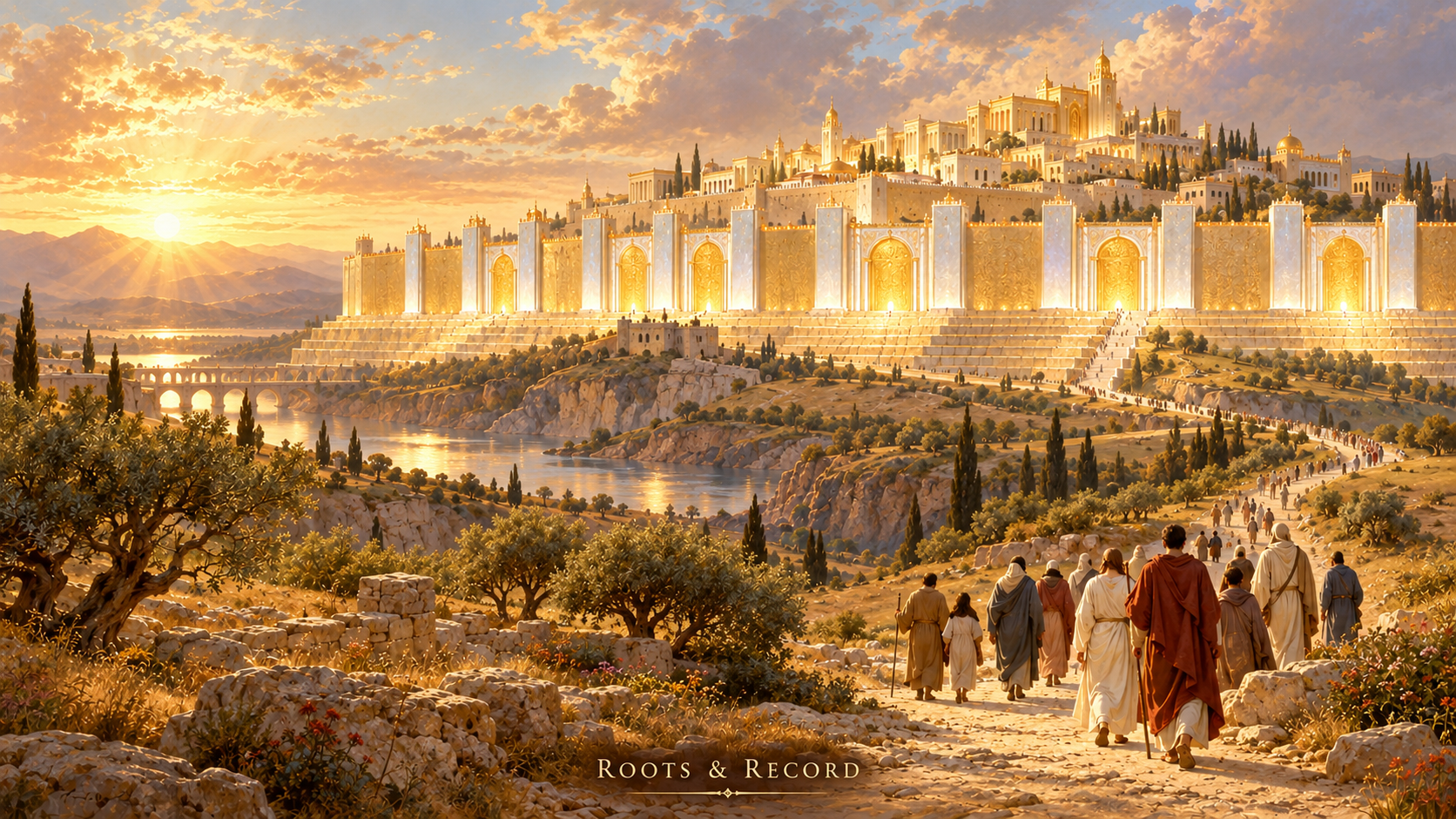
The city's architecture therefore carries the weight of a conclusion. According to Revelation 21:12–14, New Jerusalem has twelve gates inscribed with the names of the twelve tribes of Israel and a wall with twelve foundations inscribed with the names of the twelve apostles of the Lamb. Israel occupies the gates and the apostles occupy the foundations, and both sets of twelve remain fixed in the structure of the city, each in its own place. A simple replacement reading strains at this point, since the apostolic names take their own position in the foundations while Israel's names keep the gates.
The imagery descends from Ezekiel, whose closing vision in Ezekiel 48:30–35 describes a restored city with gates named for the tribes of Israel. Revelation transforms that prophetic city, and John keeps the tribal gates, so that the final chapters reach back into a vision of restored Israel at the moment they describe God's final dwelling with humanity.
Early commentators spiritualized this architecture. Oecumenius interpreted Israel as those who share Abraham's faith, and Andrew of Caesarea described the names on the gates as those of spiritual Israel, so that in their readings the imagery is absorbed into an ecclesial understanding of the city. The patristic tradition holds more than a march toward replacement, however. Primasius of Hadrumetum, commenting on the same gates, identifies them with the patriarchs from whom Israel descended, invokes Paul's insistence in Romans 11:1–2 that God holds fast to his people together with the image in Romans 11:18 of the root that supports the grafted branches, and turns to the twelve apostolic foundations only afterward. That reading takes John's architecture at face value, because Revelation itself assigns different names to the gates and to the foundations, and whatever unity the city represents, John saw value in retaining the distinction. Israel and the apostles belong to one city and keep their separate places in it.
The Nations Enter Through Israel's Gates
The city that carries Israel's names on its gates receives the nations. John says in Revelation 21:24–26 that the nations walk by the light of the city and that the kings of the earth bring their glory into it, and the gates that admit them stand open by day, since John adds that night is over. Revelation 22:2 continues the picture with the tree of life, whose leaves serve the healing of the nations. The nations therefore inhabit the city in John's final vision, and they arrive as the nations had arrived at Zion in Isaiah 60:3–11, drawn by Zion's light, with kings bringing their wealth through gates that stand open continually.
The arrangement describes a relationship between Israel and the nations that replacement language leaves out. Israel's names stand on the gates, the apostles' names on the foundations, and the nations enter the city with their glory, each group holding a distinct and honored place. A reading in which Israel dissolves into the nations empties the gates of their referent, while the reading the text supports gives the nations a city whose entrances are named for Israel, which follows the shape Isaiah gave the hope, with the nations coming to Zion and Zion remaining Zion.
Symbolism Keeps Its Referents
The strongest objection is obvious. Revelation is a symbolic book, and the New Jerusalem is hardly a municipal blueprint, so if the city itself is symbolic, the name of Israel on its gates might be expected to lose its concrete connection to Israel.
Symbolic language works by referring. A Lamb symbolizes the Messiah because the image communicates something about the Messiah, Babylon symbolizes an imperial system because the historical name carries a history suited to that system, and twelve symbolizes completeness because twelve already carries Israelite and apostolic associations. To call something symbolic opens the work of interpretation and leaves the referent in place.
The same principle governs the 144,000. Twelve times twelve times a thousand carries symbolic weight, and the arithmetic is built out of Israel's tribes. John says the sealed come from the tribes of Israel and gives four verses to naming those tribes one by one in Revelation 7:5–8. Every named tribe contributes exactly twelve thousand, and a symmetry of that kind speaks of ordered completeness, with the tribes represented in fullness and balance, where a claim of scarcity would look for a different pattern.
The claim that the 144,000 are the Church remains possible, particularly if Revelation 7:4–8 and 7:9–17 describe one community through John's hear-and-see technique. Even then the result is an Israel-shaped redeemed community, in which John uses the twelve tribes to define the people into which the nations are gathered. That conclusion supports continuity between Israel and the nations in the city, and a further argument would be required to turn it into an announcement that Israel has been discarded.
Israel's Names Remain
Revelation offers visions in place of a treatise on the relation between Israel and the nations, and each reader surveyed above brought a particular horizon to them: Origen the shrinking number of Jewish believers around him, Methodius the honor of virginity, Andrew the fruitfulness of apostolic preaching, Oecumenius a spiritual Israel, and Primasius the root that carries the branches. The imagery proved wide enough to shelter all of these readings, and John still repeats certain features with striking consistency.
The sealed servants are introduced through twelve tribes of Israel, the same numbered company stands with the Lamb on Zion as firstfruits, and when the final city descends the tribes appear again with their names fixed to its gates. Revelation's symbols expand outward toward peoples, nations, and languages, and each time they return to Israel for their vocabulary, their ancestry, and their architecture. If John intended to leave his readers with the image of an Israel reduced to an insignificant remnant and then supplanted by another people, he chose a peculiar way to draw his final picture. At the end of the vision, when Babylon, the beast, Satan, death, and the former world have all passed away, Israel's names are still on the gates.
Sources
Primary Texts
- Scripture quotations and references: New Revised Standard Version, Updated Edition, via Bible Gateway.
- Andrew of Caesarea. Commentary on the Apocalypse. Cited through Weinrich, ed., Revelation.
- Methodius of Olympus. Banquet of the Ten Virgins, Discourse 1, chapter 5. In Ante-Nicene Fathers, vol. 6. Available at CCEL.
- Oecumenius. Commentary on the Apocalypse. Cited through Weinrich, ed., Revelation.
- Origen. Commentary on the Gospel of John, Book 1, chapters 1–2. In Ante-Nicene Fathers, vol. 9.
- Primasius of Hadrumetum. Commentarius in Apocalypsin. Ed. A. W. Adams. Corpus Christianorum Series Latina 92. Turnhout: Brepols, 1985. Cited through Weinrich, ed., Revelation.
Secondary Literature
- Van Maaren, John. "The Twelve Tribes of Israel out from Every Nation, Tribe, People, and Language in Revelation 7:9–17." Harvard Theological Review, published online October 22, 2025. doi.org/10.1017/S0017816025100898.
- Weinrich, William C., ed. Revelation. Ancient Christian Commentary on Scripture, vol. 12. Downers Grove, IL: InterVarsity Press, 2006.
Scripture quotations are from the New Revised Standard Version, Updated Edition. Copyright © 2021 National Council of Churches of Christ in the United States of America. Used by permission. All rights reserved worldwide.