
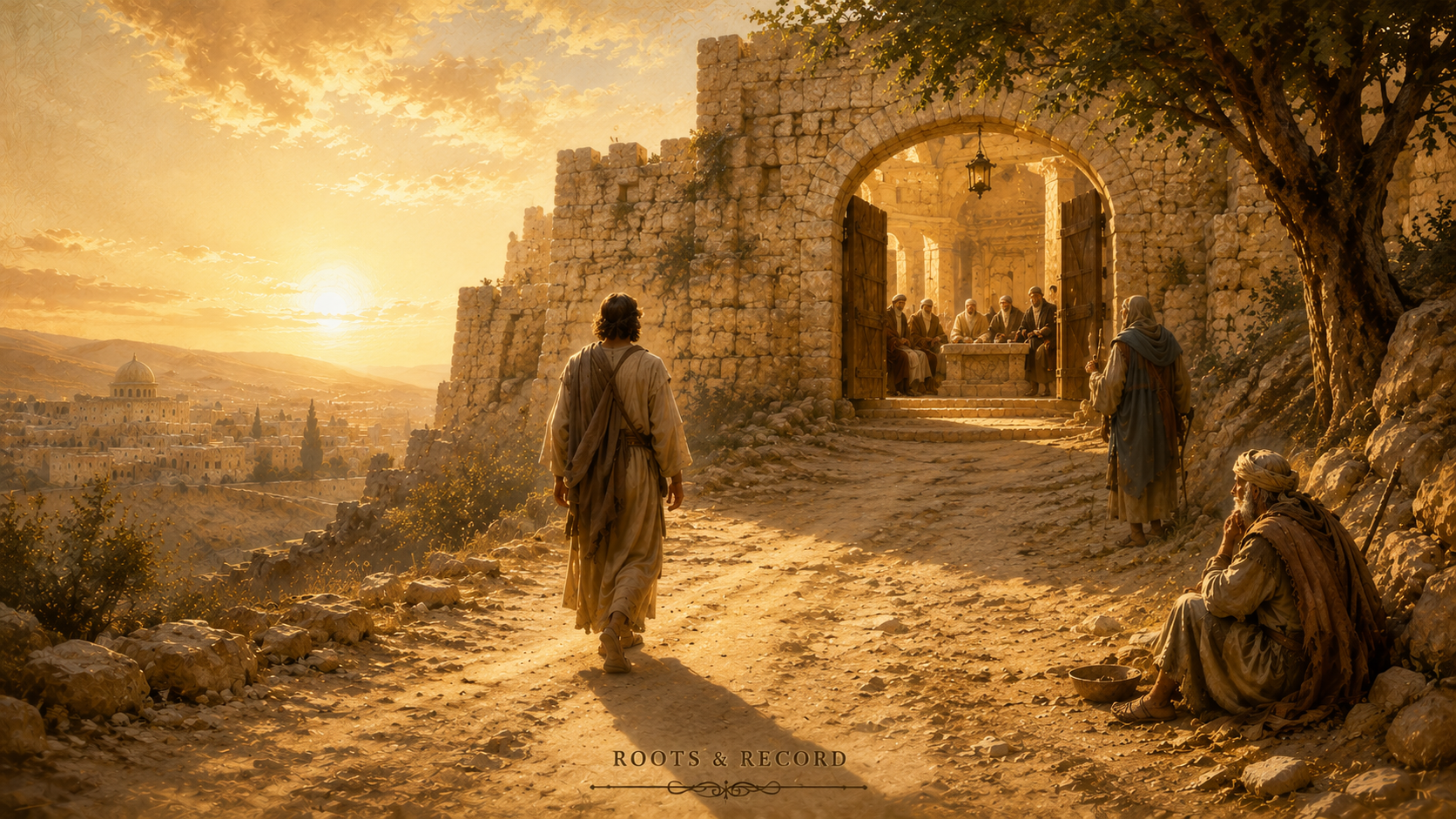
“He hath shewed thee, O man, what is good; and what doth the LORD require of thee, but to do justly, and to love mercy, and to walk humbly with thy God?” (Micah 6:8). Few verses in the Hebrew Bible carry so much weight in so little space. Micah answers the question outright rather than offering one option among many, and the answer has shaped how both the Jewish and Christian traditions understand what God requires of a human being, in worship, in public life, and in the ordinary work of getting along with another person.
The rabbis recognized the weight of this answer from within the tradition itself. In the Talmud, Rabbi Simlai taught that the 613 commandments given to Moses underwent a long compression at the hands of voices across the generations. David gathered them into eleven in Psalm 15. Isaiah gathered them into six in Isaiah 33:15. Micah gathered them into three in the verse before us. Isaiah returned and gathered them into two in Isaiah 56:1. Amos gathered the whole law into a single line, “Seek ye me, and ye shall live” (Amos 5:4), and Habakkuk did the same with a different line, “the just shall live by his faith” (Habakkuk 2:4), each compressing the entire Torah into one demand (Makkot 23b–24a). Finding the essential core of their own law mattered to the sages on its own terms, and Micah's verse is the point in that search where three words held the weight that six hundred and thirteen commandments carried elsewhere.
The search predates both Micah and the sages who would later cite him. Centuries earlier, Moses stood before Israel and asked nearly the same question Micah would later answer, “And now, Israel, what doth the LORD thy God require of thee, but to fear the LORD thy God, to walk in all his ways, and to love him, and to serve the LORD thy God with all thy heart and with all thy soul?” (Deuteronomy 10:12). Micah answers a question Moses had already put to the people, in language close enough to Moses's own that the connection cannot be accidental: fear becomes justice, walking in God's ways becomes walking humbly with God, loving him becomes loving mercy. The prophet stands inside the Torah's own question rather than outside it.
Other prophets reached for the same pairing of justice and mercy across the centuries of Israel's history. Hosea, calling the people back to covenant faithfulness, hears the LORD say, “Therefore turn thou to thy God: keep mercy and judgment, and wait on thy God continually” (Hosea 12:6), and Zechariah, addressing a generation that had confused fasting with obedience, hears the same pairing made concrete, “Execute true judgment, and shew mercy and compassions every man to his brother” (Zechariah 7:9). Justice and mercy, named together across prophetic moments separated by centuries, govern the same thing in every text: how we treat the people standing closest to us.
Jeremiah brings the convergence to its sharpest point by putting the claim directly in God's own mouth. “Let him that glorieth glory in this, that he understandeth and knoweth me, that I am the LORD which exercise lovingkindness, judgment, and righteousness, in the earth: for in these things I delight, saith the LORD” (Jeremiah 9:24). This is what God delights in, and it is nearly the list Micah hands back to us two verses after asking what offering would please him. Micah's three-part answer describes the character of God before it describes the conduct God asks of us, and the conduct asked of us is conduct that resembles him.
The sequence Micah gives opens with justice, and the placement is deliberate. The Hebrew word behind it, mishpat, reaches well beyond legal procedure, ordering relationships properly, restraining exploitation, and protecting those who cannot protect themselves. We live among neighbors, employers, creditors, widows, strangers, and the poor, and questions of fairness and responsibility arise the moment any two of us interact. To pursue mishpat is to enter that world of relationships rather than withdraw from it, since the biblical vision of holiness has rarely served as an excuse for retreat.
Yet mishpat cannot stand on its own, and Micah refuses to let it. Pursued without restraint, justice curdles into something else entirely: a person can become technically correct while losing all compassion, can defend a position while quietly ceasing to love the people for whom the position exists. The King James renders Micah's second word as “mercy,” though the Hebrew beneath it is chesed, among the richest nouns in the Hebrew Bible and one no single English word fully holds. Translators reach for loving-kindness, steadfast love, covenant loyalty, and faithfulness, each catching part of what “mercy” alone leaves behind. Chesed is love that has bound itself to action, a kindness that does not lapse the moment convenience would excuse it. The verb Micah uses is ahav, to love, and what he commands us to love is chesed itself, a request that reaches past behavior into the affections and asks for a heart that delights in kindness rather than a hand that simply discharges it. Pirkei Avot 1:2 puts this conviction at the foundation of everything else, teaching that the world itself stands on three things: Torah, the service of God, and deeds of chesed, naming loving-kindness as one of creation's own supports rather than a virtue added on top of the law as an afterthought.
Once chesed enters the picture, mishpat deepens without disappearing. The vulnerable, the stranger, the debtor, even the offender, remain bearers of God's image, and justice keeps its place, but it now works inside a framework shaped by loving-kindness rather than standing apart from it.
Micah's third requirement, to walk humbly with God, governs the first two quietly rather than standing beside them as a separate item on a list. Justice without humility hardens into self-righteousness; chesed without humility curdles into condescension. Both virtues, left ungoverned, become instruments of the ego rather than gifts to the people they were meant to serve. The humility Micah names draws on different vocabulary than the humility ascribed to Moses. Numbers 12:3 calls Moses anav me'od, very humble, a phrase describing a settled quality of character, the kind of person Moses had become through years of leadership and trial. Micah reaches for something else, hatznea lechet, to walk humbly or to walk modestly, a phrase that moves humility out of the interior life of character and into the visible motion of conduct. Numbers tells us what humility is; Micah shows what humility looks like once it has entered the way a person walks through the world, exercises authority, and treats a neighbor.
The word Micah chooses carries its own argument. Halakhah, the entire framework by which Jewish law governs how a person walks through obligation toward others, takes its name from the same root, the verb “to walk.” Micah's third command names the manner in which the whole walk, the entire halakhic life of meeting mishpat and chesed in the people around us, gets carried out, disciplining the first two rather than standing alongside them. The sages built an entire ethic of disagreement on this same humility. Pirkei Avot 1:12 records Hillel's charge to be among the disciples of Aaron, loving peace and pursuing it, drawing people closer to Torah rather than driving them away through harshness, and Pirkei Avot 5:17 distinguishes a dispute carried on for the sake of Heaven, naming the debates of Hillel and Shammai, from a dispute carried on for the sake of something smaller, naming the rebellion of Korach. The sages prized vigorous disagreement and preserved arguments across the Talmud that were rarely settled outright, yet the ideal held steady: that disagreement be conducted with enough humility to admit that no single voice holds the whole of wisdom, enough chesed to keep dignity intact on both sides, and enough devotion to mishpat that the questions at stake stayed alive.
Jesus names this same requirement directly when he rebukes a devotion that paid tithe of the smallest herbs while abandoning “the weightier matters of the law, judgment, mercy, and faith” (Matthew 23:23). He stands inside Micah's own claim and carries it forward to a people who had lost sight of it.
Paul arrives at the same place from inside the Christian tradition. Writing to the church at Rome, he gathers the commandments that govern how a person treats his neighbor into a single requirement. He writes, “Owe no man any thing, but to love one another: for he that loveth another hath fulfilled the law. For this, Thou shalt not commit adultery, Thou shalt not kill, Thou shalt not steal, Thou shalt not bear false witness, Thou shalt not covet; and if there be any other commandment, it is briefly comprehended in this saying, namely, Thou shalt love thy neighbour as thyself. Love worketh no ill to his neighbour: therefore love is the fulfilling of the law” (Romans 13:8–10). Six centuries separate Paul from Micah, and love completes the law's claim on how we treat one another in both writers rather than competing with it: justice toward the neighbor and love toward the neighbor turn out to be the same demand, named from two directions.
Micah's verse asks something of the life lived before God, the quiet hours of prayer and self-examination where no one else is watching. It asks the same thing of the much louder life lived in public, where a person argues, organizes, leads, and disagrees with people who see the world differently than he does. Most of our public failures trace back to a failure of sequence rather than a failure of conviction. We reach for justice and skip past chesed, or we reach for chesed and abandon justice, or we pursue either virtue without ever submitting it to the discipline of walking humbly, and the wreckage that follows looks different in every case while tracing back to the same broken order.
Justice pursued without chesed hardens within a season into something that mistakes the person across the disagreement for the disagreement itself, and once that happens, cruelty starts wearing the name of principle. Chesed pursued without justice produces a kindness with no spine in it, a gentleness that cannot bring itself to hold anyone accountable, including the people doing the most damage. Either virtue pursued without humility eventually convinces the person carrying it that he alone sees clearly, that his side of the argument has earned a certainty no one else's side deserves. That conviction is where the real damage tends to begin, and no community, no movement, and no civilization holds together for long once its people separate devotion to God from the discipline of how they treat one another. The breach starts small, in a meeting room or a marketplace or a congregation, and then it is no longer small.
What Micah asks of us is something more intimate than compliance with a standard. Jeremiah heard God say that lovingkindness, judgment, and righteousness are what he himself delights in, a description of his own character before they are a description of his requirements. To pursue mishpat with chesed, walking humbly in the doing of it, is to take on something of that character in our dealings with one another, to carry into the world something of the quality of the God we claim to follow. That is why Micah's verbs are verbs of doing and loving and walking rather than of achievement or performance. The verbs are verbs of character, of motion, of the sustained disposition a person cultivates over a lifetime of small choices in the presence of other people.
Walk humbly with your God, Micah says last, and the placement is the argument. The walk is where all of it happens, in the marketplace and the council chamber, in the congregation and the kitchen table, in every place where one person must decide again what he owes another. He hath shewed thee, O man, what is good.
Sources
Primary Texts
- Amos 5:4. King James Version.
- Deuteronomy 10:12. King James Version.
- Habakkuk 2:4. King James Version.
- Hosea 12:6. King James Version.
- Isaiah 33:15. King James Version.
- Isaiah 56:1. King James Version.
- Jeremiah 9:24. King James Version.
- Makkot 23b–24a. Sefaria.
- Matthew 23:23. King James Version.
- Micah 6:8. King James Version.
- Numbers 12:3. King James Version.
- Pirkei Avot 1:2. Sefaria.
- Pirkei Avot 1:12. Sefaria.
- Pirkei Avot 5:17. Sefaria.
- Psalm 15. King James Version.
- Romans 13:8–10. King James Version.
- Zechariah 7:9. King James Version.


