
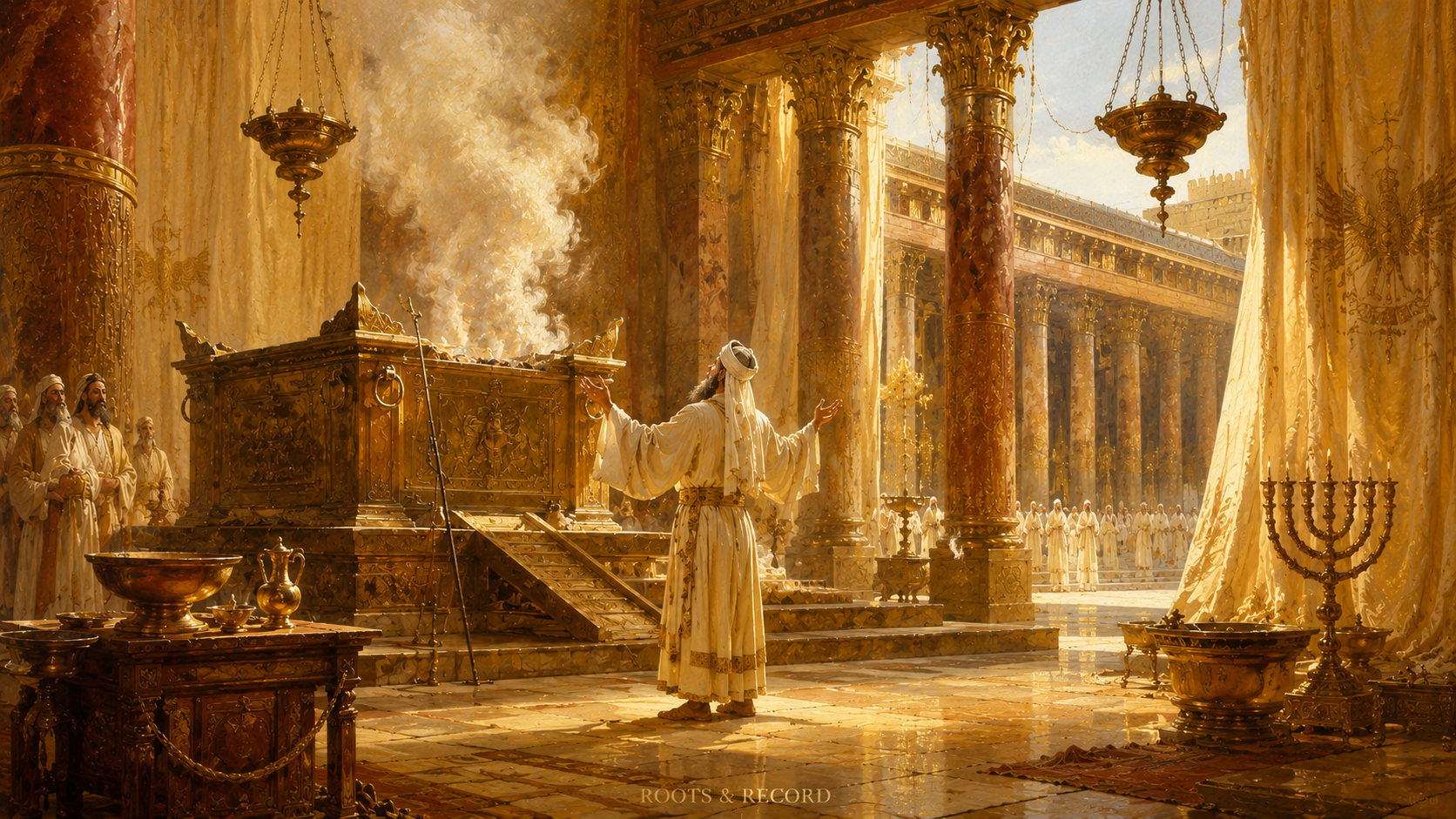
The Torah's sacrificial system and the Christian doctrine of penal substitutionary atonement are often placed in a direct line of descent, the altar of the Temple read as an early form of the courtroom logic that later Christian theology would make explicit. This article considers that line of descent. The sacrificial world of the Torah was governed by a conceptual framework, covenantal, liturgical, relational, that differs in important ways from the juridical architecture that Reformed theology in particular built on Isaiah 53 and the Levitical sacrifices. Recovering that difference matters for understanding both traditions on their own terms.
This article makes one claim, and it is worth stating precisely at the outset. Penal substitutionary atonement stands as a coherent theological system within the Christian traditions that hold it, argued from Scripture, defended by serious theologians, and sincerely believed by millions of people across centuries. The question this article addresses is not whether that system is true or false. The question is whether it represents the way Jewish sacrifice itself was understood, by the people who practiced it and by the rabbinic tradition that inherited and interpreted it. The claim that follows is historical and theological in scope: the Jewish sacrificial system, read on its own terms and through its own interpretive tradition, developed a different understanding of sin, sacrifice, and restoration than the one penal substitution would later articulate. The two systems may converge on certain texts. Their starting assumptions diverge.
Ancient Israelite sacrifice was layered and varied. Some offerings addressed ritual impurity rather than moral guilt, a category that governed both men and women alike through the purity laws of Leviticus. Others expressed thanksgiving, ratified covenant fellowship, restored a worshipper, whether man or woman, after conditions that rendered him or her ritually unclean, or maintained the sanctity of sacred space against the accumulated defilements of communal life. Even the offerings most directly associated with sin functioned, in large part, as purification and covenant restoration: the repair of a relationship, the cleansing of a space, the return of a member of the community to right standing within the covenant.
The Yom Kippur ritual described in Leviticus 16 rewards close reading on precisely this point. Two goats stand at the center of the ritual. One is sacrificed. The other, traditionally called the scapegoat, though the Hebrew azazel resists easy translation, carries the sins of Israel symbolically into the wilderness. The ritual addresses the accumulated impurity and defilement of the sanctuary itself as much as it addresses individual moral guilt; the high priest atones for the holy place, the tent of meeting, and the altar before he atones for the people. The governing idiom is spatial and covenantal. The sanctuary must be cleansed so that God may dwell among Israel, and the people must be cleansed so that they may approach the sanctuary. Holiness, presence, and restoration organize the ritual.
The Mishnah preserves a tradition that makes this organizing logic explicit. In Mishnah Yoma 8:8 to 9, the sages teach that the Day of Atonement procures forgiveness for sins committed against God, but offers no remedy for sins committed against another person until the wrongdoer has sought out and made peace with the one he wronged. Rabbi Akiva closes the tractate with a declaration of Israel's good fortune: it is God who purifies Israel, as the prophet Ezekiel promised when he spoke of clean water sprinkled upon the people. The framework here concerns purification, relationship, and the restoration of standing before God and before one's neighbor. A system organized primarily around the transfer of punishment from a guilty party to an innocent substitute would read very differently than a system whose own foundational texts conclude with an image of cleansing water and a call to interpersonal reconciliation.
The prophetic tradition complicates the picture further. The Hebrew Bible contains no teaching that blood sacrifice is the sole avenue through which divine forgiveness moves. Hosea offers the words of the lips in place of bulls (Hosea 14:2). The people of Nineveh repent in sackcloth and ashes without Temple sacrifice, and God relents (Jonah 3:5). Psalm 51:17 declares that a broken and contrite heart is more pleasing to God than burnt offerings. Micah redirects the question of what God requires, thousands of rams, rivers of oil, even a firstborn son, toward justice, mercy, and humility (Micah 6:6-8). These voices shaped Jewish theological reflection across centuries, and they describe a world in which sacrifice mattered deeply within worship while remaining one instrument among several in the relationship between God and Israel.
The distinction between animal and human sacrifice stands as another load-bearing wall of Torah theology. The prohibition on human sacrifice recurs precisely because the surrounding cultures practiced it, and Israel's refusal was understood as a defining mark of covenant faithfulness. The Akedah, the binding of Isaac in Genesis 22, is read in the rabbinic tradition as the narrative in which God definitively substitutes an animal for a human, establishing the principle that governs Israelite worship from that point forward. Many Jewish readers historically understood the movement from animal sacrifice to the sacrificial death of a human being as a theological development requiring its own independent justification, standing apart from the trajectory the Torah itself had set.
Christianity's own earliest centuries offer a useful vantage point on the question of lineage. For roughly the first thousand years of the church, the dominant way of understanding the cross was what later scholarship would call the ransom or Christus Victor view. Christ's death and resurrection accomplish a victory over sin, death, and the powers that hold humanity captive on this view, a rescue and liberation rather than a transaction in which one party's punishment is legally transferred to another. The early and medieval church drew this picture from figures including Irenaeus, Origen, and Augustine, whose writings Gustaf Aulén surveyed at length in his landmark study of the doctrine's history. Augustine taught that Christ suffered in humanity's place, but his account of what that suffering accomplished centered on liberation from death and corruption rather than on the satisfaction of a legal penalty. The shift toward a more juridical framework began with Anselm of Canterbury's Cur Deus Homo around 1097, and the specifically penal form, in which Christ bears the punishment that divine justice requires, reached its mature articulation in the Reformation, particularly in the writings of John Calvin.
Calvin's own account is worth presenting in his terms, because it documents how directly the Reformed tradition itself drew the connection to the Hebrew Bible. In the Institutes, Calvin reads Isaiah 53 as the key to the cross: Christ, he writes, was "made a substitute and a surety in the place of transgressors" to bear the punishment those transgressors owed. He treats the Levitical sacrifices, particularly the language of bearing sin in Leviticus, as types that find their fulfillment in this substitutionary bearing of punishment. This is a serious and influential reading, and it represents an honest account of how the Reformed tradition understands its own roots in the Hebrew Bible. The rabbinic tradition, reading the same Levitical material and the same Isaiah text, arrived at Yoma's framework of purification and reconciliation instead. Two traditions, reading shared texts, building distinct theological structures.
Christianity did not construct its theology in isolation from the Jewish intellectual world of the first century. Second Temple Judaism was a landscape of theological diversity. Redemptive suffering, martyrdom, heavenly mediation, apocalyptic deliverance, priestly imagery, and communal atonement were all live categories within the literature of the period, including the documents found at Qumran, which describe the community's own life and discipline as a form of atonement for the land alongside, not in replacement of, the Temple's sacrificial system. Christianity arose from within that environment and drew on its vocabulary. Shared vocabulary is a different thing from shared theological architecture, and the direction in which each tradition developed that vocabulary matters as much as the vocabulary itself.
The deepest divergence concerns the nature of sin itself. In the dominant streams of Jewish thought, sin is covenant breach: impurity, injustice, estrangement, moral failure. The appropriate response is teshuvah, return, the restoration of right relationship. The structure of Yom Kippur, with its fasting, confession, and communal reckoning, enacts this logic liturgically, and Mishnah Yoma's own conclusion places reconciliation between people at the center of what the day accomplishes. The same call carries directly into the Gospels. John the Baptist appears in the wilderness preaching repentance, "for the kingdom of heaven is at hand" (Matthew 3:2), and Jesus opens his own ministry with the same call, to repent and believe (Mark 1:15), warning his hearers that without repentance they will perish (Luke 13:3). These calls to teshuvah, addressed to people who had not yet encountered the cross, belong to the same covenantal logic that governs Yom Kippur: restoration through return, not only through a payment rendered on another's behalf. A framework built on inherited universal guilt satisfied through substitution organizes the material differently from the start.
A Jewish reader could affirm representative suffering, symbolic substitution, and the spiritual power of the suffering of the righteous, categories fully available within Second Temple thought, while understanding Yom Kippur and the sacrificial system through the framework of purification and reconciliation that the Mishnah itself describes. The disagreement between the traditions reflects a different set of prior commitments about covenant, holiness, divine mercy, and the relationship between justice and grace, commitments visible already in how each tradition's own foundational texts conclude their treatment of atonement.
The Temple was a house of divine presence, a place of covenant maintenance, a liturgical space in which Israel enacted its relationship with God through blood, fire, grain, and song. Sacrifice was the practice of that enactment, varied, layered, theologically serious, and oriented toward restoration. Christian penal substitution stands as its own theological achievement, argued from its own sources and defended by its own considerable tradition. What it cannot claim, on the evidence of the Mishnah and the prophets, is that this is how the sacrificial system was understood by the tradition that practiced it. The Temple operates by covenantal logic. Penal substitution operates by juridical logic. Recognizing the difference honors both traditions by describing each accurately.
Primary Texts
Leviticus 16 (King James Version) — Bible Gateway
Hosea 14:2 (King James Version) — Bible Gateway
Jonah 3:5 (King James Version) — Bible Gateway
Psalm 51:17 (King James Version) — Bible Gateway
Micah 6:6-8 (King James Version) — Bible Gateway
Genesis 22 (King James Version) — Bible Gateway
Matthew 3:2 (King James Version) — Bible Gateway
Mark 1:15 (King James Version) — Bible Gateway
Luke 13:3 (King James Version) — Bible Gateway
Mishnah Yoma 8:8-9 — Sefaria
Secondary Literature
Anderson, Gary A. Sin: A History. Yale University Press, 2009.
Aulén, Gustaf. Christus Victor: An Historical Study of the Three Main Types of the Idea of Atonement. SPCK, 1931.
Calvin, John. Institutes of the Christian Religion. Book 2, Chapter 16.
Klawans, Jonathan. Purity, Sacrifice, and the Temple: Symbolism and Supersessionism in the Study of Ancient Judaism. Oxford University Press, 2006.
Milgrom, Jacob. Leviticus 1-16. Anchor Bible Commentary. Doubleday, 1991.
Stökl Ben Ezra, Daniel. The Impact of Yom Kippur on Early Christianity. Mohr Siebeck, 2003.


