
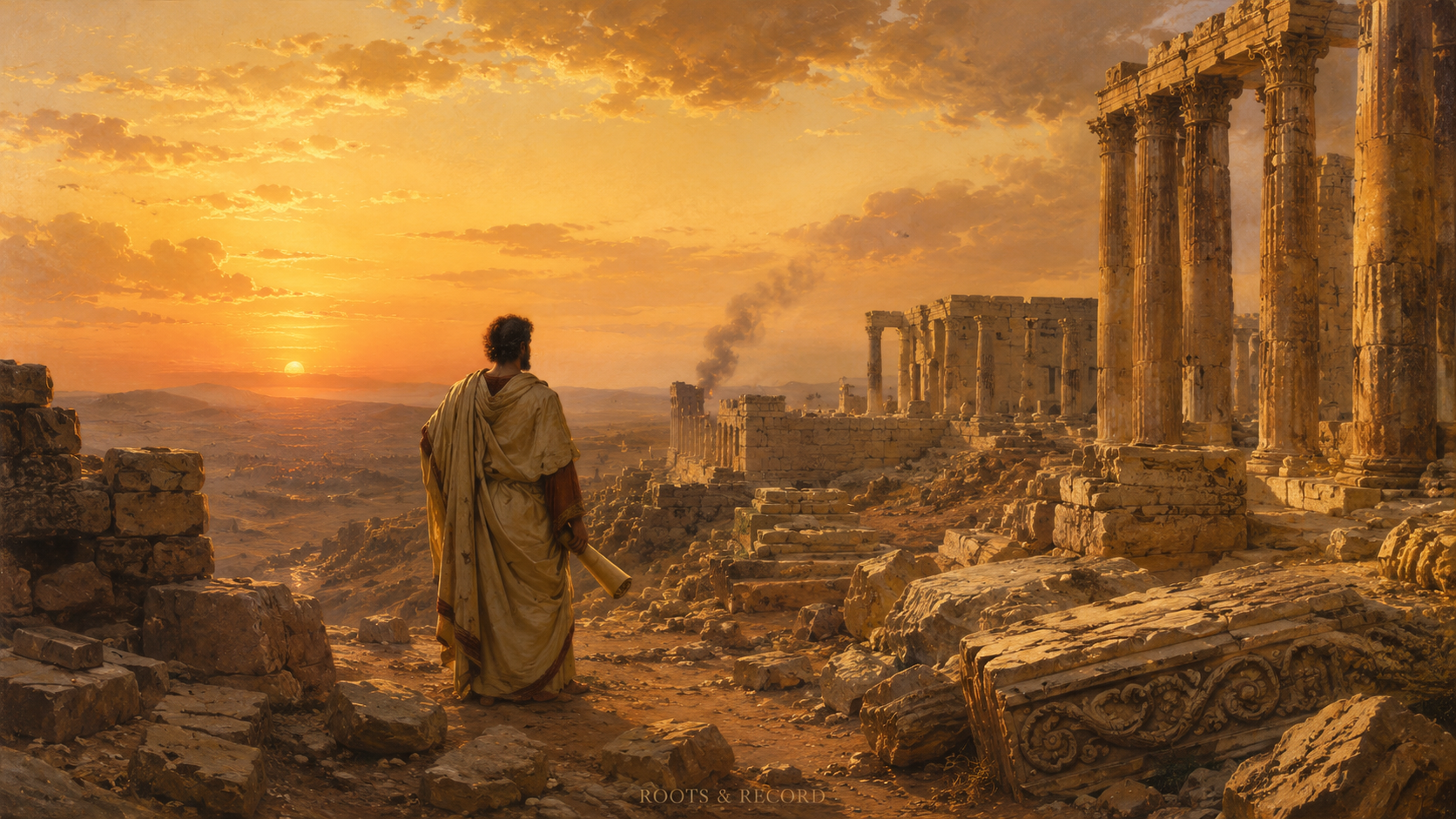
When the Babylonians burned Jerusalem in 586 BCE, they dismantled a world. The Temple had been the axis around which Israelite life turned, the place where heaven and earth met, where sacrifice maintained the cosmic order, and where the name of God rested in stone and cedar; its destruction registered as a theological catastrophe, understood as such by everyone who witnessed it.
In the ancient Near East, conquest followed a specific theological logic. Armies defeated not only other armies but other gods. When a city fell, its patron deity was presumed to have either abandoned it or been overcome by the conqueror's divine power. Babylon's own royal inscriptions state this logic in their own words: the Cyrus Cylinder describes Marduk, the chief deity of Babylon, growing angry at King Nabonidus and withdrawing his favor, delivering the city into Cyrus's hands. Nebuchadnezzar's earlier campaign against Jerusalem, documented in the Babylonian Chronicle known as the Jerusalem Chronicle, shows the same imperial machinery in motion against Judah a half-century before. The destruction of the Temple was the theological culmination of the conquest, the proof that the God of Israel had lost.
The Hebrew Bible refuses this logic with a sustained argument, developed across multiple voices and centuries, that turns the logic of conquest inside out. The argument begins before the Babylonians arrive, with what the prophets had been saying for generations.
The Ancient Logic of Sacred Space
Temples in the ancient world were the dwelling places of the gods, the points where the divine and human orders intersected, the structures around which the entire social and cosmic world was organized, a category of thing the modern word "worship" does not quite reach. The Mesopotamian concept of the cosmic mountain, the sacred site where heaven and earth were joined, was widespread across the ancient Near East. Egypt's temples were similarly conceived as the primordial mound from which creation had emerged, maintained perpetually by ritual so that the order of the cosmos would not collapse, a theology documented across the surviving temple inscriptions and explored at length in the standard scholarly treatment of Egyptian temple religion. The Canaanite high places, the ziggurats of Sumer and Babylon, and the temples of Ugarit all operated within this same conceptual architecture. To build a temple was to establish a point of cosmic stability, and to destroy one was to destabilize the cosmos itself.
Israel's Temple operated within this symbolic world while transforming it. The Temple Mount in Jerusalem was understood as the axis of creation, the omphalos, the navel of the earth, the place from which the world had been formed and from which it was still sustained. The Torah's instructions for the construction of the Tabernacle, the portable sanctuary that preceded the Temple, describe a structure that mirrors the cosmic order: its proportions, materials, and furnishings correspond to the elements of creation. The Temple Solomon built was a theological statement about where God had chosen to place his name, and within the logic of the ancient world, its destruction could only read as divine defeat. If God dwelled in the Temple and the Temple had been burned, then God had either been overcome or had abandoned his people. Both readings were devastating.
The Prophetic Indictment
The Hebrew Bible's response begins with the prophets, and begins before the destruction. Jeremiah, Ezekiel, Isaiah, and Amos were predicting catastrophe on specific grounds long before the Babylonians arrived. The kind of apologetic that simply explains defeat after the fact looks entirely different from this.
The ground they stand on is this: God cannot be located in a building, because the Temple was never designed to contain him. Solomon's own prayer at the Temple's dedication acknowledges the paradox openly: "But will God indeed dwell on the earth? behold, the heaven and heaven of heavens cannot contain thee: how much less this house that I have builded?" (1 Kings 8:27). The Temple is a place where God's name dwells, and the people had collapsed that distinction entirely, treating the building as a guarantee of the divine person rather than a marker of the divine name.
Jeremiah's Temple sermon (Jeremiah 7) states the indictment most directly. Standing in the Temple courts, he tells the people that their confidence in the Temple's inviolability is a delusion, and that repeating "the temple of the LORD, the temple of the LORD, the temple of the LORD" (Jeremiah 7:4) like a magical formula while practicing injustice has made the building an alibi, used to cover the very sins the covenant demanded Israel renounce. He invokes the example of Shiloh, the earlier sanctuary God had allowed to be destroyed, to establish that no building stands beyond divine judgment. God is protecting a covenant, and when the people abandon the covenant, no building will protect them.
Ezekiel develops this further with a vision that is among the most theologically stunning in the Hebrew Bible: the glory of God leaving the Temple. In Ezekiel 10 and 11, the divine presence withdraws in meticulous visionary stages, moving from the inner sanctuary to the threshold, then to the eastern gate, and finally to the Mount of Olives before departing altogether. The building stands vacated, its sanctity already withdrawn before the fire ever reaches it. The Babylonian destruction will follow, but the theological point is established before any Babylonian arrives: the Temple had already ceased to be what it was. The presence had left.
This prophetic framework inverts the ancient logic of conquest entirely. God had used Babylon as an instrument of judgment against his own people, wielding the very empire that appeared to have defeated him. This was a divine act executed through human armies, an extraordinarily demanding theological claim, but the claim the texts make without apology.
The Rabbinic Reinvention
The First Temple fell to Babylon in 586 BCE; the Second fell to Rome in 70 CE. Both catastrophes demanded a response, and the rabbinic tradition that emerged after the second destruction is one of the most remarkable intellectual achievements in the history of religion: the complete portability of Judaism.
A tradition that cannot be organized around a building it no longer possesses must translate its prophetic inheritance into institutional reality, and the solutions the rabbis developed were radical in their coherence. Prayer replaced sacrifice, the study of Torah replaced the Temple service, and the rabbi replaced the priest. The synagogue, a word meaning simply "assembly," became the new center of Jewish life, and unlike a Temple, a synagogue requires nothing but ten Jews and a Torah scroll. It can exist anywhere.
Avot de-Rabbi Natan 4:5 preserves a story that captures the pivot. Walking near Jerusalem after the destruction, Rabbi Joshua looks at the Temple ruins and mourns that the place of atonement is gone. Rabban Yochanan ben Zakkai corrects him: "Do not be too sad, my son. We have another way of gaining atonement that is equally meritorious. And what is it? Acts of lovingkindness — as it is said, 'For I desire mercy, and not sacrifice'" (Hosea 6:6). Hosea had supplied the answer centuries earlier. The rabbis inhabited the theology the prophets had already built.
The Christian Reading
The Gospels place Jesus's ministry in an explicitly Temple-saturated context. He teaches in the Temple courts, drives out those who have turned it into a market, and predicts its destruction with unsettling specificity: "There shall not be left here one stone upon another, that shall not be thrown down" (Matthew 24:2). For the Gospel writers, the Temple's destruction fulfills rather than refutes his claims.
The Epistles draw the same prophetic line the rabbis drew, arriving at a parallel conclusion from within a different community. Paul's language in 1 Corinthians 3 and 6 is deliberate: the Spirit dwells in the gathered community of believers the way the divine presence dwelt in the Temple, and the vocabulary of holiness, consecration, and being set apart migrates wholesale from the building to the people. The Letter to the Hebrews makes the argument most systematically, reading the entire Temple system through the lens of a greater and permanent reality.
Given the polemical possibilities of 70 CE, Paul and the author of Hebrews are strikingly restrained about making the Temple's fall a triumphalist point. The destruction confirms a theological argument already made on other grounds. The prophets and the resurrection are the evidence; the fall of the Temple is the consequence.
The Covenant Survives the Stone
Across both catastrophes, in 586 BCE and in 70 CE, the pattern holds: the institution falls while the tradition that animated it endures. The Babylonian exile produced the editing and consolidation of the Torah, the emergence of the synagogue, and a deepened understanding of covenant that could survive without land or Temple. Rome's suppression of Judea produced the rabbinic tradition that would carry Jewish life through two millennia of diaspora. The destroying empires vanished, while the tradition they tried to extinguish endured.
The covenant endures past the stone. That is the argument of the Hebrew Bible, developed across centuries of reflection on loss, from inside catastrophe rather than above it: from Jeremiah in the ruins, from Ezekiel in Babylon, from the anonymous poet of Lamentations who refused to let grief become either despair or false comfort. The God of Israel dwells where the covenant is kept. The destruction of what is most sacred, precisely because it is most sacred, is the moment that tests whether the tradition understood its own deepest claim.
Both times, enough did.
Sources
Primary Texts
Scripture quotations are from the King James Version (KJV), via Bible Gateway.
Avot de-Rabbi Natan 4:5. Sefaria Library.
Cyrus Cylinder. Translation via Livius.org.
Babylonian Chronicle ABC 5 (Jerusalem Chronicle). Translation via Livius.org.
Secondary Literature
Shafer, Byron E., ed. Temples of Ancient Egypt. Cornell University Press, 1997.


