
The Dead Sea Scrolls
The Dead Sea Scrolls
Ten weeks through the manuscripts, the questions they raised, and what they disclose about the world in which Judaism and Christianity took their defining shape.
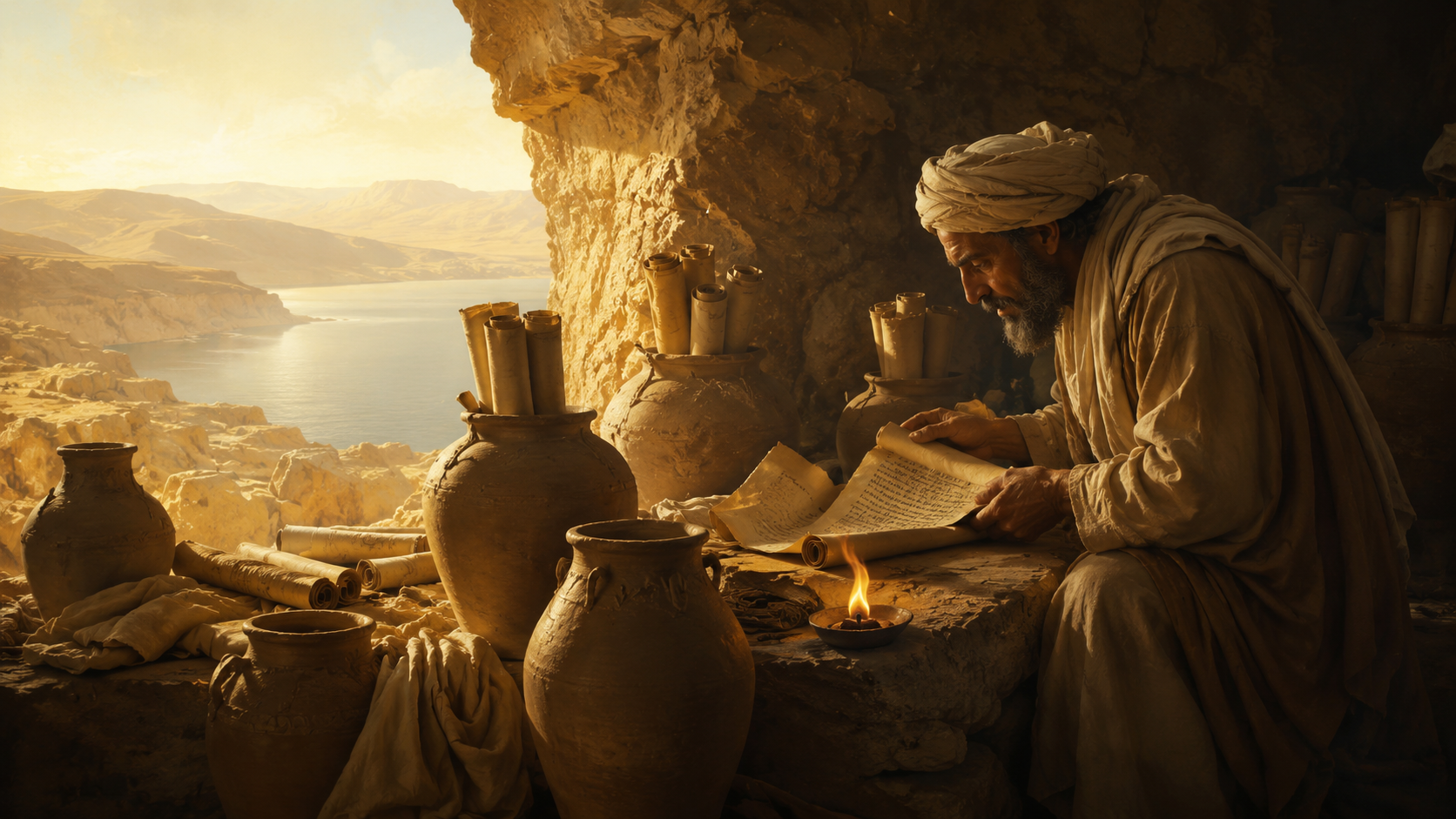
In 1947, a Bedouin shepherd threw a stone into a cave above the Dead Sea and heard pottery shatter. What emerged over the following decade — clay jars, linen wrappings, and nearly a thousand manuscripts — constituted the most significant archaeological discovery in the history of biblical scholarship. The scrolls had been sealed in the caves for roughly two thousand years.
The manuscripts include the oldest surviving copies of almost every book of the Hebrew Bible, alongside texts that had never been seen before — community rules, hymns, biblical commentaries, apocalyptic visions, and legal documents. Where they came from, who produced them, and what their relationship is to the Judaism of their time and to the origins of Christianity remain among the most actively debated questions in the field.
This track moves through the scrolls systematically — what they are, what they contain, and what questions they raise about the world in which both Judaism and Christianity took their defining shape. No prior knowledge is assumed. The reading will introduce the debates; the track's job is to give you enough ground to follow them.
- The Dead Sea Scrolls Today, rev. ed. — James C. VanderKam (Eerdmans, 2010). The most accessible scholarly introduction to the scrolls available for a general reader — covers discovery, the manuscripts, community identity, and the scrolls' bearing on both the Hebrew Bible and the New Testament.
- The Dead Sea Scrolls: A New Translation — Michael O. Wise, Martin G. Abegg Jr., and Edward M. Cook (HarperOne, 2005). The primary texts in readable English — the volume the track draws on directly from Week 3 onward. Every scroll assigned in this track is translated and introduced here.
- Reclaiming the Dead Sea Scrolls — Lawrence H. Schiffman (Jewish Publication Society, 1994). Schiffman reads the scrolls through the lens of Jewish law and history, providing a counterweight to scholarship that has emphasized the scrolls' bearing on Christian origins. His coverage of the legal texts and community structure goes deeper than any other book in this track.
Archive.org borrowing is free with a free account. Books are available one hour at a time and can be borrowed repeatedly.
The story of how the scrolls came to light — and what happened in the decades before the full corpus became available to scholars — is itself a significant chapter in modern intellectual history. VanderKam opens with the physical discoveries: the caves, the excavations, the manuscripts that emerged. Schiffman opens with the same events but carries the story through the publication controversy that dominated scroll scholarship for forty years. Reading both accounts together gives the whole picture before a single text is opened.
Coming up — Week 2: Continue with VanderKam and Schiffman. No new acquisition needed.
Before reading any scroll, it is worth understanding what the corpus actually contains and where it was found. VanderKam surveys the full range of manuscript types — biblical texts, apocrypha, legal documents, hymns, commentaries — giving the reader a map of the territory. Schiffman turns to the archaeology of the site itself: what the buildings and cemeteries at Qumran can and cannot tell us. Both chapters work at the same question from different angles: what kind of place produced this library?
Coming up — Week 3: You will need The Dead Sea Scrolls: A New Translation (Wise, Abegg, and Cook) beginning next week. This is the primary text volume for the remainder of the track — locate a copy now through your library, Alibris, ThriftBooks, or Archive.org.
Known conventionally as the Community Rule (1QS), this text is the governing document of whatever group produced it — covering initiation, communal structure, discipline, and a theological framework organized around two opposing forces. Wise et al. title it "Charter of a Jewish Sectarian Association," which is a useful reminder that the conventional title carries interpretive assumptions the text itself does not supply. Schiffman's chapter on the character of the community reads the same text through Jewish legal categories, drawing out dimensions that a purely theological reading tends to miss.
Coming up — Week 4: Continue with all three books. No new acquisition needed.
The Damascus Document was discovered twice: first in a Cairo synagogue storeroom in 1896, decades before the cave discoveries, and again among the Qumran manuscripts. It combines a narrative account of a group's origins and separation from mainstream society with a substantial body of legal material. VanderKam's chapter on group identification addresses the central question the document raises: who wrote this, and are they the same group behind the Community Rule? The question remains open, and the chapter says so plainly.
Coming up — Week 5: Continue with all three books. No new acquisition needed.
The War Scroll describes a final conflict between the Sons of Light and the Sons of Darkness — with military formations, battle orders, and priestly liturgy to be performed between engagements. Whether it is a practical document, a theological statement, or something between the two has been debated since its discovery. Schiffman's chapter on the community at the end of days reads the same eschatological orientation across multiple texts, placing the War Scroll within a broader pattern of thought rather than treating it as an isolated curiosity.
Coming up — Week 6: Continue with all three books. No new acquisition needed.
The Thanksgiving Hymns are devotional compositions — personal in register, marked by a distinctive voice that some scholars have attributed to the Teacher of Righteousness and others to a broader compositional tradition. They give a different angle on the community than the legal and apocalyptic texts, showing something of its inner devotional life. Schiffman's chapter on prayer and ritual places these hymns within the broader liturgical world of Second Temple Judaism, drawing out both the continuities with that world and the points of departure.
Coming up — Week 7: Continue with all three books. No new acquisition needed.
The pesharim are running commentaries on the prophets in which passages from Isaiah, Habakkuk, and others are cited and then read as direct references to the group's own situation. The method — known as pesher interpretation — assumes that the prophets encoded references to a later time, now being deciphered. Schiffman's two consecutive chapters on biblical interpretation and the prophets trace both the method and its limits, giving the Habakkuk and Isaiah commentaries a framework that makes them considerably more legible on a first reading.
Coming up — Week 8: Continue with VanderKam and Schiffman. No new acquisition needed.
The Great Isaiah Scroll — the only complete book of the Hebrew Bible to survive from the Qumran caves — predates the previously oldest known Hebrew manuscript of Isaiah by roughly a thousand years. VanderKam addresses what this and the other biblical manuscripts at Qumran reveal about how the Hebrew Bible was copied and transmitted across centuries. Schiffman's chapter on Bible, canon, and text approaches the same material from the angle of canon formation — asking which books carried authority in this period and on what basis.
Coming up — Week 9: Continue with all three books. No new acquisition needed.
VanderKam's chapter on the scrolls and the New Testament is the pivot the whole track has been building toward. Scholars have identified numerous points of contact between the Qumran texts and the Gospels and Epistles — shared language, shared institutional forms, shared methods of reading Scripture. What those contacts mean, how direct any connection might be, and what the differences between the two corpora reveal are questions the chapter addresses without forcing premature resolution. The three messianic texts from Wise et al. give the discussion concrete material to work with.
Coming up — Week 10: Final week. All books already in hand.
The final week steps back from the individual texts and asks what the scrolls have changed in the larger picture. VanderKam's closing chapter addresses the publication controversy and the field's evolution — how access to the full corpus transformed scholarship and what the ongoing debates look like. Schiffman closes at a different point entirely: the decline of the sectarian movement and the emergence of Rabbinic Judaism. Read together, the two chapters frame what the scrolls mean for two different traditions and two different histories.
Track complete. See the Further Reading section below for where to go next.
For Those Who Want to Go Deeper
The ten weeks above are designed to give a curious reader solid footing in the scrolls and the questions they raise. The books below are for those who finish the track and find the subject has opened further than expected.
- Qumran and Christian Origins — Jörg Frey (Baylor University Press, 2023). The most rigorous treatment available of the relationship between the scrolls and the Gospels, particularly the Johannine literature. Frey examines the points of contact and the differences with equal care. The scholarly standard on the question the track raises in Week 9.
- The Meaning of the Dead Sea Scrolls — James C. VanderKam and Peter Flint (HarperOne, 2002). A longer and more technically detailed treatment than the VanderKam volume in the main track, covering the full range of scroll categories with greater depth. The natural continuation for readers who want to stay within VanderKam's framework and go further.
The track moves at your pace. There is no deadline, no enrollment, and no gate. Return to any week as many times as the reading demands.