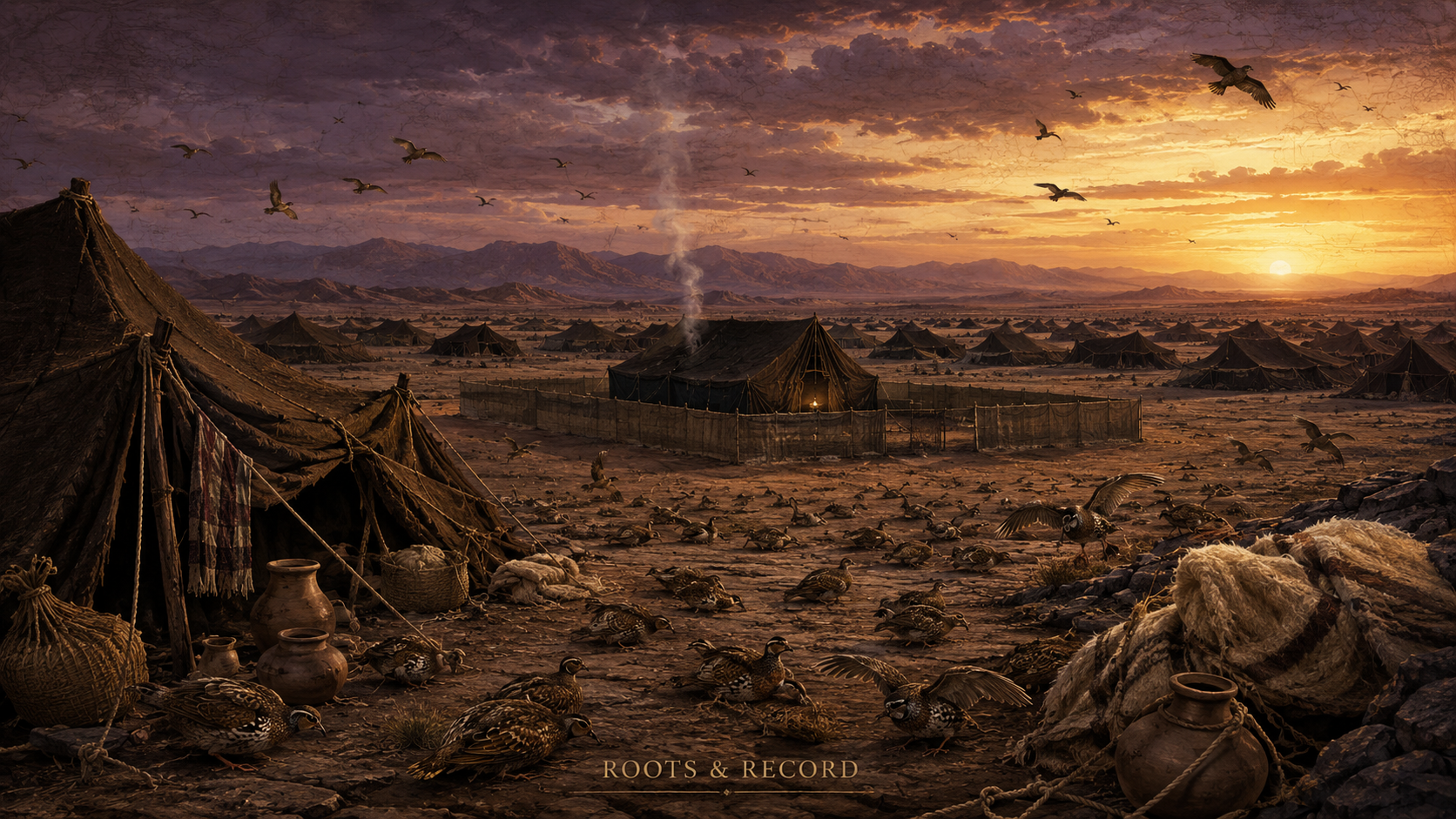
"The greater thou art, the more humble thyself, and thou shalt find favour before the Lord."
— Sirach 3:18
Numbers (Bemidbar, "In the Wilderness"): 8:1–12:16

The complaint in Numbers 11 begins with the asafsuf, a word that appears nowhere else in the Torah, rendered "mixed multitude" — the non-Israelites who left Egypt alongside Israel (Num 11:4). They crave first; the Israelites follow. The rabbinic tradition was alert to why: these are people whose Egypt was not the same bondage, whose liberation belongs to someone else's story, and who carry into the wilderness a grief with no stake in the destination. The contagion is the point. The place where the dead are buried receives a name that says so: Kibroth-hattaavah, Qivrot ha-Ta'avah, "the graves of craving" (Num 11:34).
At Hazeroth, Miriam and Aaron challenge Moses over the Cushite woman he had married. The problem is that Moses's wife is Zipporah, a Midianite. The tradition divided on how to read the discrepancy: one interpretation took "Cushite" as a term for Zipporah herself, a mark of extraordinary beauty in the idiom of the time; another posited a second, otherwise unrecorded marriage. Either way, the rabbis would not allow the accusation to gain a foothold, because an unanswered charge against Moses's marriage compromises his authority and the challenge with it. The narrator forecloses that possibility with a single interjected sentence before God speaks: Moses was anav, more than anyone on the earth (Num 12:3). The word names a chosen lowliness, a refusal to use rank as a weapon, and Moses demonstrates it by praying for Miriam before God restores her.
In Numbers 9, men who missed Passover to due ritual impurity come to Moses and ask what they should do. The law has no provision for them, and then it does: a second Passover, one month later, given to those too far or too defiled to observe the first. The rabbinic discussion that followed fixed the outer limit of "distant journey" at the boundary of Modi'in, roughly a day's walk from Jerusalem, turning an emergency exception into a measured rule. A complaint about exclusion becomes a permanent amendment.
Romans 12–16 · "Living Sacrifice"
Paul's word for the congregation's daily conduct is latreia, the term the Septuagint uses for the Levitical sanctuary service, avodah (Rom 12:1). He is relocating the vocabulary of the altar onto the body of the ordinary worshiper: the unblemished animal presented before the priest becomes the living person presented to God in daily conduct. The tradition had prepared for this move; Hosea and the Psalms had both argued that obedience of the heart outweighs the fat of bulls. Paul extends it past where the tradition had stopped, beyond the Temple gate and into the household, the street, and the relationship with the governing power.
Romans 13 instructs the community to be subject to the governing authorities, written while Nero's administration was still orderly, a decade before the persecution that would kill both Paul and Peter in Rome. The instruction is bounded by the claim that rulers exist to reward good, but that boundary is internal to the argument, not an escape clause, and later readers under later emperors had to work hard to hold it. Paul resolves the pressure from inside his own tradition: love of neighbor, drawn directly from Leviticus 19:18, is the one debt that does not discharge, and the law's demands are gathered into it rather than set aside.
The letter closes with a list of names (Rom 16): Phoebe, who carried it; Prisca and Aquila, who risked their necks; Mary, who worked hard; Junia, who had been in prison with Paul and was notable among the apostles, along with a notable number of others who are women. The living sacrifice Paul described in abstract terms in chapter 12 arrives here in the flesh, and the faces belong largely to people a contemporary reader anchored in the Jerusalem Temple world would have placed at the margins of such a movement, not at its center.
- Sun A Living Sacrifice — Romans 12:1–8
- Mon Genuine Love — Romans 12:9–21
- Tue Governing Authorities — Romans 13
- Wed The Weak and the Strong — Romans 14
- Thu Bearing with One Another — Romans 15:1–13
- Fri Paul's Mission — Romans 15:14–33
- Shab Greetings — Romans 16
Three Things Worth Sitting With
The living offering keeps its appetite. The Levites are lifted before God and given back to serve, and within a few days' march the same camp is weeping for the fish and cucumbers of Egypt and burying its dead at the graves of craving; the appeal for bodies presented as a living sacrifice is followed by four chapters on what the offered life still wants.
Moses prays for the sister who attacked him. Miriam questions his standing and is struck with disease, and his entire answer is five words, "Heal her now, O God." The man the text calls the lowliest alive does not defend his rank, which is the posture Paul presses on a congregation quarreling over food and status.
The law bends to include the latecomer. Those too unclean or too far away to keep the Passover at its time are given a second one a month later, and Paul tells the strong to carry the scruples of the weak rather than break fellowship over a day or a dish. Both texts widen the table instead of guarding it.
Further Reading
Zechariah 2:10–4:7: the night vision of the golden lampstand fed by two olive trees, and the word that the work goes forward not by might, nor by power, but by the Spirit.
Sources
Primary Texts
- The King James Version (KJV) is the standard English translation used throughout. The Complete Jewish Bible (CJB) is consulted as a secondary scholarly reference.
- Numbers 8:1–12:16. Bible Gateway.
- Numbers 11:4. Bible Gateway.
- Numbers 11:34. Bible Gateway.
- Numbers 12:3. Bible Gateway.
- Leviticus 19:18. Bible Gateway.
- Romans 12–16. Bible Gateway.
- Romans 12:1. Bible Gateway.
- Romans 16. Bible Gateway.
- Mishnah Pesachim 9:2. Sefaria.
Secondary Literature
- Pliny the Elder. Natural History, Book 10. Translated by H. Rackham. Loeb Classical Library. Cambridge: Harvard University Press, 1940.