The purity laws that open Leviticus 12 unsettle many modern readers almost immediately. The chapter begins with childbirth, and its language sounds, to a Western ear trained by centuries of moral vocabulary, like an accusation: "When a woman conceives, and beareth a man child, then she shall be unclean seven days" (Leviticus 12:2). Unclean, in that Western vocabulary, carries overtones of dirtiness, inferiority, or guilt, and the responses split along predictable lines. Some readers conclude that the Torah holds women in low regard. Others defend the passage before they have fully absorbed what troubles their opponents about it. Both responses share the same error. They read a technical, priestly vocabulary through the lens of a modern moral one, and mistake precision in one system for judgment in another.
The distinction at stake is not a modern apologetic invention. Scholars of Israelite religion, most notably Jacob Milgrom, have argued that the Torah operates two separate systems of impurity: a ritual system governing access to the sanctuary, and a moral system governing sin and its atonement, each with its own vocabulary, its own remedies, and its own theology. Jonathan Klawans extended the distinction further, tracing how thoroughly later readers, ancient and modern alike, collapsed the two into one. That collapse did not happen once. It happened twice, independently, within the Jewish and Christian traditions that both trace their sacred vocabulary to this text, and recovering the distinction means following it through both.
The Meaning of Tamei
The Hebrew word rendered "unclean" in Leviticus 12 is tamei, and understanding the purity laws depends on setting aside what that word has come to mean in Western usage. In contemporary vocabulary, unclean signals filth, shame, or moral failure, meanings almost entirely absent from Israel's priestly vocabulary. A person becomes tamei after touching a corpse, a woman becomes tamei during menstruation, a man becomes tamei after a seminal emission, and an Israelite becomes tamei through contact with certain animal carcasses. What unites these states, Milgrom argued at length, is proximity to the boundary between life and death, not moral failure of any kind. Childbirth belongs to this category because it places a woman, however briefly, at the precise threshold where life and death meet most visibly. Fulfilling the first blessing given to humanity, to be fruitful and multiply, she has just presided over the passage of a new life out of her own body, an act shot through with blood and, in the ancient world, real danger to mother and child alike. Marital intimacy, too, is celebrated throughout Scripture in its own right, and yet touches the same boundary in its own way. Caring for the dead counts among the highest acts of loving kindness a person can perform, and yet no act brings a person closer to death itself. A system built from acts like these, faithful obedience and life-giving love rather than sin, functions as a system of sacred boundaries, regulating who may approach holy space and when, and teaching Israel to distinguish states of ritual readiness from states of moral standing. The category concerns sanctity, not worth.
The Mother of All Living
After the expulsion from Eden, Adam names his wife Eve, a name whose Hebrew root means life, because she becomes the mother of all living (Genesis 3:20). The Torah introduces the first woman as the very source through whom human life enters the world, and it carries that dignity forward with striking consistency. Father and mother are honored together in the same command. Sarah stands as the matriarch of Israel, promised in Genesis 17:15-16 to become a mother of nations and kings. Miriam stands beside Moses and Aaron, named in Micah 6:4 among the three whom God sent to lead Israel out of Egypt. Deborah judges Israel outright in Judges 4:4, and the text records no hesitation about it. Huldah advises kings on the authenticity of a rediscovered Torah scroll in 2 Kings 22:14-20, entrusted with a judgment the male priesthood itself sought out. Ruth becomes the great-grandmother of David, named explicitly in Ruth 4:17. The daughters of Zelophehad petition for inheritance rights the law had not anticipated, and in Numbers 27:7 God tells Moses plainly that they are right. The wisdom literature carries the same current forward. The closing poem of Proverbs, the eshet chayil, a woman of valor, catalogs a wife's shrewdness, strength, and industry in language ordinarily reserved in the ancient world for warriors and kings, and closes by declaring that her own works praise her in the gates (Proverbs 31:10-31).
Ancient Israel was a patriarchal society by any honest reckoning, but patriarchy describes a structure of authority, while inferiority describes a judgment of worth, and the record refuses to let the two collapse into each other. A society that grants a woman judicial authority over the nation, or overturns its own inheritance law at a woman's petition, has not concluded that she is worth less than a man. It has concluded something narrower and more interesting: that structure and value answer different questions, and that Israel's God is willing to adjust the structure the moment the value is at stake.
Fulfilled Without Shame
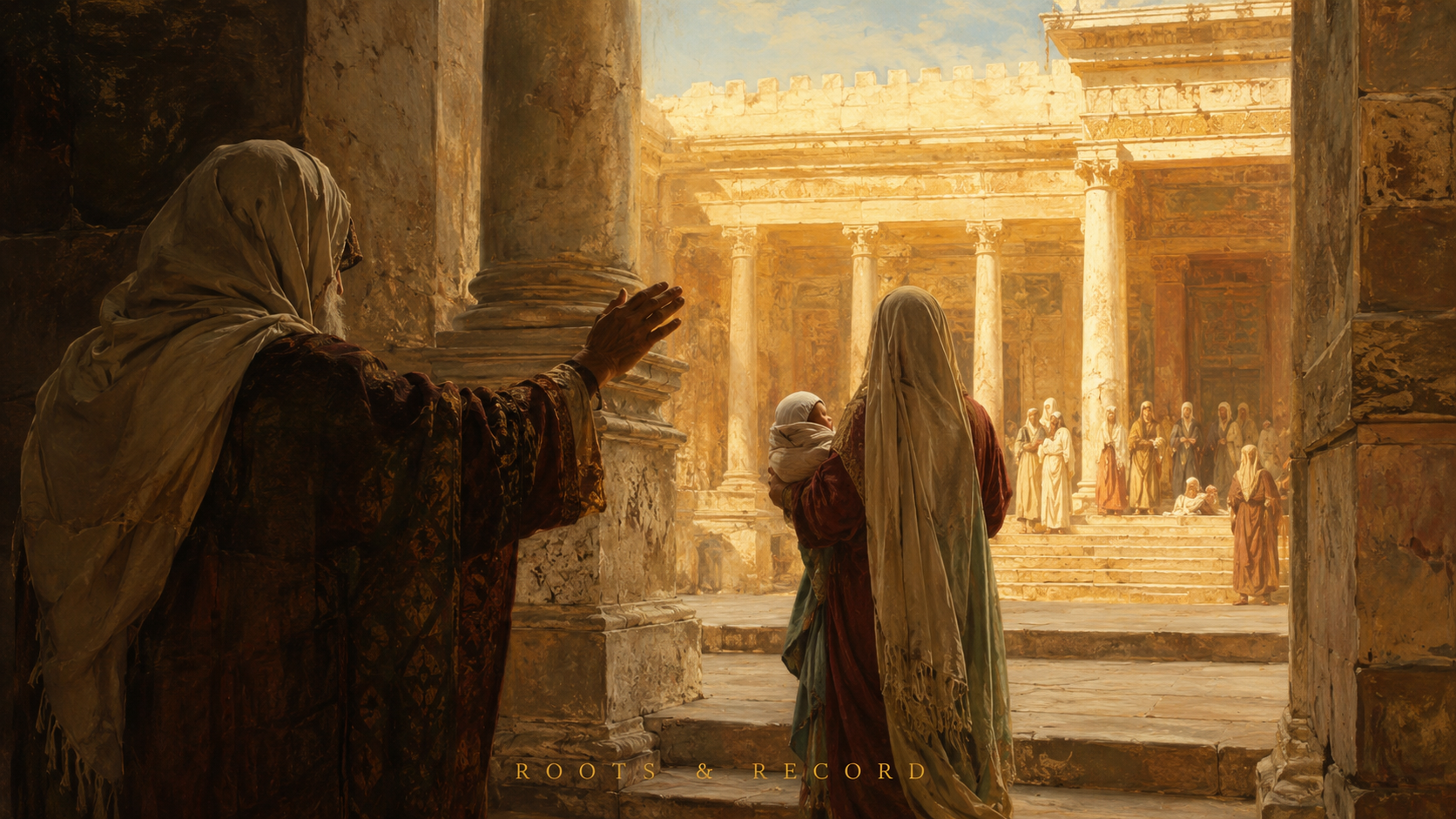
The same pattern the Torah establishes in Leviticus 12 reappears centuries later in the Gospel of Luke, and it reappears without a trace of embarrassment. When the days of Mary's purification were accomplished according to the law of Moses, she and Joseph brought the child to Jerusalem to present him to the Lord, and offered the sacrifice the law prescribed (Luke 2:22-24). Luke narrates this purification exactly as the priestly writers intended it: a woman fulfilling a sacred obligation. The scene that follows immediately is one of blessing, as the aged Simeon takes the child in his arms and pronounces him a light to the nations. Anna the prophetess, present in the Temple that same day, recognizes the child at once and speaks of him to everyone looking for the redemption of Jerusalem, a second woman honored by Luke in the same breath as the purification itself. A Gospel writer steeped in Israel's law understood what Leviticus 12 had meant from the start, and told the story accordingly. The confusion this article addresses arrived later, in both traditions, long after the texts themselves had already gotten it right.
When Ritual Became Shame
The confusion did arrive, and it arrived on both sides of the same shared inheritance, against the plain teaching of each tradition's own foundational texts. In late medieval and early modern Christian practice, a new mother was expected to undergo "churching," a rite of thanksgiving following childbirth that retained, in popular understanding if not in official theology, an undertone of penance, as though the woman required cleansing from something more than ritual status. David Cressy's study of the practice in post-Reformation England traces how thoroughly popular custom moralized what the liturgy itself intended as gratitude. A comparable drift occurred within some later Jewish communities, where social customs surrounding niddah, the menstrual purity laws, occasionally treated a woman's ordinary avoidance practices as a mark of personal contamination rather than the technical ritual status the law describes. Neither tradition's official theology authorized this shift. Both traditions, independently, let a ritual vocabulary calcify into a language of humiliation, and the traces of that error persist wherever menstruation, childbirth, or normal bodily function still carry an unspoken shame.
The Question of the Daughter
The most difficult question in Leviticus 12 is why the purification period doubles following the birth of a daughter. The initial period of impurity runs seven days after a son and fourteen after a daughter, and the following period of blood purification extends thirty-three days after a son and sixty-six after a daughter, so that a mother's full return to sanctuary life falls on the fortieth day for a son and the eightieth for a daughter, doubled at every stage. The text offers no explanation of its own for the disparity, and the honest starting point is that admission.
The rabbis did not treat that silence as license to invent an explanation carelessly. The Talmud, in Niddah 31b, records the teaching of Rabbi Shimon ben Yohai, who accounts for the seven-versus-fourteen-day difference in the initial period by way of a woman's vow during the pain of labor never to conceive again: joy at the birth of a son, he reasons, leads her to reconsider that vow within a week, while the more muted communal response to a daughter delays her change of heart to two weeks. The Talmud extends the same ratio to the following period of purification without offering a comparable account of why, leaving even the sages content to let a real gap in the reasoning stand rather than paper over it.
A further line of interpretation reaches toward reverence rather than explanation by analogy. The same tractate, a few pages earlier, records the sages' teaching that a human being is formed through a partnership of three: father, mother, and God (Niddah 31a). The parents contribute the body, and God alone contributes the breath, the soul, and the capacity for thought that makes the body a living person. Drawing on this teaching, later commentators have suggested that a mother who bears a daughter has done something a mother of a son has not: she has brought into the world not simply a life but a source of life, a person who will, in her own time, be capable of standing at the same threshold and doing the same thing. The doubled period, on this reading, marks the presence of two capacities for creation within a single birth, honoring rather than penalizing what the birth of a daughter uniquely represents.
Read together, these explanations do not converge on a single answer, and the text itself never asks them to. What they share is a common refusal. Neither treats the doubled period as a verdict on the daughter's worth. The Talmudic reading assumes a mother's feelings are worth protecting. The partnership reading treats the daughter's arrival as carrying a significance uniquely her own. The passage marks a distinction the plain sense sustains, and leaves room for each tradition's own reflection to carry the question further, since the text itself declines to settle it.
Recovering the Language of Holiness
The tragedy of Leviticus 12 sits downstream of the chapter itself, in what later readers did to it once ritual and moral categories blurred together in popular memory. The Torah teaches that childbirth is holy, and teaches it consistently enough that a Gospel writer centuries later could narrate a mother's purification as an occasion for blessing, and consistently enough that the rabbis, faced with an unexplained detail in the text, reached first for explanations rooted in reverence and compassion rather than judgment. Whenever symbolic language is confused with a verdict on human worth, texts are distorted in the very act of trying to honor them, and whenever ritual categories are mistaken for moral ones, burdens get imposed that Scripture itself did not intend. The woman who gives birth stands at the threshold of one of the most sacred acts entrusted to humanity, the bringing forth of new life. That reality deserves many things. Shame is not one of them.
Primary Texts
Genesis 3:20; 17:15-16. King James Version.
Judges 4:4. King James Version.
2 Kings 22:14-20. King James Version.
Leviticus 12:1-8. King James Version.
Luke 2:22-24. King James Version.
Micah 6:4. King James Version.
Numbers 27:1-11. King James Version.
Proverbs 31:10-31. King James Version.
Ruth 4:17. King James Version.
Niddah 31a-31b. Babylonian Talmud.
Secondary Literature
Cressy, David. "Purification, Thanksgiving and the Churching of Women in Post-Reformation England." Past & Present, no. 141 (1993): 106-146.
Klawans, Jonathan. Impurity and Sin in Ancient Judaism. Oxford University Press, 2000.
Milgrom, Jacob. Leviticus 1-16: A New Translation with Introduction and Commentary. Anchor Bible. Doubleday, 1991.
Rosenfeld, Dovid. "Uncleanness and Pure Blood After Childbirth." Aish.com.
Wasserfall, Rahel R., ed. Women and Water: Menstruation in Jewish Life and Law. Brandeis University Press, 1999.