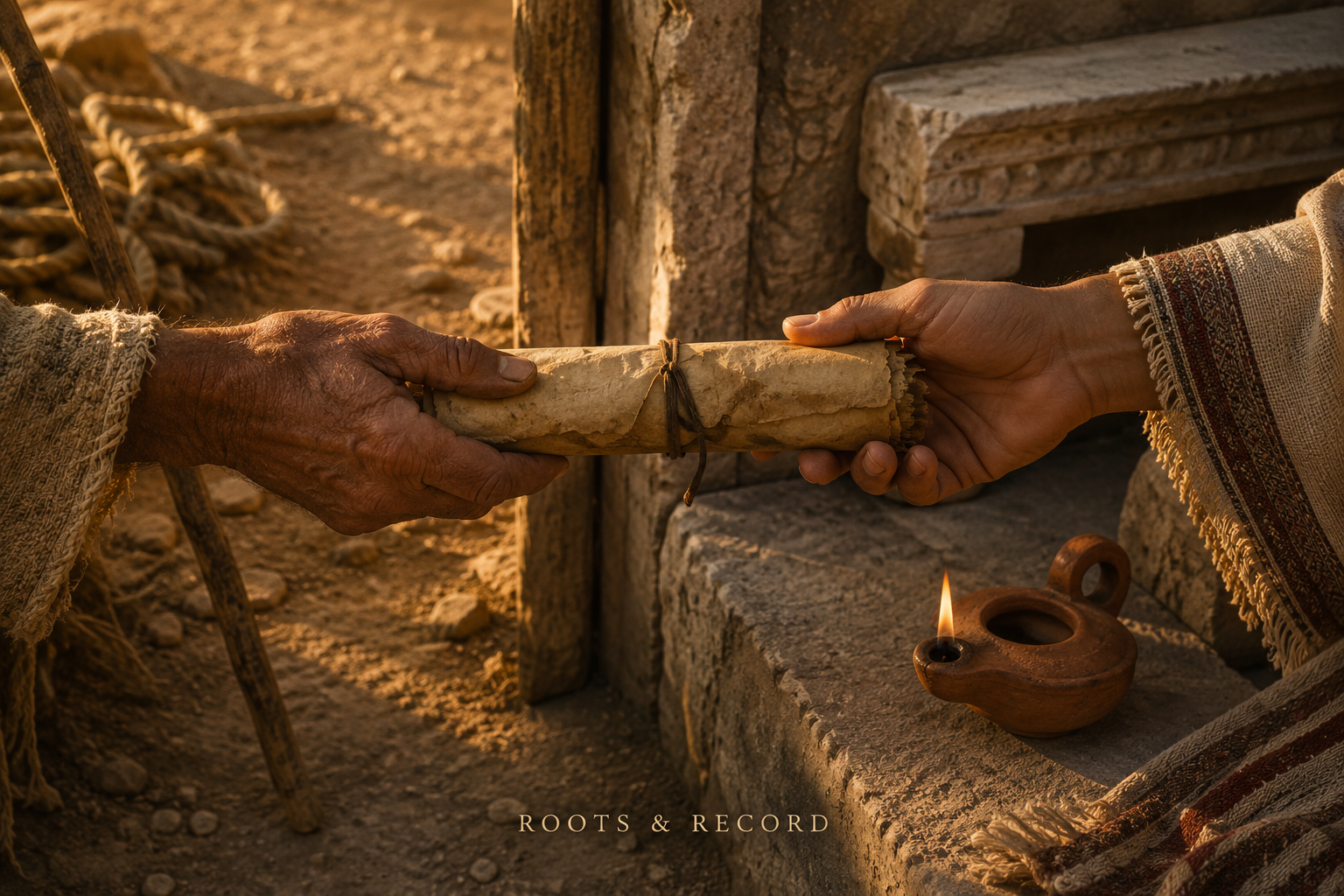
That the generation to come might know them, even the children which should be born; who should arise and declare them to their children.Psalm 78:6
Deuteronomy (Devarim, "Words")
1:1–3:22
When & Where

Plains of Moab, east of the Jordan
What to Watch For
The Hebrew title is Devarim — "Words." But Jewish tradition also calls the book Mishneh Torah, "repetition of the Torah" — the same phrase later borrowed as the title of Maimonides' legal code, and the likely root behind the Greek Deuteronomion, "second law." So the English name isn't a Christian imposition on the text; the tradition already thought of the book as a repetition. What "repetition" undersells is the content: by the traditional count, Devarim adds roughly 199 new commandments, more new legislation than any book but Leviticus. The repetition is one of genre, not content — Moses isn't correcting or replacing what was given at Sinai. He's preaching it forward, applying it fresh for a people about to live it out as a settled nation rather than a wilderness camp.
Numbers tells the story of the spies through twelve named men. Moses retells it differently: "ye came near unto me every one of you" — an unusually emphatic Hebrew construction that shifts the request for spies from twelve individuals to the whole crowd pressing forward. This isn't a discrepancy to smooth over; Jewish tradition reads it as Moses' deliberate move to keep responsibility for covenant failure with the community, not scapegoated onto a few.
Moses recalls how Israel's judges were chosen: the people put forward "wise men, and understanding, and known", and Moses appointed them. Authority here runs in more than one direction — the people participate, Moses commissions, the judges rule, and everyone, Moses included, remains under the same instruction. It's an early and deliberate check on unqualified power: no single office in Israel stands above the covenant itself.
Read on its own, the defeat of Sihon can look like simple conquest. Read against Genesis, it isn't. God had told Abraham that "the iniquity of the Amorites is not yet full" — centuries earlier, and centuries before this moment. This week's chapters show Israel explicitly forbidden from touching Edom, Moab, or Ammon, because God had already allotted those nations their land (2:5, 9, 19). Only with Sihon does God say, "I have begun to give Sihon... into thine hand." The judgment lands where four hundred years of forbearance finally run out — not before.
Moses tells Israel they are now "as the stars of heaven for multitude." It echoes the promise to Abraham, but the stars carry more than a number in the Hebrew imagination — they signal permanence and fixed order. The point isn't only that Israel has grown large. It's that this people is built to last, generation after generation, the way the heavens themselves do.
Titus 1–3 & 2 Timothy 1–4 · "The Crown"
When & Where
What to Watch For
Paul tells Timothy to take "the things that thou hast heard of me" and entrust them to others who can teach still others. This is the pattern of mesorah — the Jewish practice of handing sacred teaching faithfully from one generation to the next, the same idea Pirkei Avot later opens with: "Moses received the Torah at Sinai, and transmitted it..." Paul isn't founding something new here. He's doing what every faithful teacher in his tradition was expected to do.
The qualifications Paul lists for elders — self-control, hospitality, sound judgment, a life that holds up under scrutiny — read less like a modern job description than like Moses' own instructions for choosing judges back in Deuteronomy. In both cases leadership is a moral office before it's an administrative one. Paul isn't inventing a governance model; he's applying a very old one to a new set of communities.
Paul warns against "foolish questions, and genealogies", and this line has sometimes been read as Paul waving off the Hebrew Bible's own genealogical record. That can't be right — priestly service, tribal inheritance, David's royal line, and the Messiah's own lineage all depend on genealogies the Bible treats as load-bearing. What Paul is warning against is speculative argument built on top of them, not the record itself.
Titus returns again and again to good works — not as a counterweight to faith, but as its natural expression. For a first-century Jewish teacher like Paul, covenant faithfulness was never a private, internal matter; it showed up in how a person lived. The modern instinct to set faith and works against each other isn't a tension this letter is trying to resolve, because it isn't a tension Paul saw in the first place.
This week's Torah reading holds a scene easy to read past: Moses, forbidden to enter the land himself, is told to "charge Joshua, and encourage him, and strengthen him" — a formal, personal commissioning of one named man to carry the mission across the Jordan. Paul does the same thing in nearly the same posture, writing what he knows is his last letter, charging one named man, Timothy, to "preach the word... be instant in season, out of season." Two founders, roughly fifteen centuries apart, at the same hinge point: neither hands off to an institution or an idea in the abstract. Each hands off to a person, by name, entrusted to carry what he cannot carry any further himself.
Paul's last charge to Timothy is about continuity, not innovation: guard what's been entrusted, preach the word, keep the faith. Nowhere in these final instructions does Paul describe a community replacing Israel or a story superseding the one he inherited. His whole concern, right up to "I have fought a good fight, I have finished my course, I have kept the faith," is that the covenant story he was handed keeps being handed on, intact, to whoever comes next.